[LUM#14] Observing mourning among chacma baboons
Grief does not end at the threshold of human life. Numerous studies document the emotional and physiological responses triggered by the death of a loved one in animals. One example comes from Namibia, where Montpellier-based primatologist Elise Huchard is studying the grieving behavior of female baboons following the death of their young.
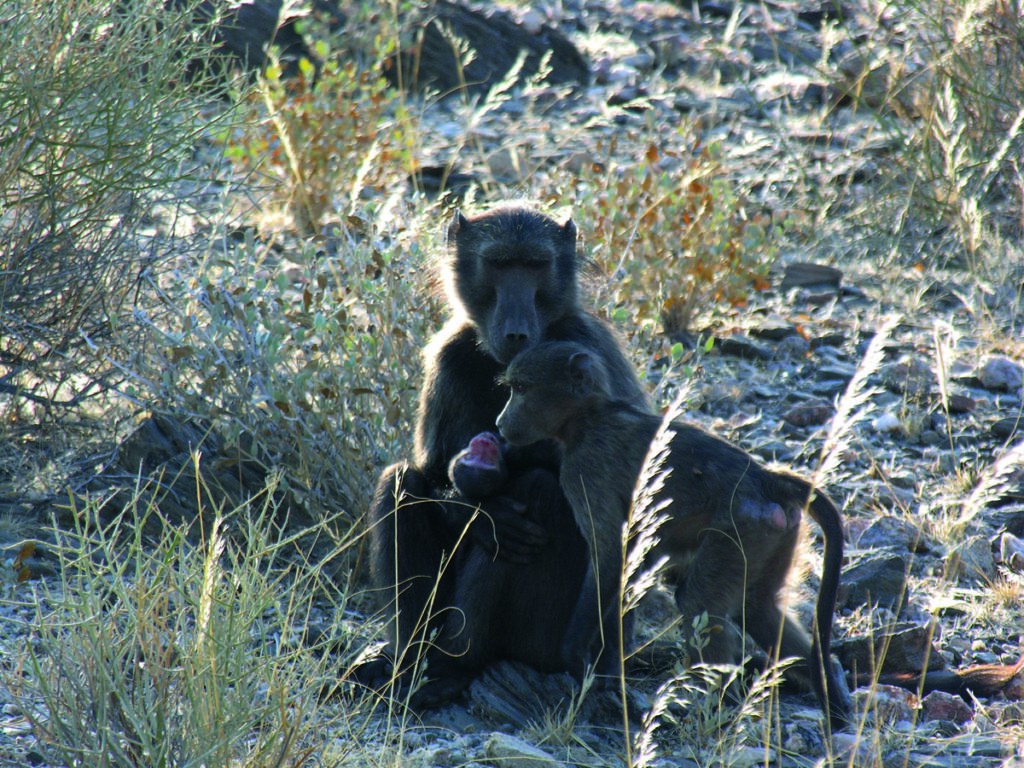
The expression “to mourn” could have been invented for them. In the Tsaobis Nature Reserve, at the edge of the Namib Desert, female chacma baboons have been observed carrying the tiny corpse of their dead baby for several days. “Carrying the baby like this is very difficult for them,” explains Elise Huchard, a primatologist atthe Institute of Evolutionary Sciences in Montpellier (Isem*). “A live baby will cling to its mother’s belly or back on its own, but in this case, they have to carry it either in their mouths or support it constantly with one arm, which makes it very difficult for them to move around.”
Grieving Head-On
For these baboons, which are forced to travel long distances every day to find food, the cost of such behavior is significant. Yet the females will sometimes carry the body for a week, or even ten days. “They set it down briefly to go eat, but as soon as another individual approaches, they rush back to it. Sometimes they lose it during a social conflict, for example. We’ve heard females emit genuine distress calls in such situations,” says the ethologist.
Continuing to groom the body is another expression of grief, even when, due to the heat, the small body appears completely mummified or dismembered. Or, for example, the examination of the wounds that caused death, most often inflicted by a male: “In the first few hours after death, we often see females putting their fingers into the wound and licking it. We’ve seen them remove debris from the baby’s mouth.” ” These behaviors, according to the researcher, “very likely” reflect the strength of the social bond between a primate mother and her infant. “When there is a sudden and unexpected rupture of this bond, mothers cannot cope with it emotionally. Staying in contact with their child’s body can help them cope.”
Researchers do not rule out the possibility that the death of adult individuals may also trigger expressions of grief; these are simply more difficult to observe, particularly because the bodies are not found. Another study on baboons, however, was able to reveal—through analysis of cortisol levels in feces—an increase in stress levels among females who had recently lost a friend. “ This is one of the few studies that quantifies a physiological stress response to the death of a close relative,” explains Elise Huchard. “These females will then have more grooming partners than usual, which helps them return to their normal stress hormone levels more quickly.”
The Field of Grief
Expressions of grief in animals in general remain a relatively under-researched topic due to their very nature. Rare and unpredictable, death and the reactions it elicits are difficult to study as the focus of a specific research project, as the behaviorist points out: “For a long time, we recorded these behaviors as part of our routine research projects. Then, in the 2010s, a field of research on animals’ reactions to death emerged, which has been particularly prolific among primates.”
A field that Elise Huchard and her colleagues from the Tsaobis Baboon Project hope to expand by using this study as the starting point for a full-fledged, long-term project dedicated to observing grief among baboons. Their goal: to establish a protocol for quantifying all of these behaviors over several years. “We’d like to understand the impact that grief can have on the lives of these females. Will they become socially withdrawn, or, on the contrary, more social? Will we observe behaviors of consolation or social compensation from other members of the group? Will they eat less? Does the intensity of the maternal bond influence the duration of grief…?”
With a heavy heart…
But are primates, in fact, the only social mammals that react to death? For Elise Huchard, the answer is no. “Typically, in the case of primates, we see this conspicuous carrying behavior, which stems from the fact that they have hands. There is also a longer developmental period in these species , which explains the strength of the mother-child bond, but I think many animals react to death with manifestations that are more or less evident.” She cites the example of whales ororcas that remain in contact with the carcass of their calf for several days, orelephants that return for months to the site where a loved one died.
After these observations, one question inevitably comes to mind: Shouldn’t we see this as evidence of an awareness of death in animals? It’s not that simple, according to the expert, for whom the act of mourning “does not necessarily imply a high level of awareness of death, but that is partly the realm of philosophers, and their contributions to concepts as difficult to grapple with as consciousness are extremely valuable to scientists like us.” One thing is certain: these baboons are not merely mimicking their grief.
Check out theUM podcasts, now available on your favorite platform (Spotify, Deezer, Apple Podcasts, Amazon Music, etc.).
* ISEM (UM —CNRS—IRD—EPHE)