Why Are There So Few Women in French Research?
Gender equality in the fields of research and innovation is one of the core principles of the European project.
Julie Mendret, University of Montpellier and Martine Lumbreras, University of Lorraine
This is a critical challenge because, while women in the European Union aged 25 to 34 are initially more likely to hold higher education degrees than men, the proportion of men working as scientists or engineers in the workforce far exceeds that of women.
In many European Union countries, women researchers are significantly underrepresented, with the Netherlands at the bottom of the list (25% in 2016), while Romania stands out as a model with 46%. France, meanwhile, with 28% of its researchers being women, falls below the European average of 33%. Within the European Union, as in France, only 20% of researchers in industry are women, with the highest representation in Spain (31%).

She Figures 2018, Author provided
Under these circumstances, it is hardly surprising that barely one in seven patents is filed by a woman. Despite the positive upward trend in the participation of female inventors in the international patent system compared to their male counterparts, the situation is still far from balanced. The proportion of women using the patent system remains low compared to the number of scientific articles they publish each year—a phenomenon referred to as the “leaky pipeline.” Based on current growth rates, gender parity in the field of patents will not be achieved until 2070.
Still Not Enough Female Science Students
While girls and boys perform similarly in science subjects in high school, young women gradually drift away from science subjects as they progress through their education. In France, in 2017, 55 percent of higher education students were women. Over the past sixteen years, since 2001, their numbers have increased in engineering schools (+4.9 percentage points) and in university health programs (+6.8 percentage points). However, they remain a minority in the most selective programs (42.8% in preparatory classes for the grandes écoles) and, above all, in science-oriented fields (37%). In 2017, 10,600 out of 38,000 engineering graduates were women, or 28 percent. This represents a 32 percent increase over 10 years, but progress remains slow.
Among female science students, the choice of specialization remains highly gendered: in 2017, 61 percent of students in the life sciences were women, compared with 28 percent in the basic sciences. This gendered specialization in academic programs continues into the workplace. In 2015, in the field of mathematics and software design, 14% of researchers in industry were women. In the field of medical sciences, women accounted for 61% of the research workforce.
Another finding is that, upon graduation, women’s employment conditions are consistently less favorable (employment rate, job stability, salary, etc.) than those of men. The glass ceiling remains very much in place within the European Union, particularly in academia. It refers to the array of obstacles women face in gaining access to high-level positions: it is as if an invisible ceiling were preventing women from climbing the career ladder. Thus, over the course of an academic career, for example, gender inequalities continue to widen.
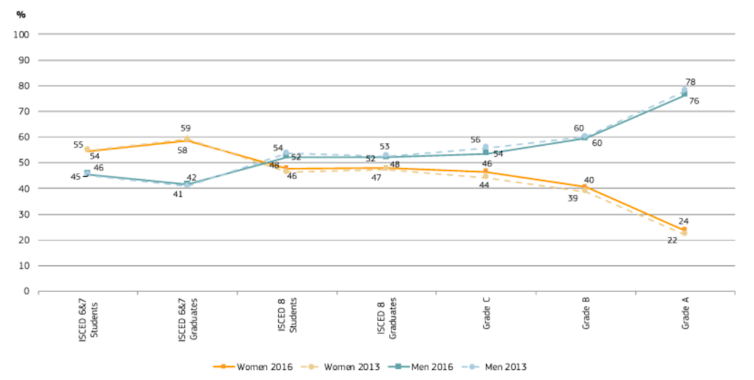
She Figures 2018, Author provided
France is not considered a role model in Europe
The situation in French academia speaks for itself: there are not enough women in French universities (37%), and their advancement to full professorship is low (25% of female researchers in universities). While the recruitment of “ Professors ” is becoming more gender-balanced, women are less likely to apply for these positions. Gender parity in leadership bodies has improved thanks to legislative and regulatory measures that mandate it, notably the ESR Law of July 22, 2013, which requires gender parity in all governance bodies. Despite this, women remain a very small minority in the highest-level positions. Barely 17% of universities were led by women in 2019.
This trend may be linked to the weight of tradition: women are expected to take care of their families and manage daily life. As a result, some women give up on pursuing greater ambitions, daunted by the amount of work required to achieve them. For example, the need to travel both within France and abroad for collaborations or to participate in international conferences—in order to advance their research—can pose serious problems if the researcher does not have “flexible” childcare support.
Toward a New, More Free Generation
However, younger generations are gradually shaking off this burden. Furthermore, those who overcome this obstacle achieve outstanding results; for example, the pursuit of excellence in the public sector by women (who account for 39 percent of researchers in the public sector) is now widely recognized, as public research organizations have awarded 42 percent of their highest honors to women in recent years.
The goal of the Ministry of Higher Education, Research, and Innovation is to have 40 percent of students in science-related fields by the start of the 2020 school year. Research To achieve this, it is relying in particular on initiatives such as those proposed by our association, Femmes & Sciences, which aims to encourage young girls to pursue careers in science and technology and to strengthen the position of women in these fields.
Among the measures implemented is a mentoring program for women scientists designed to support female doctoral students in building their careers. This program is based, in particular, on the formation of mentoring pairs: a mentor supports a student mentee. The pairs are formed based on mutual interest during a speed-meeting, ensuring that the mentor and mentee do not belong to the same institution.
Discussions may focus on the mentee’s career goals, her questions, the challenges she faces, or any other topic she wishes to address based on her needs. Our pioneering Montpellier F&S group launched the mentoring program in 2015, in partnership with a doctoral school (15 mentoring pairs).
Since then, this program has expanded; it is supported by the University of Montpellier, the CNRS, and, as of this year, an agricultural engineering school. The scope of the program is expanding, as is the number of volunteers (both women and men) who wish to serve as mentors. This mentoring program has already proven useful in difficult situations (such as harassment), where the mentor has been able to work with university authorities to ease tensions.
In France, government authorities and industry leaders have taken the imbalance in the number of female scientists seriously. The gap is gradually closing, but unfortunately very slowly, and we still lag behind other European countries. Presentations in schools, industry-sponsored events (such as “Girls’ Day”), competitions, and initiatives like mentoring are all aimed at closing this gap.
Julie Mendret, Associate Professor, HDR, University of Montpellier and Martine Lumbreras, Professor Emerita, University of Lorraine
This article is republished from The Conversation under a Creative Commons license. Readthe original article.