When Marine Biology Meets Robotics
To study the marine fauna of the Indian Ocean, the BUBOT project is applying big data to biology. The project involves automating underwater observations and then developing the algorithms needed to analyze the thousands of hours of video footage collected in this way. This project is supported by I-SITE MUSE as part of its 2018 research support program.
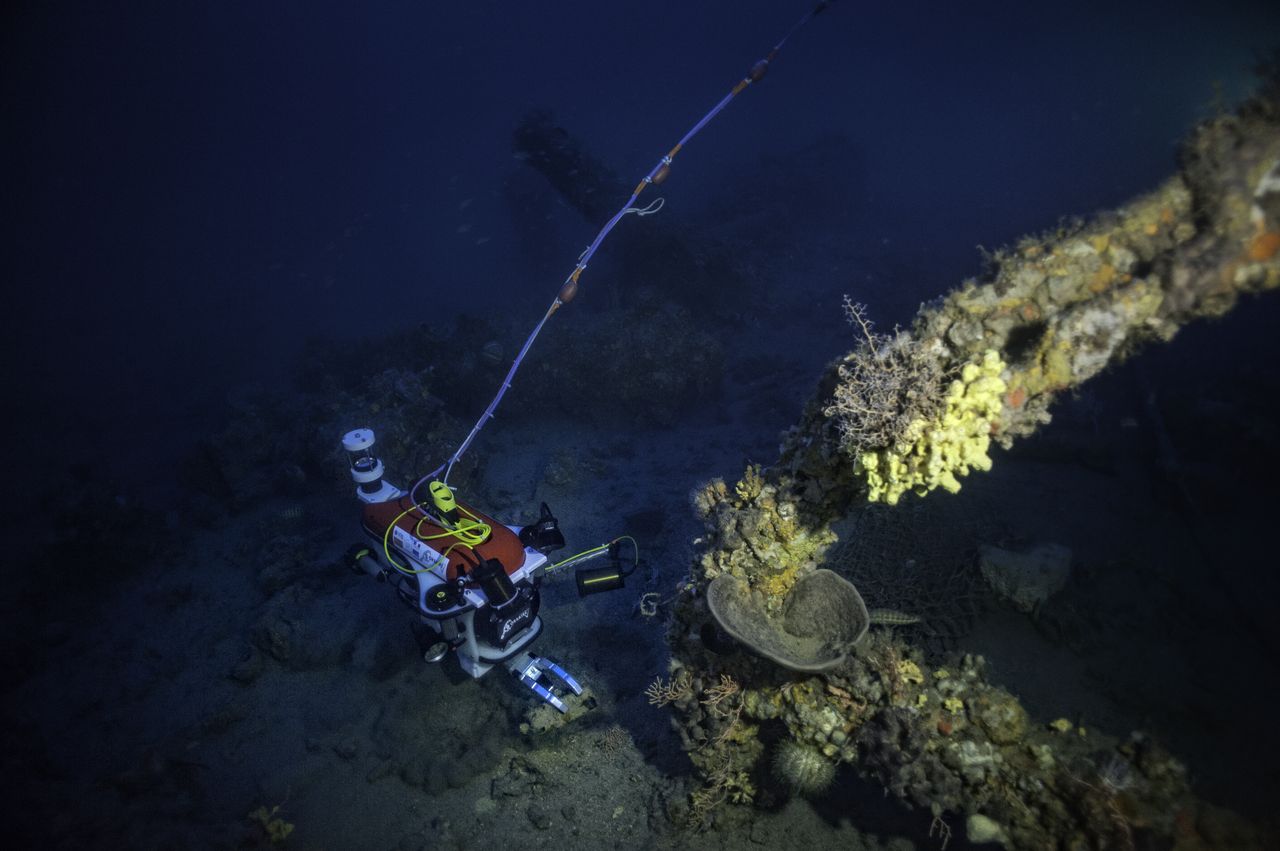
Why use robots when diving is what makes exploring underwater life so appealing? For marine biologists, robotics holds great promise for unprecedented observations, as it allows them to explore marine habitats for hours on end at depths that can exceed twenty meters. Through new observation tools, the BUBOT project (Better Understanding Biodiversity changes thanks to new Observation Tools) is thus opening a new window onto the marine biodiversity of the Indian Ocean.
Low-cost robot
The first step is to build a robot that will automate observations at depths ranging from 10 to 100 meters, thereby enabling the study of coral reef biodiversity along this vertical gradient. “Biologists provided us with precise specifications for creating a customrobot,” explains Karen Godary-Déjean of the LIRMM (Montpellier Laboratory of Computer Science, Robotics, and Microelectronics). Specifically, the robot must be able to perform a transect autonomously, avoiding turtles, nets, and other drifting objects. Equipped with sensors, the device will therefore need to navigate around obstacles, slow down, and turn around. Another constraint is cost: while underwater technology exists, the state-of-the-art versions available are prohibitively expensive, costing hundreds of thousands of euros.
"Maritime Video Surveillance"
The robot is not the ultimate solution. The cameras installed on the seafloor are a complementary tool for observing the seafloor over the long term. “It’s like a real-life video surveillance system for the ocean,” says Camille Magneville, a doctoral student at the Marbec (Marine Biodiversity, Exploitation, and Conservation) laboratory, as she describes the system she installed at two sites in Mayotte—one in a protected area and the other in a fishing zone. Using twelve cameras, she collected nearly 500 hours of video footage over four days, which will help better assess the diversity and ecological roles of fish at each site.
However, big data is only of value to research if the research is capable of harnessing the vast amounts of data produced by automated systems. BUBOT therefore includes a component focused on artificial intelligence: teaching machines to recognize fish species in order to automatically analyze all images recorded by cameras, whether mounted on a robot or fixed in place. “Thanks to all the videos collected in Mayotte, we hope to be able to recognize more than 100 species within two years (which should account for more than 95% of the individuals visible in the videos),” explains Sébastien Villéger, a researcher in functional ecology at MARBEC. To train the deep learning algorithms, the project is supported by students—primarily from the University of Montpellier—who are applying their taxonomy skills to annotate the fish in the videos. “Our goal is to have a wide variety of postures, conditions (lighting, apparent color), and backgrounds for each species, so that ultimately the algorithm will be effective in all situations,” notes the researcher.
In addition to identifying species, assessing the size of each individual is also a crucial aspect of studying underwater ecosystems. This measurement is not currently possible with the GoPro cameras mounted on the robot. The next step, therefore, is to equip the robot with a video system featuring stereo cameras.
Chatty Fishermen
In keeping with its transdisciplinary approach, BUBOT also draws on the humanities to understand the environment through the knowledge of the primary observers: the fishermen. A geographer and an anthropologist thus round out the team. In Mayotte, they conducted nearly thirty interviews and gathered accounts of declining fish populations in certain areas, shifting fishing grounds, and other information useful for selecting study sites. And the small-scale fishermen are talkative. “The interviews last an average of a little over three hours, and the fishermen don’t hesitate to share information about their fishing grounds,” says Esmeralda Longépée of UMR Espace-Dev.
Due to COVID-19, BUBOT has fallen slightly behind schedule. Another unexpected change to the plan: of the three areas originally covered by the project, the fieldwork in Mozambique had to be canceled, as the country was recently classified as a high-risk area. It will be replaced by the Comoros. As for the first site, the Éparses Islands, the initial underwater expeditions proved promising, revealing a wealth of biodiversity. However, given the challenging diving conditions on a sheer drop-off, the team is eager to send its robot there.