What public health measures are the French willing to accept?
Small New Year’s Eve gatherings or canceled celebrations, families scattered and isolated, self-quarantine, local, partial, or widespread lockdowns, curfews, travel restrictions, border closures, and uncertainty regarding the reopening of certain sectors: France, like many other countries around the world, has faced a series of restrictions in an effort to contain the pandemic.
Thierry Blayac, University of Montpellier; Bruno Ventelou, Aix-Marseille University (AMU); Dimitri Dubois, University of Montpellier; Marc Willinger, University of Montpellier; Phu Nguyen-Van, University of Strasbourg and Sébastien Duchêne, University of Montpellier
While each type of measure or restriction has its own effectiveness in controlling the epidemiological dynamics, these measures must also be evaluated based on their acceptability to the public.
At a time when policymakers are considering whether to reevaluate restrictive measures to prevent a resurgence of the epidemic, the public’s preferences should be taken into account in public decision-making.
This is especially true after many months of sustained efforts, followed by the implementation of new measures in recent weeks in many European countries.
Different Attitudes
Our team of behavioral economics researchers quantified the degree to which a population resists or accepts various strategies for combating the COVID-19 pandemic. Our findings led to the publication of an article in the international scientific journal *The Lancet Public Health*.
The study's findings show that mask-wearing, transportation restrictions, and digital tracking are relatively well accepted.
In contrast, closures of restaurants and recreational venues, as well as excessive restrictions on leisure travel, are much less acceptable. Analyses of population subgroups (clinical vulnerability, age groups, gender) also show that the acceptability of certain strategies depends on personal characteristics.
In particular, the younger population differs quite significantly from other groups in terms of preferences for COVID-19 policies and demands for financial compensation, suggesting the need for a tailored “menu” of COVID-19 policies based on distinct attitudes.
Assessing the Population's Preferences
The study uses a preference-revelation method known as the " Discrete Choice Experiment," which makes it possible to assess the public's preferences regarding various combinations of public policies for controlling COVID-19 outbreaks.
Between May 4 and 16, 2020, at the end of the first lockdown in France, our team conducted an online survey of a representative sample of the French population.
One of the survey’s objectives was to assess public acceptance of the restrictive measures among the key anti-COVID strategies discussed by the French government in early April for the period following the lockdown.
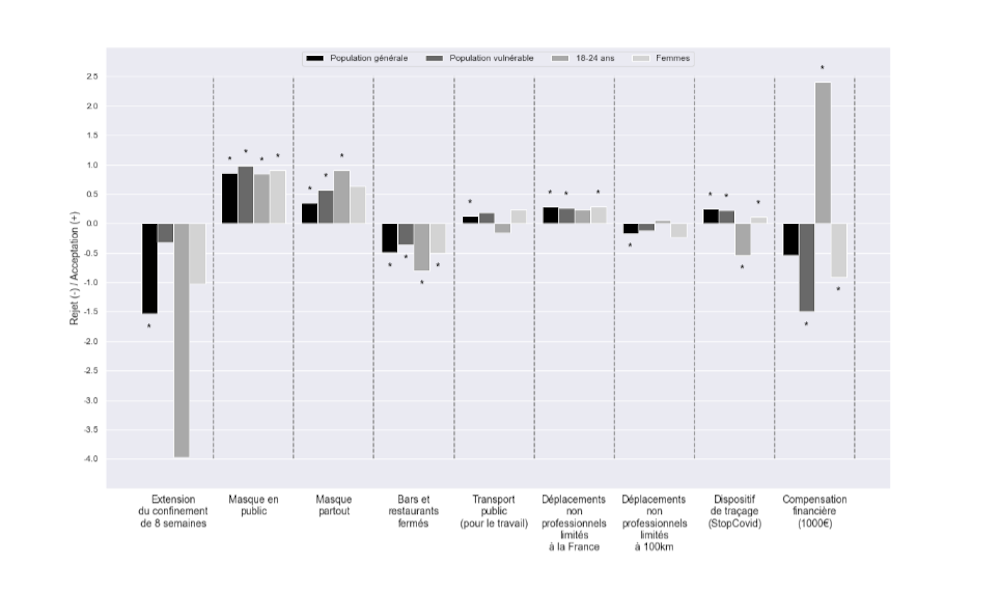
The chart below shows a ranking of preferences for the general population and for certain subgroups, defined based on their clinical vulnerability, age, or gender.
Authors: Author provided
A Necessary Evil
Masks, restrictions on public transportation, and digital contact tracing (via an optional mobile app) were deemed acceptable by the general public, provided that the restrictions in each of these areas remain reasonable. Thus, mask-wearing is far less acceptable when it is associated with the phrase “everywhere.”
Conversely, additional weeks of lockdown, the closure of restaurants and bars, and excessive restrictions on leisure travel (less than 100 km) were not considered acceptable.
Overall, these results indicate that the French public has generally accepted the restrictive measures that followed the first lockdown, viewing them not only as constraints but also as a “necessary evil”—a perspective that must be weighed against the risk of another lockdown, a possibility that was viewed very negatively.
Opposition to additional weeks of lockdown was, in fact, more than proportional: the longer the additional lockdown, the stronger the opposition to it.
Vulnerable people are more tolerant
Compared to the general population, clinically vulnerable individuals—that is, those who report having a chronic illness—showed greater tolerance for lockdown measures, were more accepting of mask-wearing, and were less likely to oppose the closures of restaurants and bars.
However, these differences were small, suggesting either a form of altruism on the part of non-vulnerable individuals toward vulnerable individuals, or a lack of distinctiveness in the attitudes of vulnerable individuals toward risk.
Young people (ages 18–24) were the group that stood out the most, perhaps because they are less concerned about health risks than older age groups (even though the medical risk is not zero for young people, and remains significant for the older adults with whom they come into contact).
In our survey, among the various attributes we considered, we proposed financial compensation to offset the burden of restrictive policies. Our analyses showed that young people were strongly in favor of this proposal, unlike other segments of the population, who clearly rejected it.
From this finding, we can conclude that financial incentives could be an effective tool when targeted at young people, and that they are likely to encourage young people to be more accepting of restrictive anti-COVID policies.
This solution would amount to implementing a compensation mechanism—such as a Pigou transfer—which has already been applied in other areas of public economics. According to Arthur Pigou, an English economist from the early 20th century, the principles of “welfare economics” can lead to taxing—or compensating—individuals who generate negative—or positive—externalities, in order to steer them toward behaviors that are more optimal for society.
Therefore, understanding how people within a population rank the various COVID-19 preventive measures is essential for designing appropriate programs and measures—a challenge that many countries in the Northern Hemisphere must face every day while they wait for a vaccine to become widely available.
Our survey therefore highlights the need for anti-COVID policies that are more attuned to people's concerns.
It proposes strategies—particularly through compensation for young people—to increase acceptance of control policies, taking into account the preferences of different segments of the population, and to prevent some of them from refusing to comply with the measures, which would then spread the risk of an epidemic throughout society as a whole.
Thierry Blayac, Professor of Economics, Montpellier Center for Environmental Economics (CEE-M), University of Montpellier; Bruno Ventelou, CNRS-AMSE Researcher, economics, public health, Aix-Marseille University (AMU); Dimitri Dubois, Behavioral Economics, Environmental Economics, Experimental Economics, University of Montpellier; Marc Willinger, Professor of Economics, Behavioral and Experimental Economics, University of Montpellier; Phu Nguyen-Van, CNRS Research Director in Economics, University of Strasbourg and Sébastien Duchêne, Associate Professor of Economics, University of Montpellier
This article is republished from The Conversation under a Creative Commons license. Readthe original article.