Research and innovation: a shared commitment between the University of Montpellier and the Nîmes University Hospital
On Tuesday, September 2, an after-work gathering brought together the Nîmes university hospital community around Philippe Augé, President of the University of Montpellier; Frédéric Rimattei, Executive Director of the Nîmes University Hospital; and Michel Prudhomme, Chair of the Nîmes University Hospital’s Medical Commission, in the presence of Véronique Dominguez-Guillaumel, Deputy Rector for Higher Education, Research , and Innovation for the Occitanie Academic Region, to discuss the collaborative efforts between the two institutions.
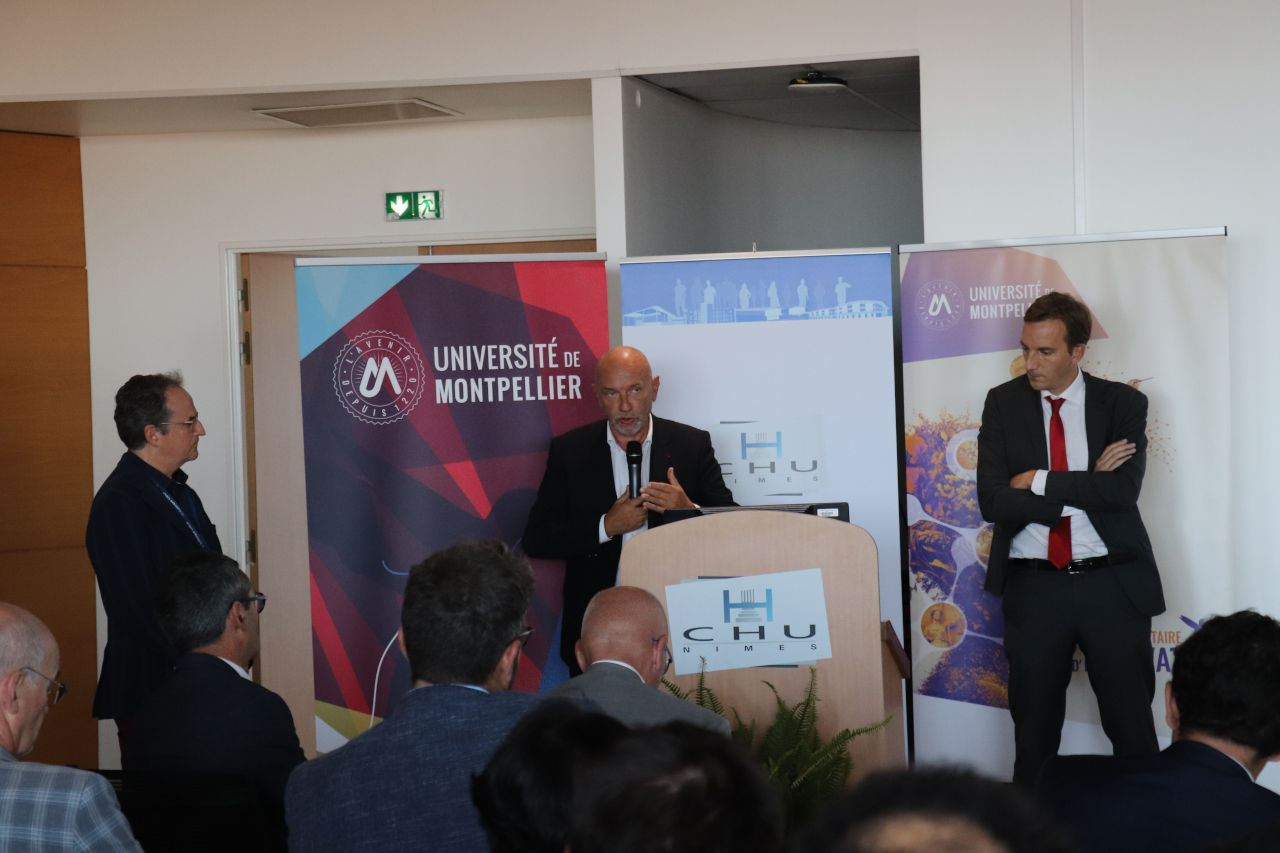
For many years, the Nîmes University Hospital and the University of Montpellier have shared a common goal: to combine academic excellence, cutting-edge research, and medical innovation. This partnership is exemplified in particular by I-SITE and the Montpellier University Innovation Hub (PUI), of which the Nîmes University Hospital is a founding member.
This event highlighted this shared momentum by presenting the innovation strategy of the Nîmes University Hospital and the University of Montpellier through three flagship projects of the University Innovation Hub, led by the University Hospital. Following the presentations, a new joint call for projects in translational research—aimed at further strengthening the innovation dynamic for the benefit of patients, healthcare providers, and society—was officially launched.
The Innovation Strategy of the Nîmes University Hospital
The Nîmes University Hospital’s innovation strategy aims to foster, support, and disseminate new ideas—whether technological, medical, or organizational—to improve patient care, optimize resources, and enhance the institution’s appeal. This approach is driven by two key factors: internal initiatives led by staff teams and external collaborations with academic partners, industry partners, and startups. A structured process, including a one-stop shop and support for project leaders, makes it possible to transform these ideas into solutions tailored to the needs of patients, CHU staff, and its partners.
The research strategy is organized around five strategic areas (Infections and Immune Dysfunction, Neurosciences, Health Data, Critical Care, and Oncology) and relies on innovative research platforms to develop the personalized medicine of the future. With an annual investment of over 3.5 million euros and teams fully integrated into research units led by the University of Montpellier and national research organizations such as INSERM, the University Hospital is actively engaged in the regional, national, and European research ecosystems. For example, the Nîmes University Hospital is a partner in the European project coordinated by the University of Montpellier, APOLLO 2028, which aims to propose innovative solutions to improve mental health and resilience in the workplace. As part of the Nîmes University Hospital’s Institutional Plan and fully aligned with the scientific roadmap for the Montpellier-Nîmes site, the University Hospital’s Program for Support of Research , and Innovation (PARI 2030) serves as a catalyst for the university hospital’s influence and regional socioeconomic development.
The PUI at the University of Montpellier in a Nutshell
The Montpellier University Innovation Hub (PUI) is a consortium of 14 founding members, coordinated by the University of Montpellier, which aims to strengthen collaborative research partnerships with the socio-economic sector, encourage technology transfer, and support the creation of startups in the region. Aligned with the University of Montpellier’s strategic priorities of “Feeding, Healing, and Protecting,” it draws on a dynamic scientific community comprising 5,000 scientific professionals, more than 100 research units, and 5 research clusters: Agriculture-Environment-Biodiversity, Biology-Health, Chemistry, Mathematics-Computer Science-Physics-Systems, and Social Sciences. The University Innovation Hub also brings together 5,000 scientists and 120 specialists in commercialization and partnerships, and facilitates an average of 350 partnership agreements per year.
Projects that benefit patients and healthcare providers
Three projects supported by the Montpellier University Innovation Hub (PUI) were presented. They demonstrate the ability of hospital and university teams to transform clinical needs into concrete solutions, thanks to the support of PUI initiatives such as the Montpellier Innovation Booster (BIM) and Companies and Campus:
- PEASY: an innovative medical device for managing male urinary incontinence, developed by Prof. Xavier Garric (University of Montpellier – IBMM, Nîmes University Hospital). As a BIM award winner, it has received nearly €44,000 in funding and exemplifies the synergy between clinical expertise and university research.
- 3D4 PEDIA: a 3D printing project in the pharmaceutical field for pediatrics, led by Dr. Ian Soulairol (University of Montpellier – ICGM, Nîmes University Hospital), in collaboration with the company MB Therapeutics. As a winner of the Companies and Campus program, the project received €50,000 to develop personalized medications tailored to children.
- DM CONNECT: an innovative digital platform led by Dr. Laure Roux (Nîmes University Hospital), aimed at improving the coordination of care pathways. Also a BIM award winner, this project has received €26,000 in funding and draws on expertise in digital health and hospital engineering.
These initiatives embody the shared ambition of the University of Montpellier and the Nîmes University Hospital: to innovate together for the benefit of patients, healthcare providers, and research.
“The Nîmes University Hospital and the University of Montpellier are joining forces to make innovation and research a driver of regional development and improved care. Our investments and scientific priorities reflect our commitment to cutting-edge medicine that serves patients and healthcare providers. “Our ambition is to position the Nîmes University Hospital as a key player in healthcare innovation through its ability to bring together healthcare professionals, patients and service users, startups, and industry partners,” said Frédéric Rimattei, Executive Director of the Nîmes University Hospital.
A New Call for Proposals: Strengthening Translational Research
Beyond these achievements, this after-work event also marks the launch of a joint call for projects titled “ Research ’ Translation,” led by the University of Montpellier and the Nîmes University Hospital. This call, with a budget of 100 K€ (50% from the UM, 50% from the Nîmes University Hospital), aims to encourage new collaborations between researchers, clinicians, and industry partners by supporting initiatives capable of accelerating the transition from basic research to concrete clinical applications, in line with the strategic priorities of both institutions.
“The synergy between research and innovation is what makes us strong. Together, we want to build a center of excellence in health care on a European scale,” said Philippe Augé, President of the University of Montpellier.
This call for projects is part of the national health innovation strategy and reinforces the Montpellier–Nîmes corridor’s position as a leading region for university hospital and biomedical innovation.
Practical Information
- Date: Tuesday, September 2, 2025
- Learn more about the PUI