Rivoc and BiodivOc: The Keys to a Better Future in Occitanie
Advancer regional in the region to better preserve biodiversity and more effectively combat vector-borne diseases. This is the mission that the Occitanie region has chosen to entrust to theUM as part of these last two key challenges. An initiative aimed at bring togetherregional academic, scientific, and economic forces around major strategic issues for the future of Occitanie. Here is an overview of these two key challenges, dubbed BiovidOc and Rivoc.
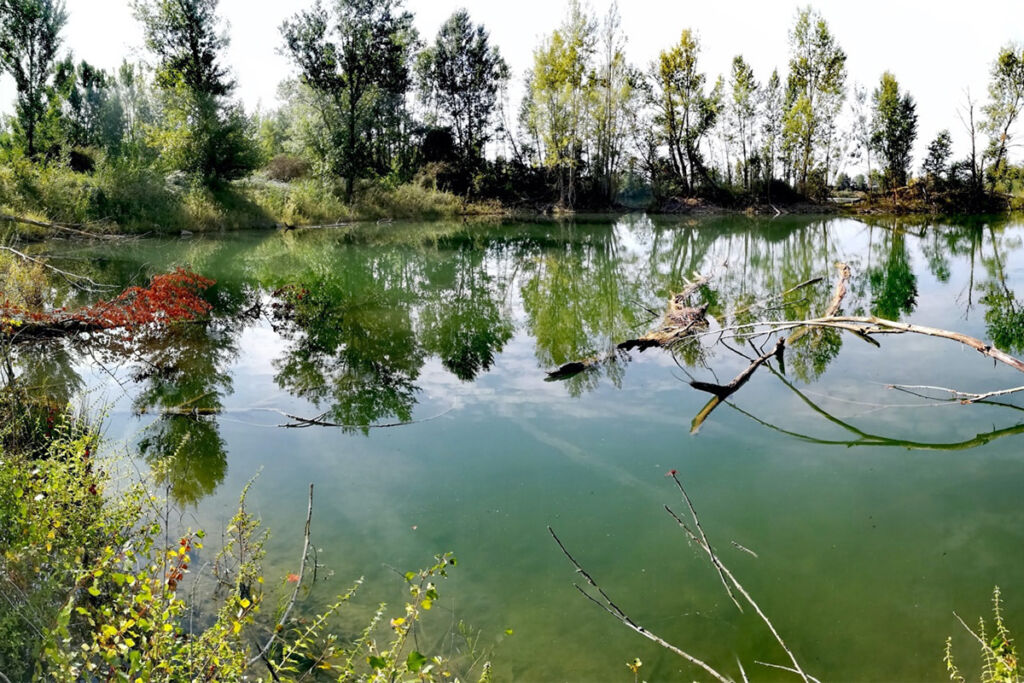
A body of water at a gravel pit in Haute-Garonne.
Copyright: © Rémy Lassus, EDB Laboratory, Toulouse.
How will we live in Occitanie in the coming decades? What kind of climate will we face? What impacts will this have on biodiversity? On human, animal, and plant health? Will we face new diseases? If so, will we have the means to treat them? Will we have succeeded in developing greener energy? While these questions are at the heart of science, connections between research teams at the regional level are sometimes lacking in structure, and ties with the business world still need to be strengthened to allow, in the long run, for greater utilization of research results at the local level.
Making Research More Attractive in Occitanie
“I’m one of those who believe that research can be useful,” says Montpellier-based biologist Didier Fontenille, “and when it addresses societal, economic, health, or environmental issues, we must seize this opportunity to bring about change. ” And for this researcher at the French National Research Institute for Development (IRD), the opportunity to make a difference is called Rivoc, one of the four key challenges supported by the Occitanie region, which was officially launched on March 18. A few days before the launch of BiodivOc—the second key challenge led by theUM —this initiative is spearheaded by ecologist and evolutionary biologist Philippe Jarne, a CNRS researcher at the Center for Functional and Evolutionary Studies (CEFE).
"Key Challenges" is an initiative of the Occitanie region aimed at identifying and organizing the scientific community and local economic stakeholders around strategic themes for the region. “Excel, unite, and protect—these are the three keywords that apply to the goals we want to achieve,” says Nadia Pellefigue, vice president in charge of economic development, innovation, research, and higher education. “We’ve been in dialogue with researchers to mobilize resources where we can make rapid progress. We want to implement initiatives that facilitate an ecological transition and help make research more collaborative, more visible, and more attractive in Occitanie.” Four key challenges have been launched so far, two of which are led by the University of Montpellier, in line with MUSE’s three pillars: nourish, care, and protect.
Heal and Protect with Rivoc and BiodivOc
The goal of the Rivoc key challenge is to address health issues, particularly by anticipating the diseases of the future (see box) and by using research to foster the development of new control strategies. “Many animal diseases not only cause production losses but also pose a risk to human health. The Occitanie region, mindful of both the health risks and local economic challenges, has decided to support this project,” explains Didier Fontenille.
This is a topic that is already well established in Montpellier, Perpignan, and Toulouse, where there is a strong expertise in the field. It is also part of the broader “One Health” strategy, which views human, animal, and plant health—and, more broadly, environmental health—as a single, integrated whole. “An unhealthy environment leads to diseases in plants, animals, and humans. This ties in with the concept of biodiversity,” adds the director of Rivoc.
Biodiversity, which is at the very heart of the second key challenge, BiodivOc. “If there’s one scientific field that’s essential for addressing these issues, it’s scientific ecology,” emphasizes Philippe Augé, president of the University of Montpellier. “And that’s fortunate! Because it’s also a field in which theUM excels and one of the pillars of the MUSE project, which aims to promote a transition toward an environmentally responsible society.”
Occitanie does indeed boast exceptional environmental potential, but it is under heavy pressure from human activities. “The region is also one of 34 biodiversity hotspots. This means it is very rich in species. We have a diversity of landscapes that continues to amaze me every day, but it also means that this biodiversity is under serious threat,” warns Philippe Jarne. The causes include very high population pressure, which poses major problems in terms of natural resource management; intensive agriculture; and local species threatened by the arrival of exotic species such as the coypu or the infamous tiger mosquito, which are addressed in this second key challenge. “The relationship we each have with nature is philosophical in nature, but this loss of biodiversity will not come without economic, social, and health consequences.”
Synergy Booster
For all stakeholders, the success of these key challenges therefore depends above all on better structuring of research based on synergy, as Philippe Augé points out. “These are excellent tools for fostering interactions among regional research hubs, organizations, and disciplines; for creating synergy among the 30,000 researchers in Occitanie; and for developing projects with the private sector and nonprofit organizations, as well as making scientific knowledge accessible to as many people as possible.”
Stemming from the KIM Rive initiative launched by Muse last February, the Rivoc key challenge already has about 40 partners. These include academic and university partners in Montpellier, Toulouse, and Perpignan; institutional partners such as the ministries of agriculture and health; professional associations; civil society organizations; as well as companies working to combat vector-borne diseases—developing diagnostics, medications, or vector control tools that are more environmentally friendly than current pesticides. “The region’s mandate is to organize scientific activities that include multidisciplinary basic research, of course, but also implementation initiatives—that is, the application of research and expertise at the regional level—and this is already beginning to forge connections, build networks, and create opportunities,” explains Didier Fontenille. Several companies in Toulouse have reportedly already contacted researchers in Montpellier with a view to collaborating, “and the door remains open to anyone who believes they can contribute to or benefit from Rivoc,” adds the director (1).
Action-oriented research is something to which Philippe Jarne also feels deeply committed. “Among our objectives are, of course, a better understanding of biodiversity and the mechanisms that govern it, but there are also issues of cross-disciplinary collaboration and socioeconomic partnerships. While this isn’t necessarily the area where our community is expected to focus, we are already heavily involved in shaping public policy. ” To achieve these goals, the ecologist will be able to count on the 70 partners already participating in the BiodivOc challenge, including about twenty research units in Perpignan, Toulouse, Banyuls, Moulis, and, of course, Montpellier, as well as organizations such as theCemeb and TULIP Labex programs. “We will rely on collaborative platforms, develop a multidisciplinary approach, and forge ties with biodiversity managers, as well as with consulting firms and large private companies.”
From Occitanie to the Rest of the World
Each of these two key challenges will receive regional funding of 2 million euros over four years. For BiodivOc, this amount will specifically fund “between 3 and 5 projects, each receiving approximately 300,000 euros and involving at least five teams across two university campuses. “We want to turn these projects into dynamic scientific initiatives and use them as a lever to secure additional funding.” As for Rivoc, this funding could also make it possible to bring in collaborators: “If African, American, or Asian researchers working on vector-borne diseases want to see what we’re doing in Occitanie, we have the funding to bring them here for three or six months,” adds Didier Fontenille.
For both researchers, while everything starts in Occitanie, the goal remains the dissemination of knowledge and making it available to everyone. “We certainly aren’t going to fund research on penguins in Antarctica, but our research won’t be limited to Occitanie because the issues are much broader,” says the biodiversity specialist. “Our idea is for the rest of the world to take an interest in us, to understand that things are happening in Occitanie, and to come work with us—but conversely, we have a duty to put these results to work for the rest of the world,” concludes the director of Rivoc.
(1): For more information, please contact Rivoc-Projet and BiodivOc
Vector-borne diseases
“A vector-borne disease is a disease affecting plants, animals, or humans caused by an infectious agent transmitted by a vector. This vector is an arthropod—either an insect, a tick, or, by extension, a mollusk,” explains Didier Fontenille. Vector-borne diseases are responsible for approximately 700,000 deaths per year worldwide. In an article titled “Chronicle of Foretold Epidemics in the South of France,” the researcher and his colleagues highlight four emblematic examples of vectors responsible for diseases that could emerge in Occitanie in the coming years:
- the tiger mosquito (Aedes albopictus), a vector for dengue, chikungunya, and Zika;
- the striped-legged tick (Hyalomma marginatum): a vector of Crimean-Congo hemorrhagic fever for animals and possibly for humans;
- a midge (Culicoides sp.): a vector of bluetongue in sheep;
- the meadow leafhopper, or “cuckoo spit”: a vector that transmits the plant-pathogenic bacterium Xylella fastidiosa to plants.