Digital Health:UM Sets a Trend with ESNbyUM
A pioneer in medicine for eight centuries, the University intends to remain so in the digital age with the creation of ESNbyUM. This digital health school will begin training future healthcare professionals—as well as lawyers, engineers, and administrative staff—starting in 2023. This project is supported by the government as part of the “Skills and Professions of the Future” call for expressions of interest and will serve as the foundation for the region’s future center of excellence in digital health.
“For the past decade or so, digital technology has been revolutionizing the healthcare professions and has become part of the daily lives of professionals who use software and electronic health records, or who deal with issues such as identity protection, cybersecurity, and telemedicine,” explains Maurice Hayot, a professor at the University of Montpellier’s Faculty of Medicine and a hospital physician at the University Hospital. “However, at present, there is no specific training dedicated to these issues, despite all the problems this can pose in terms of security, confidentiality, and so on.”
The highest level of domestic funding
To address this shortfall,UM Maurice Hayot—supported by a project team of experts in the field—to respond to the call for expressions of interest (AMI) titled “Skills and Professions of the Future,” launched by the government as part of the Investment for the Future 4 program (France 2030). “To develop our project, we brought together professors, researchers, trainers, and businesses with the goal of establishing a digital health school that truly aligns with professional expertise,” explains Maurice Hayot. It was a winning strategy, as the Montpellier project is not only among the 66 winners recognized this summer by the government, but it also secured the largest grant in the “digital health training programs” category, receiving the substantial sum of 4 million euros.
The Region, which hopes to make this project the cornerstone of its future center of excellence in digital health, will contribute 600,000 euros. These substantial amounts are in addition to the funds allocated by the consortium members, foremost among which are, of course,UM the university hospitals in Montpellier and Nîmes, as well as training organizations and private companies (see box). In total, the School of Digital Health will have a budget of nearly 8 million euros.
Five out of five
“The call for proposals suggested targeting at least one of the five proposed audiences. We chose to target all five—first, because we have a history of offering training in this field in Montpellier, and second, because we want to lay the groundwork for a center of excellence in digital health training that will become a national benchmark. ” This naturally includes future healthcare professionals, whether they are students of medicine, pharmacy, dentistry, midwifery, or enrolled in training programs for healthcare or nursing professions, or those pursuing careers in paramedical fields such as physical therapy or occupational therapy, as well as professionals in adapted physical activity with degrees in Sports Science (STAPS)…
Next come digital specialists (engineering scientists, technology specialists, etc.), executives from health and social services organizations, and legal professionals, because“we need specialists in digital health law to support and protect patients, professionals, and institutions that use digital health,” explains Maurice Hayot; and finally, expert professionals capable of certifying digital devices and medical applications —“something France sorely lacks in order to become an international leader,” he adds.
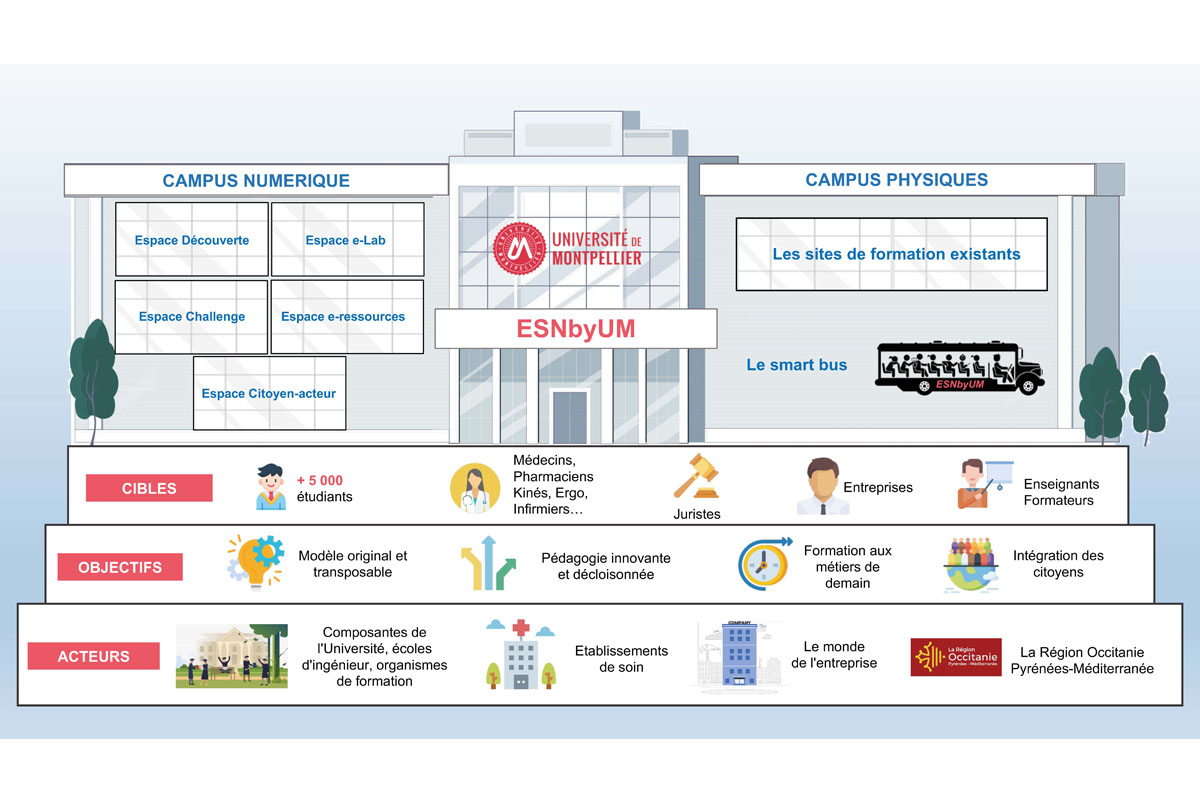
Known as ESNbyUM, short for “University of Montpellier School of Digital Health,” this school“should not be viewed as a school in the strict sense of the term, but rather in the sense of ‘setting a standard’ by imparting generic or specific skills to various audiences—some of which constitute a core knowledge framework defined by the Ministry of Health through the Ministerial Delegation for Digital Health, ” continues Maurice Hayot. In practical terms, for undergraduate health students, this will involve skill modules integrated into current curricula for widespread implementation starting in the 2023 academic year. Topics covered will include health data, cybersecurity, digital health tools, telehealth, and health communication. For graduate and postgraduate students, as well as professionals enrolled in continuing education programs, customized modules closely aligned with their professional practices and specialties will be offered later this year.
A 6P Pedagogy
“Personalized” is one of the key words in the pedagogical approach designed and developed for this program by Maurice Hayot’s team.“Our goal with ESNbyUM is to create an innovative and effective pedagogical model for training professionals who will practice humanistic digital health—and to ensure that this model can be replicated in other cities. “We want to develop and implement a ‘precision pedagogy’ where everyone can acquire the specific skills they need for their practice, based on their background, availability, or geographic location within the region,” the professor emphasizes. This method, dubbed “6P Pedagogy,” is based on six pillars: Personalized; Preventive—“that is, preventing people from abandoning the field due to insufficient training”; Predictive—“capable of predicting the needs and thus the jobs of tomorrow in digital health”; Participatory—“empowering learners to take an active role in their learning choices and career paths”; Evidence-Based; and Practice-Centered.
On a more practical level, this school will be based on the creation of a digital campus where students and professionals in training will have access to various spaces: an introduction to digital health terminology, challenges among students and trainees, an e-lab connected to the business world, resources for becoming a trainer themselves, and opportunities for dialogue with and among citizens.“This innovative space was designed in collaboration with the Institute of Business Administration (IAE) to enable people from different professions or fields to work together on the same project. “In the digital age, a healthcare professional can no longer work in isolation; they must interact with engineers, lawyers, and others,” notes Maurice Hayot. Funded for a five-year period, ESNbyUM aims to become the new French model for training in emerging healthcare professions.
They are part of the ESNbyUM consortium:
The consortium’s members include, of course, the University of Montpellier—along with most of its constituent institutions—and the university hospitals in Montpellier and Nîmes, as well as: the Montpellier Regional Cancer Institute, the engineering schools Polytech Montpellier, IMT Mines Alès, and ISIS Castres, GRADeS e-santé Occitanie (Regional Consortium for the Development of e-Health), training organizations such as FORMATICSanté, the KEEFP association, which brings together the training institutes for occupational therapists and physical therapists (IFMK, IFE, EPK), the GCS IFSI consortium (Nursing Training Institute), and KORIAN Academy—the Korian Group’s in-house training organization—as well as companies such as ONAOS and the Pfizer Innovation Endowment Fund…
The following organizations support ESNbyUM: