Science in Stock with Meso@LR
In an era where science increasingly relies on data, the University of Montpellier, thanks to financial support from the Region and the Metropolitan Area, is providing the scientific community with a shared storage space. More efficient, more secure, and more environmentally friendly, it is part of a regional initiative in which Inserm is participating. Anne Laurent, Vice President for Open Science and Research Data, explains.
Inserm and the University of Montpellier have just signed a cooperation agreement regarding the establishment of a shared data management environment. Why is this important?
It’s important because, in order to conduct scientific research and produce scientific results, engineers, researchers, Professors, and doctoral students are increasingly relying on data. Data is a resource that we store, manipulate, analyze, and enrich; however, all of this requires enormous amounts of storage and processing capacity, which must be shared. It is this capacity that we are providing for our scientific communities through Meso@LR.
What is Meso@LR?
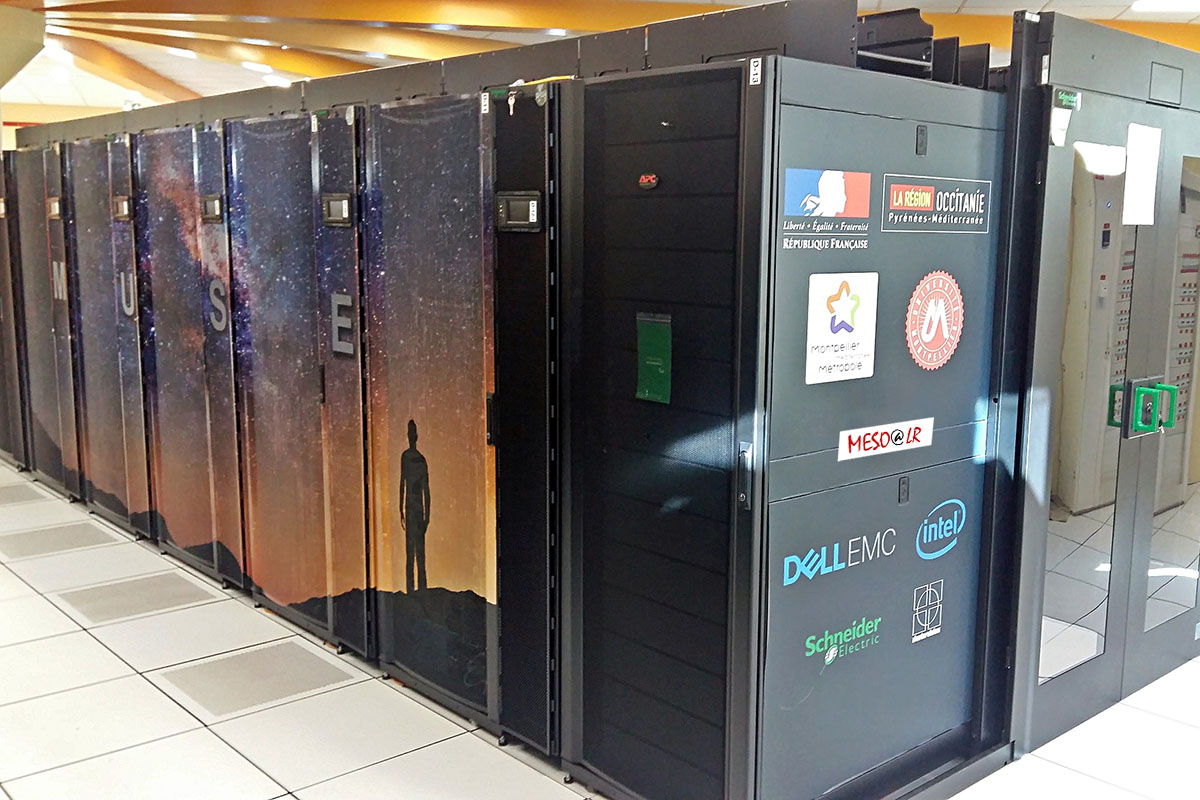
It’s a kind of gigantic computer divided into two parts: high-performance computing and storage. On the computing side, there are enormous processors. On the storage side, Meso can be compared to a super hard drive—or rather, two super hard drives located in two different rooms to double the security. It is this super hard drive that is gradually being made available to the scientific community for their work. This conference serves as a sort of launchpad for this collaborative effort, which everyone is invited to join.
And those big hard drives—what’s their storage capacity?
The Meso@LR data infrastructure can store 15 petabytes—that’s huge! 15 petabytes is equal to 15 million billion bytes. That’s the equivalent of about a million USB flash drives!
Will this platform be open to all Muse partners?
It’s broader than that. It’s one building block of a regional initiative. Meso@LR is an organization managed by the University of Montpellier but designed to meet all the IT needs of research in Eastern Occitanie. It is co-funded by the Region and the Metropolis, while theUM has been responsible from the outset for hosting, staffing, electricity, and so on.
So is the agreement with Inserm the first in a series?
Yes, Inserm is the first organization to sign, but we are indeed working with other partners. And this cooperation is strengthened by the leading role Inserm plays in the development of the Montpellier Institute of Data Science (ISDM).
And what exactly does it entail?
Inserm now has 2 petabytes of storage space on Meso@LR, which it can use to develop its offerings and services for the scientific communities associated with Inserm. Inserm holds the keys to this storage and manages it using the expertise of its IT teams.
UM s do not have access to their storage space. Isn’t this data sharing?
No, Inserm sets its own data-sharing policy, and this data is and remains the property of the lead institution. There are other infrastructures for data sharing and openness at the national level.
And what’s in it for them?
By pooling these infrastructure resources in highly secure environments, we enable IT teams to work with greater peace of mind—reducing concerns about potential issues, such as air conditioning, for example—while allowing them to acquire top-of-the-line equipment and share their experiences and expertise. This enables us to develop even more ambitious projects.
And what about users?
Value-added services and data processing environments that are easier to use and more efficient. It’s a paradigm shift—it’s like no longer having your own tools at home but having better ones instead; there’s everything to gain. Furthermore, scientific projects bring together interdisciplinary teams, and Meso aims to provide a harmonized response to questions that all researchers ask themselves.
What kinds of services will be available?
To give one example, the cloud offering currently under development will allow us to provide “virtual machines.” Instead of having to install hardware, access software, or data processing software on each of our computers, these resources will be pooled in this space. This also improves performance and security.
By the way, who handles the technical side of Meso?
It’s a team of top-notch engineers—I want to emphasize this because it’s truly impressive; our model is closely scrutinized. Here, too, it’s a collaborative and shared effort: each partner has agreed to make engineers available for 20 or 30 percent of their time, sometimes more. When it comes to these kinds of projects, no one can do it alone anymore; we really have to work collectively—otherwise, we wouldn’t be able to move forward.
And from an environmental standpoint, is there a benefit to pooling resources?
We now know that housing these environments in dedicated, ultra-energy-efficient buildings helps reduce their environmental impact. But this benefit will also depend on how we use them, both individually and collectively. I’m the first to admit it—I filled up my hard drive because I had the space; it’s just like closets! We need to learn to delete our data when it’s no longer useful. In this regard, the support efforts being made are essential; in fact, a cross-departmental project is currently underway atUM to address this issue.
Precisely by creating a new storage space when laboratories already have their own solutions, isn’t there a risk of duplicating storage?
The idea is that, over time, we can phase out local solutions that consume human resources and electricity—except when they’re needed, and sometimes they are needed. That’s also why we’ve included this in the agreement.
A cost of 300,000 euros. What does that cover?
This is the total cost: electricity, personnel, and storage facilities for this Inserm project over a 5-year period. Inserm also contributes personnel and expertise, which are invaluable for providing high-quality service.
Are there any connections between Meso@LR and the Institute for Data Science?
Yes, we are convinced that data science and scientific data will be at the heart of science. And this poses major challenges in making this data easy to find, accessible, interoperable, and reusable (FAIR). Managing and leveraging this data requires expertise and support… This is one ofthe ISDM’s missions. Some of these issues are also still active areas of research in which the laboratories at the Montpellier site are highly active and well-regarded.
And how can you access these support services?
The cross-departmental working group on open science at theUM was created for this purpose, in collaboration with the ISDM, Méso@LR, and all of Muse’s partners. This support is available through the services catalog in the digital campus platform (ENT). We are currently working together to increase its visibility and enhance its services.
Is open data a goal?
People sometimes say,“Data: as open as possible, as closed as necessary.” Once again, we need to give researchers time to analyze and make the most of the data, and Meso is specifically designed for science that is in the process of “FAIR,” if I may say so. It is neither a data warehouse nor a data portal. Nevertheless, data governance is an issue that must be addressed in order to collectively build environments that are designed to ultimately lead to sharing and openness. We want to make Montpellier a place where scientific data is not only produced but also utilized and, whenever possible, shared as a common good.