Learning Through Research with Idil
Since the start of the 2022 academic year, nearly 80 students have had the opportunity to pursue their education through research thanks to the graduate program Idil. The program features courses taught in English, hands-on lab experience, and various academic units that foster a multidisciplinary approach to learning, all designed to address today’s societal challenges. We spoke with Agnès-Fichard Carroll and Mathieu Sicard, the program’s co-directors, to learn more.
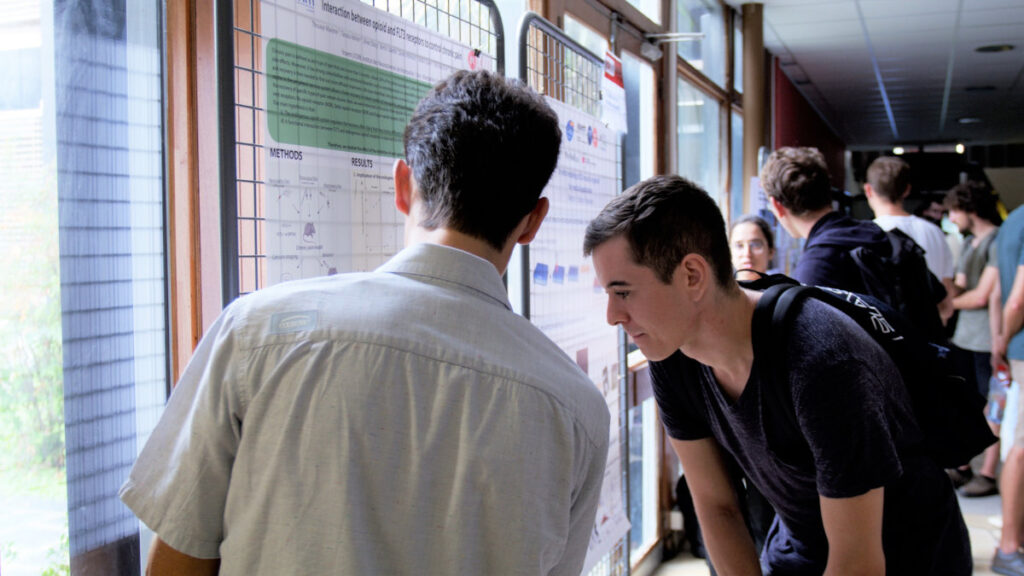
The Idil tracks were launched at the start of the 2022 academic year. What does this program entail?
Mathieu Sicard: The goal of the Idil program is to train students from various disciplines through hands-on laboratory work. Students spend six months a year immersed in the lab; courses are taught in English, and the programs focus on fostering interdisciplinary collaboration. IDIL also aims to increase the number of international students at the University of Montpellier by making its programs more attractive.
Agnès Fichard-Carroll: The challenge was to develop a program with a strong interdisciplinary focus, while remaining grounded in a specific major: students will graduate with a degree in a specific major but will have followed a personalized path in which openness to other disciplines and their concepts is a key element.
Now that it’s the second semester with Idil, can you tell us how many students are enrolled in this graduate program?
MS: As for the master’s programs, approximately 80 students are enrolled in the Idil program during their first and second years of master’s study, across 10 tracks and an equal number of different academic specializations. The engineering track involves more than 20 students. The goal was to have 30% international students who had not previously studied in France, which is a requirement for receiving an Idil scholarship: we have met this goal, thanks in large part to Idil’s presence at international education fairs. Today, we have students from the United States, Japan, and Brazil who are writing to us to request information about the program and find out how to apply.
Do you have a typical profile of Idil students?
MS: Overall, we’re looking for students who are truly motivated by learning through laboratory research and who possess a strong ability to adapt—a skill that’s essential for pursuing an international and interdisciplinary path. For example, they need to be able to manage the shared components across the different tracks by consulting with the Idil team, which supports them. Students must be flexible in organizing their schedules, as conflicts are bound to arise. It’s impossible to coordinate the schedules of 10 programs across five different departments.
AFC: I’d like to add that while students need to be curious and flexible, the program—due to its cross-component nature—has also required a significant commitment not only from the teaching staff but also from the administrative teams: it was necessary to refine not only the academic curriculum but also the procedures specific to each UEI. This is an opportunity for us to congratulate them on the work they’ve accomplished: the difficulties have been resolved, and this inevitably has a positive impact on the students’ academic experience.
On that note, how are students supported throughout their academic journey?
AFC: There is already an IDIL team of four people—a project manager, two instructional designers, and an administrative manager—who are doing a remarkable job supporting not only the students but also the teams at headquarters and in the various departments.
MS: In addition to the Idil team, students are supported by two individuals with research experience: a tutor and a mentor. The academic advisor is available only during the M1 year; they serve primarily as a “ Professor ” who guides students in selecting their coursework, in addition to their laboratory work. They also support students with their M1 research project—a bibliographic and methodological study that prepares them for their laboratory work.
And what is the mentor's role?
MS: The mentor, who works with students in the M1 and M2 programs, is a researcher or a professional Professor d in the research component of their work; they supervise the student in their lab, much like in a traditional internship but in a more in-depth manner. This is true not only in terms of duration—since Idil students spend six months in the lab during the M1—but also in terms of commitment, as this internship is not merely a research placement but also an immersion in the workings of the lab: Idil students attend meetings and seminars to gain insight into the life of a researcher. Beyond that, the mentor also commits to deepening the student’s general knowledge of their discipline, particularly through guided reading of articles accompanied by dedicated discussion sessions. This helps round out the student’s general knowledge of their field within the laboratory setting. In fact, the mentor’s work is recognized as equivalent to 20 hours of tutorial time—not for supervising the internship, but for teaching right in the heart of the laboratory.
Does the student have the same mentor in the first and second years of the master's program?
MS: That’s entirely possible, since students can potentially stay in the same lab during their first and second years of the master’s program—and why not continue on to a Ph.D. there, since there are Idil doctoral contracts available?
AFC: Indeed, a student could remain in the same laboratory for a total of five years. Since the IDIL program is research-based, it made sense for it to include doctoral contracts that share this interdisciplinary nature.
How are student-mentor pairs formed?
MS: At the beginning of the year, during the interdisciplinary summer school, the mentors will present their research projects, and the students will be able to choose. This marks the start of the program; every evening during the summer school, there are interdisciplinary lectures on topics such as “management and ecology” and “science policy and political science.” These lectures are given in English, primarily by researchers from Montpellier but also by invited international researchers. It’s a very interesting time when all backgrounds come together and everyone asks questions from different perspectives, with diverse origins and expertise. There’s also a “team-building” day where Idil students participate in activities designed to foster integration. This summer school concludes with a gala at the Jardin des Plantes.
Does this summer school help students identify more closely with Idil and "feel" like part of Idil?
MS: Yes, it’s important because throughout the year, they spend most of their time with students in their own disciplines! To help them feel a sense of belonging to the Idil graduate program, there’s also a year-round event called the “Idil House Cup.” Idil students from different tracks are grouped together in different houses and take part in challenges, such as collecting as much trash as possible on the beaches, or visiting the Moco—which is also a way to introduce them to cultural experiences. The Idil team also organizes events at least once a month that give them a chance to get together.