[LUM#9] What if plants no longer provided us with food?
“Eat five fruits and vegetables a day.” A slogan that could very well become outdated in the coming years. The reason? The decline in the nutritional quality of plants caused by rising CO2 concentrations in the atmosphere. This phenomenon is still poorly understood, and researchers at the Montpellier laboratory of plant biochemistry and molecular physiology.
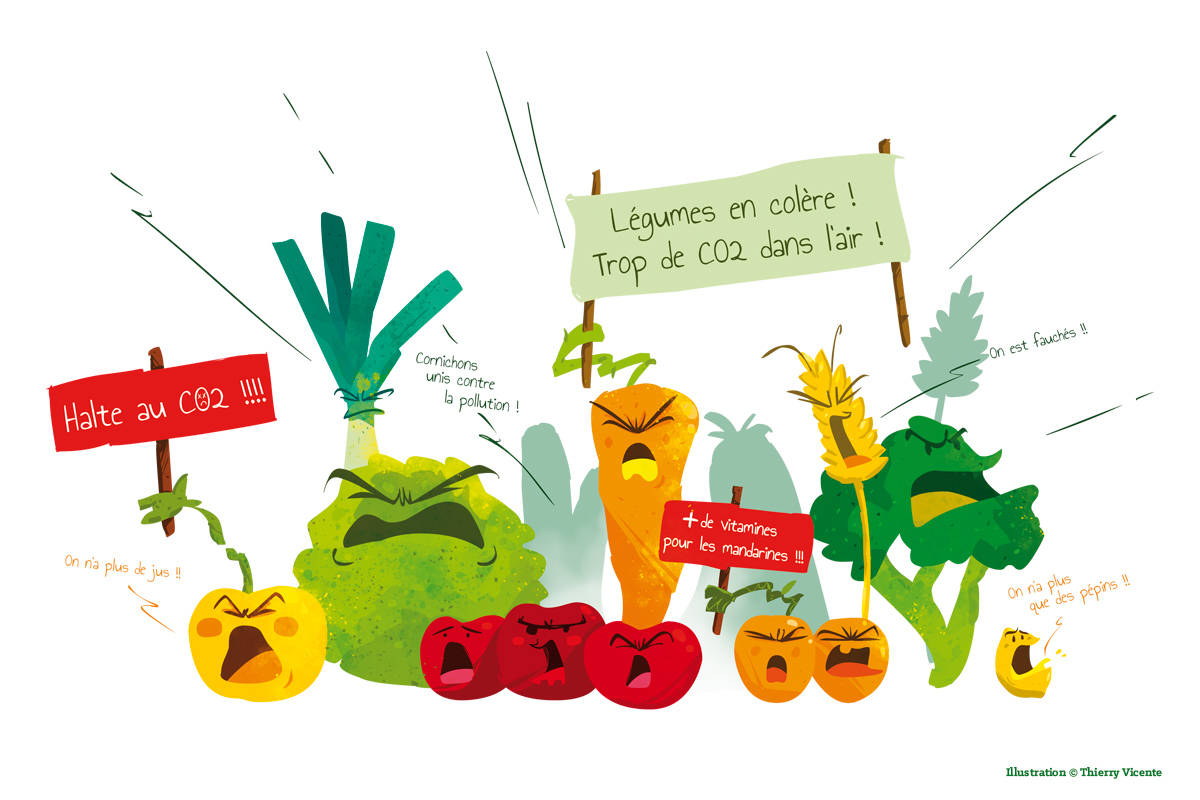
“In 50 years, the rise in CO2 levels—which we can no longer control—will likely significantly boost agricultural production, but the nutritional quality of these crops will be lower.” This is the alarming conclusion shared by Alain Gojon, a researcher at the Laboratory of Plant Biochemistry and Molecular Physiology.
A Global Food Challenge
Yet it had all started out well. For once, the rise in atmospheric CO2 concentrations caused by human activity—which is responsible, among other things, for global warming—had a positive effect. It stimulated the growth of a great many plant species by boosting their photosynthesis. “ Photosynthesis,” explains Alain Gojon, “is the ability of plants to produce sugars using CO2, light, and water . It is the foundation of the food chain of life.”
As early as the 1990s, researchers saw this as offering a twofold hope: boosting global food production while capturing excess CO2. “It’s one of the possible solutions to the food challenge facing the planet, ” continues Alain Gojon. “There will be 9 billion of us by 2050, and more than 10 billion before the end of the century. We’re going to have to feed everyone.” Initial calculations based on projections of rising CO₂ levels estimate a 40% increase in agricultural production . A windfall.
Fewer minerals but more sugar
More than 2,600 experiments were conducted to test this prediction. These experiments, known as FACE ( free-air CO₂ enrichment), involve creating an artificial CO₂ bubble over open-field crops using a system of nozzles that continuously inject carbon dioxide. Hundreds of plant species, including wheat, tomatoes, rice, potatoes, and beans, have been tested around the world. “The first publications appeared as early as 1998, but it’s only in the last 3 or 4 years that we’ve had comprehensive summaries of all these experiments.” The results point to two key conclusions.
First, the increase in agricultural productivity, which turned out to be much smaller than researchers had hoped.“We’re closer to 10% than to 40%,” explains Alain Gojon. The second, unexpected finding is the significant loss of minerals and proteins in these plants grown under CO₂: “The loss of nitrogen, which is a major component of proteins, is about 15%. For minerals such as phosphorus, potassium, calcium, magnesium, or iron, the loss is 10% or more.”
Recent studies on rice varieties even report a loss of vitamins of up to 40%. On the other hand, sugar content is higher because the carbon content has increased.
Serious health consequences
Within fifty years, commonly consumed plants could therefore be higher in energy but lower in essential nutrients, with potentially serious consequences for the human population.
“A recent study indicates that, globally, an additional 120 million people will suffer from protein deficiency, and an additional 1.5 billion women and children will suffer from severe anemia due to iron deficiency.” Once again,it is the Global South that will pay the highest price. “ In the North, ” the researcher continues, “nutritional imbalance could lead to a rise in obesity and overweight rates due to the increased sugar content of plants.” To better understand this phenomenon, the QualiSud laboratory will analyze changes in the nutritional quality of foods produced under high CO₂ levels to assess their impact on human health.
This process may already be underway, since when researchers compare contemporary wild plants with samples from pre-industrial herbariums, they find that, for the same species, the mineral content is already lower. “ The problem,” continues Alain Gojon, “is that nothing in our current understanding of the physiology of mineral nutrition in plants allows us to explain this.” And that is precisely the focus of the research set to begin in Montpellier in January 2019.
Two hypotheses
“The first hypothesis is that, for some reason we don’t understand, rising CO2 levels affect how plants function, making them less efficient at absorbing minerals from the soil. ” The second hypothesis, which the Eco&Sol laboratory in Montpellier will investigate in collaboration with Alain Gojon’s team , is that “CO2 could affect the functioning of the biogeochemical cycles of elements in the soil. The idea is that plants may still be functioning just as well, but there are fewer mineral elements available to them in the soil.”
By testing these hypotheses, the researchers hope, of course, to understand this mechanism, but perhaps also to find solutions to this future crisis. “Thanks to the unique facilities available atthe Ecotron in Montpellier, we will use 140 plant lines to try to identify the genetic factors responsible for the negative impact of high CO₂ levels on the nutritional quality of plants.”
With the hope, perhaps, of developing plant varieties that areless affected by rising CO₂ levels.
Check out theUM podcasts, now available on your favorite platform (Spotify, Deezer, Apple Podcasts, Amazon Music, etc.).