[LUM#20] Sports for Everyone—Everyone’s Forced to Participate!
While a typical inmate may spend 22 hours in a cell, the plan for the Lavaur juvenile detention center, when it opened, called for 60 hours of weekly activities, including 20 hours of sports. A great idea on paper, but one that, in practice, turns the logic of incarceration on its head and turns movement into a constraint.
It was in 2007, while Rachida Dati was serving as Minister of Justice, that the first juvenile correctional facilities (EPMs) were established, intended to gradually replace the juvenile wings located within conventional prisons. “The government’s justification for these EPMs was based, among other things, on the lack of separation between adult and juvenile wings and on the difficulties faced by educators with the Judicial Youth Protection Service (PJJ) in ensuring educational continuity in detention centers,” explains Laurent Solini1, a sociologist on the Santesih research team and author of numerous studies on the detention experiences of adolescents incarcerated in juvenile correctional facilities.
The Life of a "Typical" Teenager
EPMs are distinguished first and foremost by their slogan , “You can’t learn how to live in prison.” But how can we offer these young people, aged 13 to 18, a real chance at reintegration while simultaneously isolating them from society for the duration of their sentences? Faced with this ontological contradiction inherent in the prison system, EPMs propose to replicate the standard life of a teenager within the prison. “So, as a sociologist, I ask myself: What is a ‘standard’ teenage life?” The answer is a 60-hour-per-week schedule divided into three parts: 20 hours of school, 20 hours of sociocultural activities, and 20 hours of sports. “We can already see a vision emerging of the so-called ‘average’ adolescent, whose lifestyle quite clearly resembles that of young people from the most legitimate and upper strata of society,” the researcher continues.
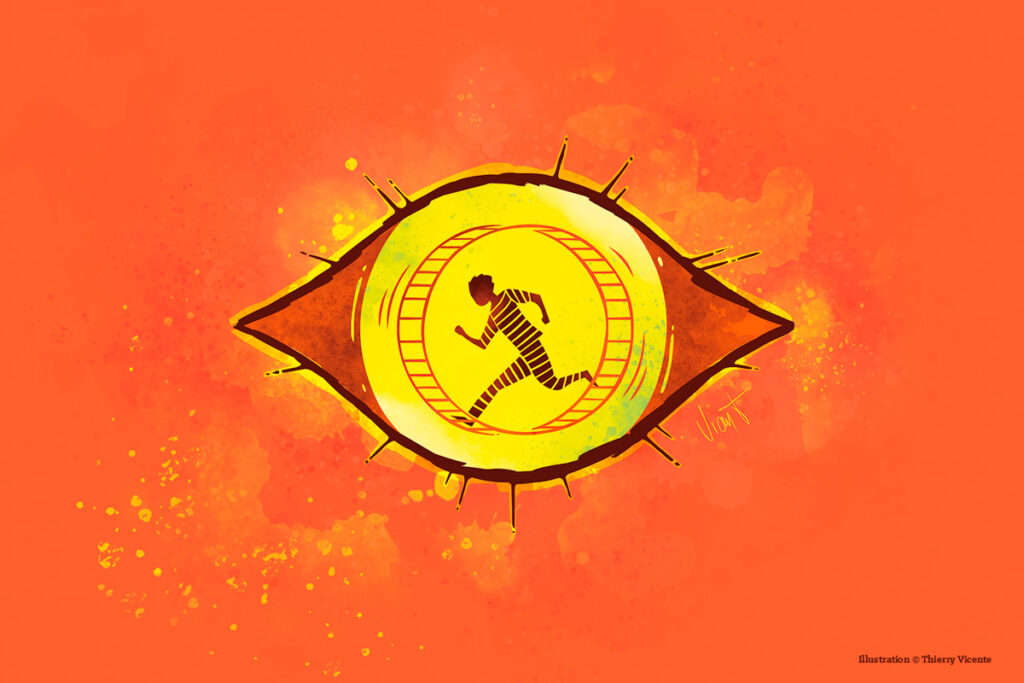
To conduct his ethnographic fieldwork, Laurent Solini gained access to the EPM in Lavaur through sports programs, where he worked with the youth from 2007 to 2009. The facility houses between 30 and 40 boys and a maximum of 5 girls. Sports activities centered mainly on soccer, weight training, and stretching. “It’s a constant in the prison world: the fantasy that sports can rehabilitate, reintegrate, and resocialize. Except that 20 hours of sports a week for young people who aren’t elite athletes is a huge amount!” ” In interviews, these young people report exhaustion or fatigue caused by this “economy of hyperactivity”—by this compulsion to be active, which creates a reversal of the typical prison experience here. “They won’t associate their fatigue with being locked in a cell, as in other prisons, but with having to exercise when they don’t feel like it—when they’ve already done six hours of group activities and would rather be alone for a while.”
The Body Made Visible
This pressure is exacerbated by the unique architecture of the EPMs, characterized by a large open-air courtyard located at the heart of the facility, where some of the sports activities take place. Cells, the media library, the school, the weight room, and the administration offices—every area of the prison is equipped with large windows that all overlook this central courtyard. This design certainly allows for natural light, but it also keeps the inmates constantly visible. “All movement takes place through the central courtyard and is therefore under the watchful eyes of other young people who are in their cells or engaged in activities,” explains the sociologist. “The constraint is experienced by these bodies, which are made visible—with all the problems, stigma, labels, and mockery that this can entail, which, in detention, take on extreme proportions.”
What is experienced as a reward in traditional prisons—the famous “walk”—becomes yet another constraint in EPMs. “At the time of my investigation, solitary confinement was a minimal part of the sentence, since from 7:30 a.m. to 9:30 p.m. they were in group settings. They were more often on the move than stationary.” To escape this hypervisibility, some inmates negotiate the right to stay in their cells for a few hours, with a blanket hung over the bars to serve as a curtain. This practice is tolerated by the guards themselves, who are also subject to this architectural design. “When a staff member crosses the courtyard, they may be faced with 50 youths at their bars who will stare at them and possibly insult them or yell at them.”
Step into the arena
This hyperactivity, combined with hypervisibility, encourages constant self-dramatization the moment one leaves the cell and is thrust into the central courtyard, which the guards call “the arena.” In his book titled Serving One’s Sentence2, Laurent Solini explains that “for young inmates, serving one’s sentence means presenting oneself in the most positive light possible within this prison theater.” One must therefore “show oneself,” prove one’s worth by stepping into the arena. “Because movement involves being in a state of hypervisibility, it is the site of risk-taking and confrontation. This requires showing and revealing oneself.”
A confrontation that manifests itself in practices sometimes far removed from the rules of traditional soccer, more conducive to rough play and physical contact. This is the case with “goal-to-goal,” where two players face off on a soccer field with the goal of scoring, but without being allowed to use their hands to defend their goal: “I’ve seen a lot of young people stop the ball with their heads and end up with broken noses. If they use their hands or try to hide, they get beaten up. It’s not meant to hurt; it’s a ritual used to project a certain image of themselves. For these young people, earning your stripes means earning your place!”
Check out theUM podcasts, now available on your favorite platform (Spotify, Deezer, Apple Podcasts, Amazon Music, etc.).
- SOLINI, Laurent, and BASSON, Jean-Charles, “Leaving the Cell/Staying in the Cell: A Sociology of the Paradoxical Experiences of Detention in Juvenile Correctional Facilities,”*Agora débats/jeunesses*, 2017/3 (No. 77), pp. 67–79. DOI: 10.3917/agora.077.0067. https://www.cairn.info/revue-agora-debats-jeunesses-2017-3-page-67.htm
↩︎ - SOLINI, Laurent,Serving a Sentence at the Lavaur Juvenile Detention Center. Champsocial, “Questions de société,” 2017, ISBN: 9791034603848. DOI: 10.3917/chaso.solin.2017.01. https://www.cairn.info/faire-sa-peine-a-l-etablissement-penitentiaire–9791034603848.htm
↩︎