"Super Mario Bros.," "Assassin’s Creed," "Uncharted"… Video Game Adaptations: A Winning Bet?
In 2023, *Super Mario Bros.*, the film inspired by the Nintendo game of the same name, topped the box office in France with 7,359,264 admissions. This is a specific example of a well-known and widely used practice in the entertainment industry: the adaptation of narrative content from one medium to another—a strategy that proves effective in many ways.
Guergana Guintcheva, EDHEC Business School and Philippe Aurier, University of Montpellier
Is Content Adaptation a Winning Strategy?
The most common example is the adaptation of a book into a film, a practice that has proven effective since the medium’s inception. From a commercial standpoint, film adaptations of books generate 53% more revenue than films based on original screenplays, and 70% of the world’s 20 highest-grossing films are based on books.
In terms of viewership, an adaptation of a story that has been successful and has won over a broad audience ensures the appeal of a captive audience that will certainly want to revisit it through another medium, thereby enriching the experience. The appeal of repetition is evident from childhood onward. From a very young age, we listen to or watch stories (fairy tales, stories told by our elders, books, and movies). Laura Perachio shows that children prefer fidelity to the source material over creative interpretation. They enjoy reliving a story they already know. They seek a predictable experience that reassures them because they are familiar with the characters, the climax, and the resolution.
Adapting a story without distorting it
The process of adapting a video game for the big screen (or vice versa) can be analyzed through the lens of the concept of brand extension, which is well known in marketing. Brand extension involves developing and marketing new products under the name of an existing brand, but in new categories. For example, Nutella (parent brand, spread category) has launched cookies (a brand extension into a new category: cookies). The goal is to leverage the brand awareness, image, and trust associated with the existing brand to penetrate new markets. It is essential that the brand extension align with the parent brand’s values to avoid any confusion or dilution of its image. This alignment—known as the “fit” between the parent brand and the extension—facilitates the transfer of the parent brand’s values to the extension. In turn, this strengthens the parent brand’s credibility and creates a positive connection with the target audience.
[More than 85,000 readers rely on The Conversation’s newsletters to better understand the world’s major issues. Subscribe today]
The figures show that this form of brand extension has been highly successful in the case of video games adapted for the big screen.
Why Does the Synergy Between Video Games and Movies Work?
First, over the years and with technological advances, we have seen a technical convergence between these two media. Video games, like movies, strive for realism in framing and shots; they use real actors via motion capture to make character animations more realistic; they feature high-definition graphics; and they include cutscenes (scenes during which the player is not actively playing, used to advance the narrative, introduce a character, or enhance immersion).
Second, video game adaptations for the big screen capitalize on a captive audience that is already loyal to the game’s universe and will certainly be among the first to go to the theater, which reduces the risk associated with the film’s release. Furthermore, adapting a video game’s universe to a film format broadens the audience base, as film is a shorter, mainstream medium that is more accessible. Typically, a video game takes several dozen hours to complete (143 hours to finish *Assassin’s Creed Odyssey*; 52 hours to finish *Mario Kart Deluxe*; or even years for long-running series—33 years and 123 days for the *Dragon Quest* series), whereas the film’s shorter format allows for immediate immersion in the universe.
The 2016 film *Assassin’s Creed* wasn’t necessarily aimed at immediate profitability but rather at promoting the franchise by expanding the brand’s reach to audiences unfamiliar with the franchise and the game’s universe.
It is important to note that there is an imbalance in the adaptation process: the majority of video games are adapted into movies, while few movies are adapted into video games.
Even though film production companies and video game publishers seem to be collaborating successfully, it is crucial that the adaptation be well-received by audiences.
A mixed reception
The answer is not so clear-cut. For example, the movie *Uncharted*, based on the hugely successful PlayStation video game series, is a commercial success with an estimated production budget of $120 million and $400 million in worldwide box office receipts, but audience reception has been mixed: a 6.3/10 rating on IMDb.
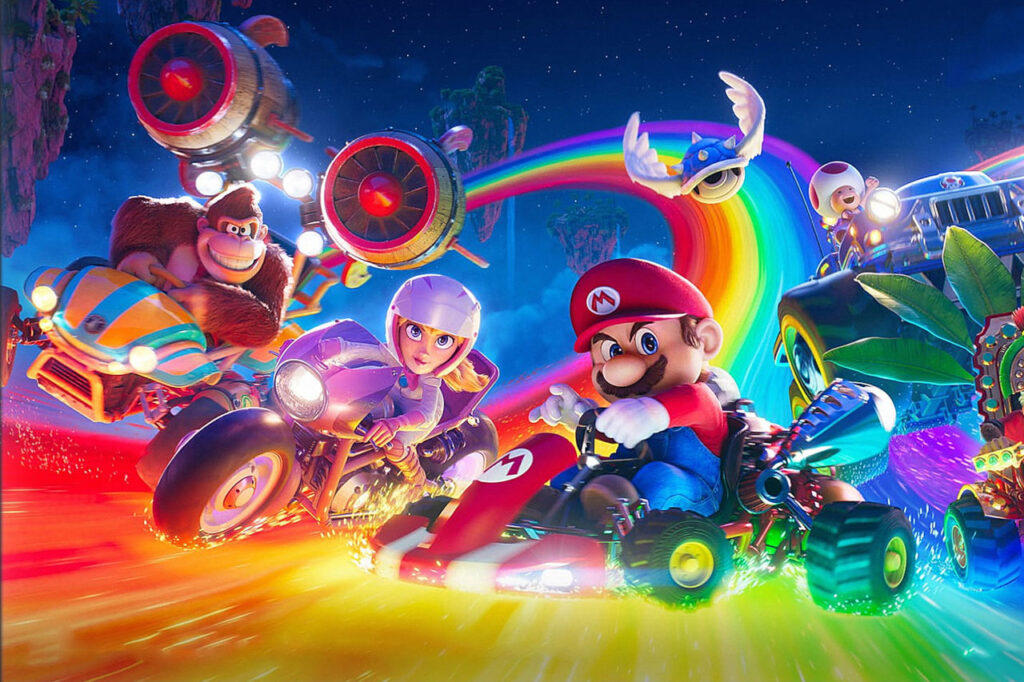
The movie *Super Mario Bros.*, on the other hand, with a production budget of $100 million, grossed over $ 1 billion worldwide and received a more favorable rating from audiences: 7/10 on IMDb.
Audiences who watch narrative content adapted from another medium at the movies arrive with expectations that the adaptation must meet. But these expectations are ambivalent. Viewers want to see a story they already know and love perfectly preserved, while also experiencing something sufficiently different, new, and enriched. The adaptation must therefore walk a particularly fine line, with fidelity to the source material on one side and creative enrichment on the other. For example, the movie *Super Mario Bros.* remained very faithful to the game’s colorful universe and its protagonists, while offering a more complex story that delves deeply into the character of Princess Peach—a strong, independent woman who defends herself using wrestling moves—and incorporating creative elements unique to the medium of film, such as the voices of well-known actors and a score that evokes the game’s themes but is remixed with musical touches like Bowser’s declaration of love to Peach on the piano.
The connection between video games and film will continue to grow stronger in the future. Globally, the video game industry surpasses the film industry in terms of revenue. It is experiencing steady growth and a continuously expanding player base.
This collaboration is clearly a “GG” (“Good Game” in gamer slang).
Guergana Guintcheva, Professor of Marketing, EDHEC Business School and Philippe Aurier, Professor of Marketing, University of Montpellier
This article is republished from The Conversation under a Creative Commons license. Readthe original article.