Trump 2.0: The Rise to Power of an “Anti-Elite” Elite
Donald Trump is bringing a new cohort of political figures in his wake. While one of his campaign promises was to overthrow the “corrupt elites” whom he accuses of flooding the American political landscape, his second term is propelling to the helm of the country elites chosen, above all else, for their loyalty to him.
William Genieys, Sciences Po and Mohammad-Saïd Darviche, University of Montpellier

Does Donald Trump’s new presidency herald the rise to power of “the people and the end of corrupt elites, ” as he claimed during his election campaign? Contrary to what this populist rhetoric suggests, the president-elect is in fact bringing an “anti-elite” elite to power .
While Trump’s outlandish statements about Canada and Greenland—or Elon Musk’s statements in support of European far-right parties —dominate the media, they overshadow the federal government’s ambitious transformation agenda that the new political elite, set to take power after Trump’s inauguration, hopes to implement.
In fact, following the ceremony on January 20, 2025, the faction of the Republican elite most loyal to the MAGA (“Make America Great Again”) leader—which shares a strong, common hatred of the Democratic elite and their policies— will monopolize the executive (the administration), judicial (the Supreme Court, among others), and legislative branches (at least until the next midterms—the midterm elections for Congress— which will take place in 2026).
However, the political agenda of the Trumpist camp is less about challenging elitism in general than about a specific vision of the elite unique to liberal democracies.
Rhetoric denouncing “democratic elitism”
Typical anti-elite political propaganda (“I speak for you, the people, against the elites who betray and deceive you, etc.”) claims that the populist leader would be able to exercise power for and on behalf of the people without the mediation of an elite that is out of touch with the people’s needs.
John Higley, a theorist of neo-elitism, sees behind this form of anti-elite discourse a connection between so-called“forceful leaders” and “leonine elites” (who take advantage of the former and their political success). This phenomenon threatens the future of Western democracies.
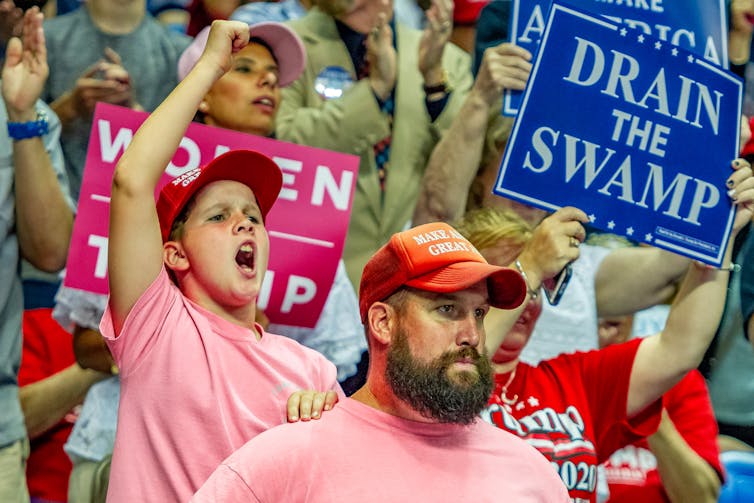
Since World War II, there has been a consensus in American politics regarding the concept of democratic elitism. According to this principle, elite mediation is inevitable in mass democracies and must be based on two criteria: respect for election results (which must be free and competitive), on the one hand; and the relative autonomy of political institutions, on the other.
However, challenges to this consensus have been growing since the 1990s, amid the increasing polarization of U.S. political life, and have gained new momentum since the 2016 presidential campaign, which was marked by anti-elite rhetoric used by populist leaders on both the Republican and Democratic sides (Bernie Sanders, Elizabeth Warren). At the heart of their diatribes lies an aversion to the establishment on the East Coast of the United States—where many prestigious financial, political, and academic institutions are located—as well as the conspiracy theory of the “deep state.”
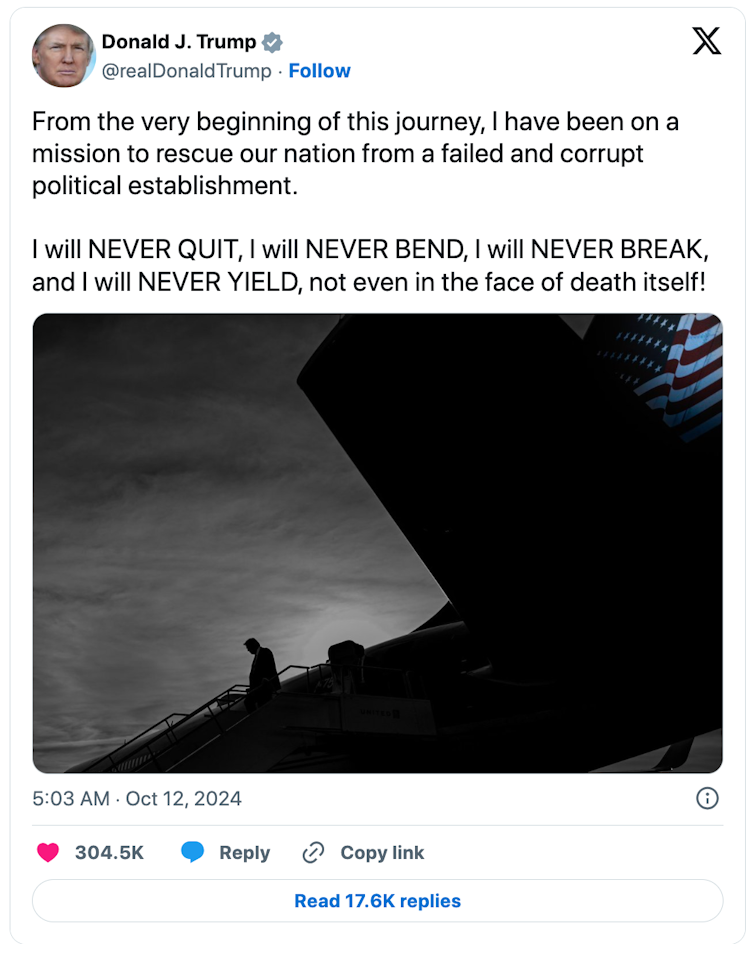
Trump’s re-election— despite his refusal to acknowledge his defeat in the 2020 presidential election—along with growing political hostility and the direct involvement of high-tech tycoons in political communications—especially on the Republican side—further reinforces the rejection of democratic elitism.
Trump’s “Top-Down” Populism: A Revolt by the Elites
The idea that democracy could be betrayed by “the revolt of the elites, ” put forward by the American historian Christopher Lasch (1932–1994), is not a new one. For anthropologist Arjun Appadurai, it characterizes contemporary populism in particular, which comes “from above.” Indeed, if the20thcentury was the era of “the revolt of the masses, ” the21stcentury would be that of “the revolt of the elites.” This would explain the rise of populist autocracies (Orbán in Hungary, Erdoğan in Turkey, Bolsonaro in Brazil, Modi in India, etc.) as well as the victories of populist leaders in established democracies (Trump in the United States, Giorgia Meloni in Italy, Geert Wilders in the Netherlands, for example).
As Appadurai explains, the success of Trumpian populism—which positions itself as the standard-bearer of a revolt by ordinary Americans against the elites—obscures the fact that, following his victory in the last presidential election, “it was a new elite that ousted from power the Democratic elite it despises, which had occupied the White House for nearly four years .”
The goal of this “alternative elite” is to replace not only the “mainstream” Democratic elites but also moderate Republicans by thoroughly discrediting their values (liberalism, “wokeness,” etc.) and their supposedly corrupt political practices. Consequently, this “top-down” populism driven by the president-elect’s supporters constitutes an alternative elitist framework, whose impact on the transformation of American democratic life could be more significant than that observed during Trump’s first term.
To paraphrase the famous line by American political commentator James Carville—“It’s the economy, stupid!”—we could say today,“It’s the elite, stupid!”
Moving Beyond the Idea of a “Muskoligarchy”
The idea that we are witnessing the emergence of a “Muskoligarchy”—that is, an economic elite (including tech barons such as Jeff Bezos, Mark Zuckerberg, Marc Andreessen, etc.) rallied behind the figurehead of Elon Musk, who has served as “tsar of government efficiency ” since November 2024—is an appealing one.
It perfectly combines the vision of an alliance between a “conspiratorial, cohesive, self-aware” ruling class and an oligarchy composed ofthe “ultra-rich.” For Martin Wolf, the renowned Financial Times columnist, this is even a sign of the rise of “pluto-populism.” https://www.youtube.com/embed/BN_82NLmqm4?wmode=transparent&start=0
Other observers, however, remain cautious about the emergence of this “Muskoligarchy.” They point to the sociological eclecticism of the new Trumpian elite, whose superficial unity is held together primarily by a political loyalty—so far unwavering—to the “MAGA” leader.
Nevertheless, the various factions of this new “anti-elite” elite are united around a common agenda: to rid the federal government of the supposed stranglehold of Democratic “insiders.”
The desire to get rid of the “deep state”
In his 1981 inaugural address, Ronald Reagan had already stated:
"The government is not the solution to our problem; the government is the problem."
The anti-elitism of the Trumpian elite draws on this assessment and advocates a simple political agenda: to rid democracy of the “deep state.”
Although we know that the idea that the United States is under siege by a “government of insiders” within its own ranks —one that subverts the public interest—is unfounded, it nonetheless remains a dominant belief within the new Trump administration.

This conspiracy theory is taken to its extreme by Kash Patel, a leading candidate to head the FBI. In his book—a veritable manifesto against the federal administration, which he calls a “gangster government”—the former lawyer argues for the need to carry out “purges” in order to prosecute Democratic elites in court. He lists some sixty prominent figures, including Joe Biden, Hillary Clinton, and Kamala Harris…
The appointment of Russell Vought—known for having sought to obstruct the Biden administration’s transition to power in 2021—as head ofthe Office of Management and Budget (a key agency within the president’s cabinet) also underscores the authoritarian turn the Trump administration may take.
Shaping the State by Affirming Political Loyalty to the Executive Branch
In order to carry out their plan to “deconstruct” the U.S. government, the “anti-elite” elites are relying on the Project 2025, a program spanning more than 900 pages and co-signed by over 400 experts. According to Paul Dans, director of the conservative think tank The Heritage Foundation, which published this document, never before has a group of this magnitude developed a program of such political ambition. Its goal: to require administrative officials in every federal department in Washington to pledge their loyalty to Project 2025.
However, the idea isn't new. At the end of his first term, Trump had decreed the Schedule F appointment , which made it easier to fire statutory federal employees holdingpolicy-related positions who were deemed “disloyal.” That executive order was rescinded by President Biden, but Trump’s return could reverse the trend once again, thanks in particular to the discretionary power he will be able to exercise as president to fill leadership positions within the federal government with his supporters (the infamous spoils system).
The stated goal of this “populism” among the anti-elite elites is therefore no longer to scale back the role of the state, as was the case during the era of Reagan’s “neoliberalism,” but rather to dismantle the state in favor of presidential power that is prone to potentially arbitrary abuses. On January 20, 2025, Trump’s swearing-in will pave the way for an openly partisan democracy in which the ruling elites will be able to act based solely on their own perception of the head of state’s interests and desires, without regard for justice or truth.
William Genieys, CNRS Research Director at the CEE, Sciences Po and Mohammad-Saïd Darviche, Associate Professor, University of Montpellier
This article is republished from The Conversation under a Creative Commons license. Readthe original article.