A “gay game”: everyday homophobia and imposed heterosexuality
Do you know how many soccer players around the world are open about being gay? And how have they been perceived? In 2018, the issue remains taboo and makes both players and fans uncomfortable.
Sylvain Ferez, University of Montpellier
Admittedly, recent polls have revealed that 85% of French people consider homosexuality in soccer to be “acceptable,” and several initiatives launched by organizations aim to combateveryday homophobia and raise public awareness—especially since the 2018 World Cup is taking place in Russia, a country considered to be particularly homophobic.
These campaigns—whether they are statements of principle or issues of public expression and language policing—do, however, have their limits. They even seem to contribute to reinforcing the veneer of political correctness, leaving in the shadows a multitude of practices that persist, and whose meaning has, in the end, changed very little.
Behind a practice that presents itself as neutral and universal—and, in a sense, desexualized—lies the need to expose the deeply heterosexist culture in which it is rooted.
Rare Coming-Out Stories
In 2009, in an autobiographical book titled I’m the Only Gay Soccer Player. Or at Least I Was…, amateur soccer player Yohan Lemaire explains the unexpected cost of coming out to his teammates.
The scenario he describes corresponds to the experiences documented by North American sports sociology. It unfolds in three stages. First, the fear of speaking out, and then the efforts to control any signs that might give him away (even going so far as to project an image of heterosexuality to avoid questions) in an environment perceived as extremely hostile.
Then, curiously, it is the surprise at not being excluded that prevails after the announcement—an announcement experienced as an ordeal, given how numerous the signs of hatred toward homosexuality have been over time. The expected outburst of violence therefore never materialized. But heterosexist culture does not disappear as a result, slowly leading to the self-exclusion of those who can no longer tolerate it…
Is that why so few players have publicly come out as gay? And why those who have sometimes paid a heavy price for it?
"Gay" soccer players?
In May 1998, just before the World Cup, a tragic event shook the soccer world.
Justin Fashanu, considered one of the great hopes of English soccer, took his own life eight years after coming out as gay to *The Sun* newspaper in an effort to silence rumors. His announcement had the opposite effect. He quickly became the scapegoat for fans and his professional peers. At Nottingham Forest, his own coach did not hesitate to echo the insults hurled by the club’s fans and call him a “dirty faggot.” He was forced to switch teams several times.
In 1998, the LGBT monthly magazine Têtu took a satirical look at the invisibility of homosexuality in professional soccer. When, in September, “the Barthez mystery”—concerning the possible homosexuality of the French national team’s goalkeeper—made headlines, the magazine wondered whether there were “one or two rare gems” among the 22 players on the French national team that had recently won the World Cup. It goes on to show that many players claim to be heterosexual by default, or simply avoid any publicity on the subject. (Têtu, No. 27, p. 7)
Desexualization
This heterosexual normalization is inextricably linked to the very history of modern sports.
During the second half of the19th century, these activities took on the character of autonomous practices, separate from other social activities (see *La raison des sports* by Jean-Michel Faure and Charles Suaud (2015)). The International Federation of Association Football (FIFA) was founded in 1904, followed by the French Football Federation (FFF) in 1919.
Physical engagement in the game involves a desexualization of the body, a neutralization of its erotic power. The purpose is primarily utilitarian. Contact with other bodies is instrumental. Sexuality is kept at a distance. Here, motor skills must be precise and effective. Collective expressions of joy (such as when a goal is scored or to celebrate a victory) do not change this. They rely on ritualized expressions which, from the perspective of those performing them, involve no sensuality whatsoever.
In fact, if soccer offers any clues about sexuality, it does so indirectly and obliquely, by projecting a cold, pragmatic masculinity.
This view is based on two implicit assumptions: 1) sexuality is out of the question; 2) there is no place for gay people.
That is, in fact, why the gay and lesbian magazine *Têtu* took an early stand against soccer culture by hypersexualizing top-level soccer players and seeking to identify gay men among them.
In June 1996, Eric Cantona was thus included among the icons of the “new gay generation” featured in the fourth issue of Têtu. This strategy of sexualization continued—not without irony—after the 1998 World Cup, when an article focused, after “Zidane’s butt” and “Barthez’s goatee,” on “Pirès’s c*** mouth” (Têtu, No. 33, April 1999).
The soccer player—that body that's always straight
Aside from these rare public appearances, the soccer player's body remains subject to heterosexual norms.
In France, Olivier Royer is the only professional soccer player who has publicly come out as gay—in 2008, at the age of 52, long after his career had ended.
His testimony follows efforts by the Paris Foot Gay (PFG) association to bring the issue of homophobia in soccer to the media's attention.
Founded in December 2003, this association of soccer players called on the leadership of Paris Saint-Germain (PSG), which committed as early as 2004 to combating homophobia in the stands at the Parc des Princes.
In 2005, Vikaj Dorasso, a PSG player selected for the French national team, agreed to serve as a sponsor for the PFG. The PFG drafted a charter against homophobia in soccer. It was signed by the president of PSG on September 5, 2007, and then by the president of the Professional Soccer League on June 8, 2008. Nine Ligue 1 and Ligue 2 clubs endorsed this charter in the months that followed.
However, on September 29, 2015, a terse press release announced the dissolution of the PFG, stating that:
“In the face of widespread indifference, the reluctance of institutions to truly commit, and the shame some feel in addressing this issue, we must face the facts: we are no longer able to make progress in our fight against homophobia.”
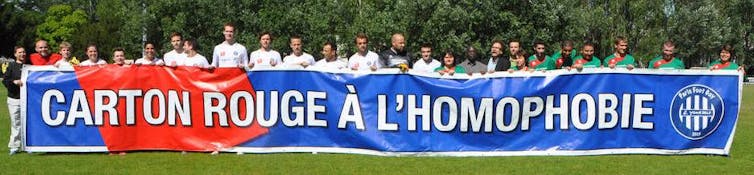
Paris Foot Gay/Wikipedia, CC BY

A Deeply Rooted Homophobic Culture
Ten years after Olivier Royer came out, no other professional soccer player in France has come out as gay.
Yet we are seeing a proliferation of rhetoric and initiatives aimed at “combating homophobia.” Despite the growing number of official positions, put forward as part of carefully orchestrated communication campaigns, something persists nonetheless, because it belongs more to the realm of the unofficial and to what is conveyed through small, everyday gestures—in short, to a culture.
Homophobic attitudes are rarely openly acknowledged. Of course, some people do make that mistake from time to time.
In October 2009, this was the case with the Créteil Bébel club, which, on the eve of a match against PFG, sent an email explaining why it refused to participate in the game:
“We’re sorry, but given your team’s name and in accordance with the principles of our team—which is made up of practicing Muslims—we cannot play against you. Our beliefs are far more important than a simple soccer game. Once again, please accept our apologies for notifying you so late.”
The national media and elected officials quickly seized on the case, pointing to it as an example of the “rise of communitarianism.” Vilified, the club eventually made amends… Did it not make the mistake of writing—or stating too clearly—a sense of discomfort and rejection that is usually expressed in less explicit ways?
Also in 2009, Louis Nicollin, president of Montpellier Hérault Sport Club, found himself in the spotlight. On October 31, 2009, following the12th matchday of Ligue 1, he called Auxerre player Benoît Pedretti a “little faggot” in a TV interview. A penalty was imposed on Nicollin, who was well known for his verbal “slip-ups.” He admitted to a regrettable communication error, attributing it to his outspokenness, and an apology followed.
"Faggot shot"
Yet homosexuality is far from absent from soccer fields. What is striking, above all, is the disconnect between its imagined ubiquity and its invisibility in reality. It thus casts a heavy shadow, insidiously established as a counter-model.
Its specter always looms as a negative force. “Faggot,” “asshole,” and “queer” inevitably characterize the other, the opponent, the one who botches a technical move (a “faggot shot”); in short, the one who fails or those who are a bore (watching a “faggot game”).
The insult is repeated over and over again, out of sheer habit. When addressed, the person uttering it has, on the face of it, no sexual ulterior motive. It is simply a matter of describing the evil; in short, of subscribing to the collective designation of a negative value.
The sexuality of the person being insulted is not really being called into question. Their heterosexuality is a cultural given, just like that of the other participants.
A way of subtly conveying what “soccer players” are supposed to be. A way, therefore, of reminding people not only of the values shared within the soccer community, but also of the sexual orientation that is supposed to define them.
 Thus, soccer—as a media fiction governed by unofficial rules, with its characters and scripts, and its players-as-performers who attempt—more or less in vain—to “control their image”—leaves little or no room for narratives that deviate from the “norm.”
Sylvain Ferez, Associate Professor of Sociology, University of Montpellier
The original version of this article was published on The Conversation.