A First Launch for EasyCov
On November 28, the French National Authority for Health (HAS) issued a positive opinion regarding the use and reimbursement of the rapid SARS-CoV-2 detection test developed by Sys2Diag, a joint CNRS/Alcen laboratory based in Montpellier. Its use is currently subject to certain conditions: only symptomatic patients for whom a nasopharyngeal swab is impossible or difficult may use it. And any positive result must be confirmed by a standard PCR test. The test’s developers have expressed mixed reactions…
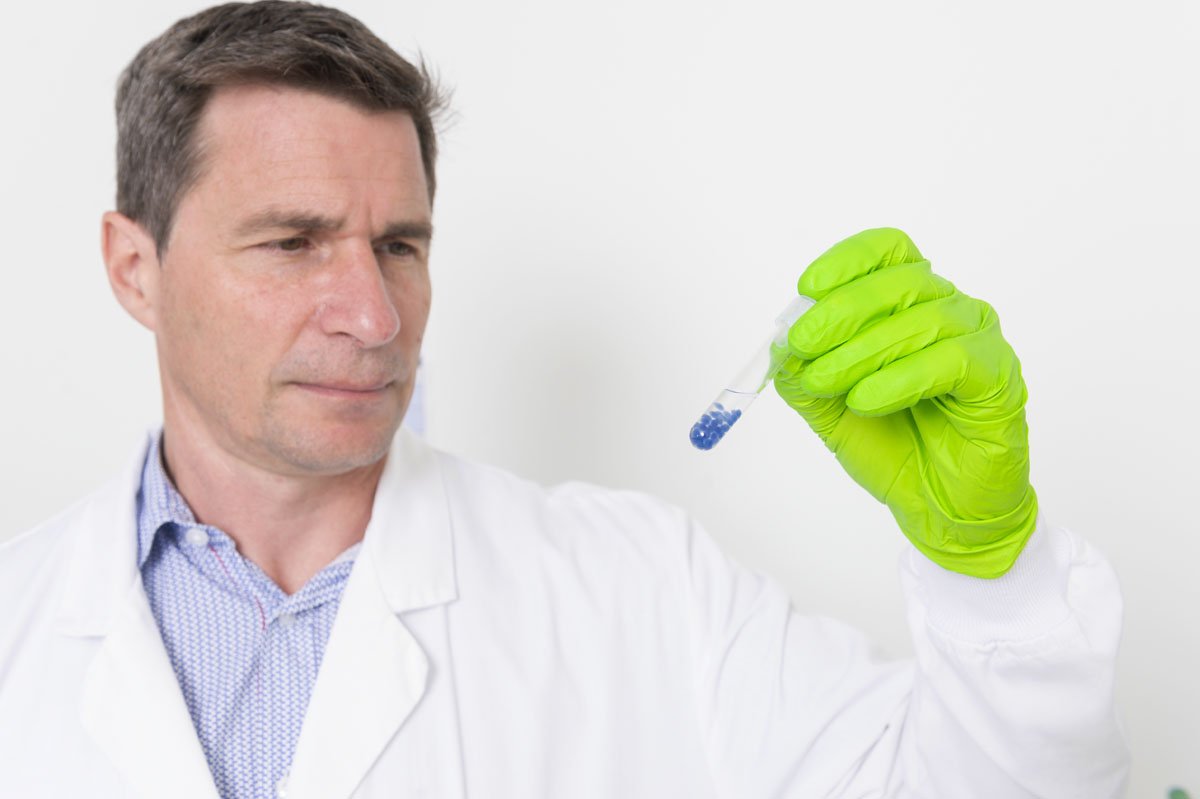
Worried you might have SARS-CoV-2? It would be so easy if you could just take a simple saliva sample and get your test results in as little as 40 minutes. Such a test exists, and it’s called EasyCov. Hundreds of thousands of units have been sold abroad over the past several months… but not in France. And yet, ironically, it was actually in Montpellier that this device was designed. Certified with the“European Conformity”mark last June, its rollout in France had until now been pending approval from the French National Authority for Health (HAS).
Use restricted by the HAS
In an interview on November 26—the day the HAS verdict was expected—Franck Molina, a CNRS researcher at Sys2Diag, was certainly eager but confident:“The clinical study conducted with the university hospital is unequivocal and demonstrates the test’s extremely good performance. The High Authority is doing a remarkable job, but we would have liked to roll it out sooner to tackle the second wave.”
On November 28, however, scientists in Montpellier expressed a more nuanced sense of satisfaction. While the HAS did issue a positive opinion on the use and reimbursementof EasyCov—“which is already a major step,” notes Franck Molina—it limits its use to symptomatic patients for whom a nasopharyngeal swab is impossible or difficult to perform, and requires confirmation via an RT-PCR test in the event of a positive result. This restriction therefore currently limits the usefulness of this rapid saliva test,“but we’re already working with the HAS to expand its use,” the researcher adds.
40 minutes from sample collection to diagnosis…
EasyCov is a PCR test similar to the standard tests currently in use, known as RT-PCR, but it differs radically from them thanks to a technology called LAMP-PCR, which offers numerous advantages. First of all, the sample is collected from saliva rather than the nasopharynx:“It’s a self-collection test, which is simpler and well accepted by the public. “You can take this test as many times as you like, and that makes life easier for healthcare workers,” explains Franck Molina.
The analysis is also greatly simplified. There is no longer a need for laboratories or machines; the virus extraction and purification steps—which are necessary for its amplification in RT-PCR—are replaced here by a simple heating process.“The test is carried out in two steps: heating to 80° for ten minutes, followed by a second heating to 65° for 30 minutes, which allows the virus to be amplified using LAMP technology. The test uses very few enzymes and almost none of the supplies that are so hard to find during a crisis,” the researcher continues. Few supplies are required, resulting in a very low cost.
Finally, the test result is delivered immediately via an app developed in partnership with the Montpellier-based company Vogo.“The app provides real-time results using a color-coded system: yellow for a positive result, brick orange for a negative result. The result is immediately transmitted to the relevant authority: the Regional Health Agency (ARS), a doctor, airport authorities, a sports club’s medical staff…,” concludes Franck Molina. And here again, the time savings for healthcare staff are considerable.
One study, but two different interpretations
The EasyCov test therefore checks all the boxes for addressing the challenges posed by this global crisis, such as product availability, large-scale deployment with high social acceptance, and a cost that is low enough for society. Better yet, it is also reportedly more reliable than conventional RT-PCR, according to a clinical study conducted by Professor Jacques Reynes’s team at Montpellier University Hospital on more than 500 patients, including 450 drive-through patients in real-world settings.“This is interesting because we tested it in real-world conditions. These patients were tested using the EasyCov saliva test, as well as the RT-PCR method on nasopharyngeal and saliva samples,” explains Franck Molina.
And the results are unequivocal for the researchers in Montpellier, since, according to them,“the EasyCov test detects 88% of infected patients, compared with less than 70% for the nasopharyngeal RT-PCR test. It has a specificity of over 99%, meaning fewer than 1% false positives.” And that’s precisely where the problem lies. Based on the same study, the HAS, for its part, concludes that the specificity is 92%.
Why such a difference? Because the HAS considers only the nasopharyngeal PCR test to be reliable. In other words, if a patient tests positive on the EasyCov test and the laboratory-based salivary RT-PCR test but negative on the nasopharyngeal RT-PCR test, the HAS considers the first two results to be false positives, resulting in a lower specificity rate.
A Community Adventure in Montpellier
Pending further guidance, Franck Molina’s team continues to move forward in consultation with the HAS. The researcher remains optimistic:“Under normal circumstances, it would have taken several years to develop and bring such a test to market. We’ve been working seven days a week and nearly 24 hours a day to speed up the process and respond to the emergency.” All of this took place amid the challenges posed by the first lockdown, which nevertheless did not prevent many stakeholders from answering the call from the Sys2Diag laboratory. Public partners such as the Infectious Diseases Department at Montpellier University Hospital (CHU),the Montpellier Institute for Infectious Disease Research (IRIM) located on the CNRS campus, the DNA and oligonucleotide synthesis platform at theUM, and Monsef Benkirane’s team atthe Institute of Human Genetics (IGH). But also private companies such as Vogo and numerous local and regional laboratories.“It’s not just Sys2Diag—it’s a Montpellier-wide effort. We went through a human journey that we hope never to repeat, but one that left a lasting impression on us both individually and collectively,” concludes Franck Molina. An endeavor recognized with the MUSE Innovation Award.