[LUM#12] A Strategist Named Zika
What do Odysseus and the Zika virus have in common? Cunning! Like the hero of the *Odyssey*, Zika uses the so-called “Trojan horse” strategy to deceive and attack its host’s brain. A myth brought to life in a test tube, revealed bythe Montpellier Institute for Infectious Disease Research and published in the journal *Nature Communications*.
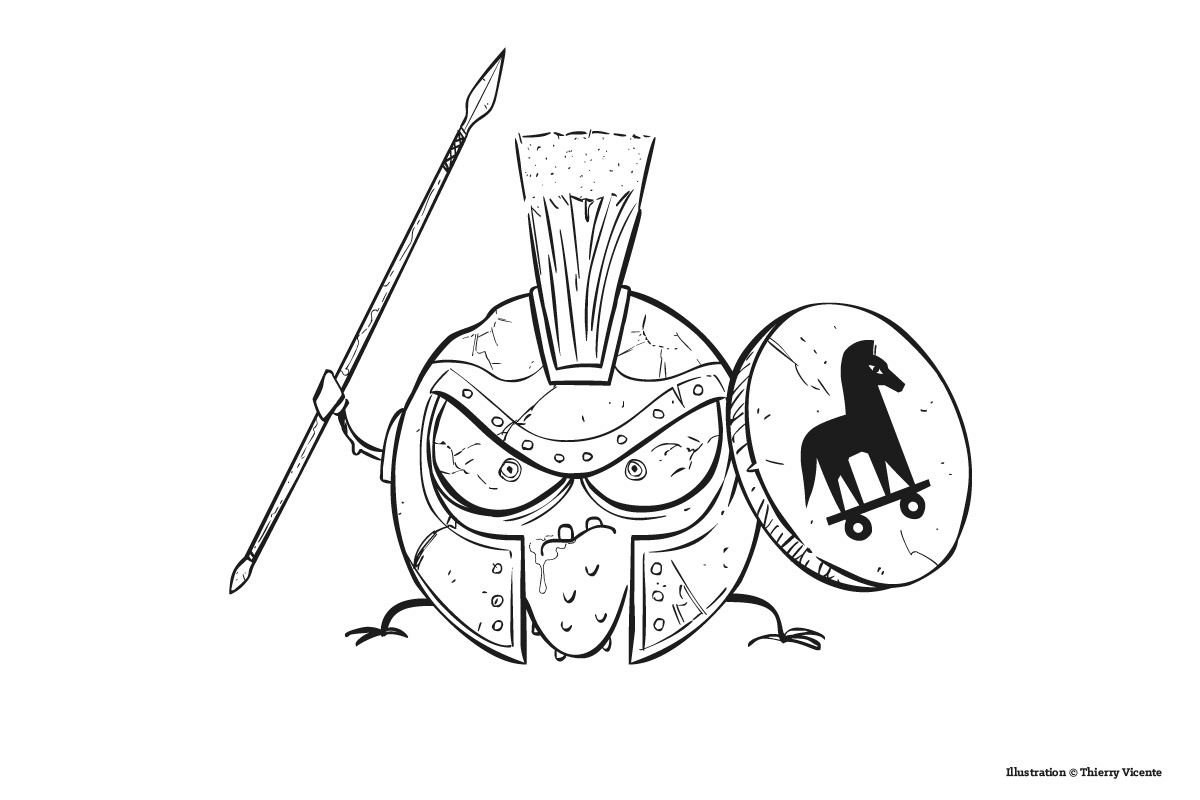
The brain is a fortress that the human body works to defend against any external intrusion through what is known as the blood-brain barrier. “It consists of an army of cells ‘connected to one another by junctions so tight that not even water or blood can pass through,’ explains Raphaël Gaudin, a virologist atthe Montpellier Institute for Infectious Disease Research. ‘And a virus is, after all, much larger than a water molecule!’”
Trojan Horse
And yet, it must be acknowledged that some of them have no qualms about invading our brains. Among these unwelcome invaders is the Zika virus. “This process of Zika migrating to the brain had already been observed, but its mechanism of action remained a mystery to researchers,” explains the biologist. While the Trojan horse strategy has been known to virologists since the 1980s, Raphaël Gaudin and his team were the first to test this scenario in vivo using Zika and a subtype of white blood cells called monocytes.
Two types of experiments were thus conducted. First, human monocytes infected with the Zika virus were injected into zebrafish embryos, a popular animal model in biology due to their near-transparency. “We used a genetically modified strain of fish in which the cells of their blood vessels express GFP—in other words, so that they turn green—and we tracked the virus’s path through the fish’s blood vessels in real time and in 3D.” The researchers were thus able to observe that infected monocytes migrated to the brain more rapidly than healthy cells.
Achilles' heel
This line of research was continued in vitro. Raphaël Gaudin’s team collaborated with a Dutch laboratory specializing in the creation of brain organoids—“mini-brains”—produced from embryonic stem cells. “These organoids were placed beneath a blood-brain barrier, over which we introduced infected monocytes, healthy monocytes, and free virus.” Once again, the researchers observed greater dissemination of the virus throughout the brain by the infected monocytes.
A promising discovery that could well become Zika’s Achilles’ heel and pave the way for new therapeutic applications to combat the virus, because while the virus is asymptomatic in adults in 85% of cases, it can very rarely cause Guillain-Barré syndrome or even severe encephalitis. “More recently, a study indicated that the virus may be responsible, in monkeys, for certain alterations in the brain connections involved in emotional and sexual behaviors,” adds the researcher.
A breadcrumb trail against cancer?
Raphaël Gaudin’s team is now focused on understanding the mechanisms involved in Zika infection of monocytes. The researchers have observed that the virus acts inside the white blood cell to alter the molecules responsible for adhesion. “When we observe how a healthy monocyte and an infected monocyte adhere to the cells of the blood vessels into which they want to migrate, we see that the infected monocyte spreads out much more. This has enormous implications!”
“Understanding this phenomenon could not only help inhibit the migration of infected monocytes but, beyond Zika, ‘trigger monocyte migration when necessary, ’ enthuses Raphaël Gaudin. Better yet: ‘We could understand—and perhaps influence—the migration of metastases!’” The Zika study would then become a new lead in the fight against cancer.
Zika: Far from a Myth…
The Zika virus was discovered in the Zika Forest in Uganda in 1947. It came to the attention of the general public between 2015 and 2016 when it caused a massive outbreak in several states in northeastern Brazil. The virus is primarily transmitted through the bite of an Aedes mosquito, as well as through sexual contact and blood transfusions. While Zika symptoms are generally mild in adults, transmission from a pregnant woman to her fetus can cause severe brain malformations in newborns, including microcephaly. In 2019, the WHO noted that 87 countries were still affected by Zika. In France that same year, the first two cases of locally acquired infection were reported in the Var department.
Check out theUM podcasts, now available on your favorite platform (Spotify, Deezer, Apple Podcasts, Amazon Music, etc.).