A conference on the topic “Water Resources: A Global Issue, an Issue for the Century?” as part of the “Rendez-vous de l’éco” series at the University of Montpellier
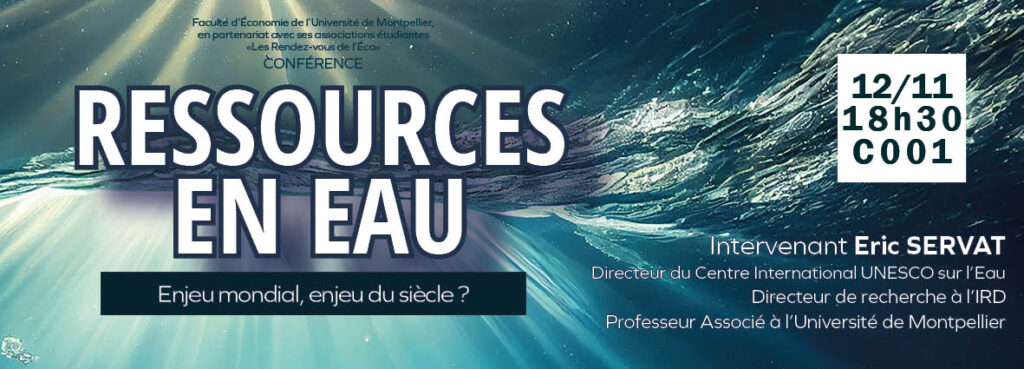
As part of the “Rendez-vous de l’éco” series, the University of Montpellier’s School of Economics, in partnership with its student associations, is organizing a conference on the topic: “Water Resources: A Global Challenge, a Challenge for the Century?” on Tuesday, November 12, 2024, starting at 6:30 p.m., at the School of Economics’ Richter Campus.
Why this conference?
Today, more than ever, the issue of water is a universal and multifaceted topic. And its importance will only grow in the years and decades to come, particularly as a result of climate change, population growth, and inevitable urbanization—all of which have the potential to generate risks, disasters, economic and/or social difficulties, as well as tensions or conflicts across the globe. How, then, can we integrate and address the fact that the existing responses and solutions to these multifaceted crises must be implemented locally and require, everywhere, a reevaluation of certain elements and foundations of how our human societies function?
Speakers:
- Éric SERVAT: Director of the UNESCO International Center for Interdisciplinary Research on Water Systems Dynamics (ICIREWARD) in Montpellier, research director at the IRD, and associate professor at the University of Montpellier. He served as director of the Montpellier Observatory of Universe Sciences (OSU) from 2015 to 2024. Éric Servat is a hydrologist by training. He has taken a keen interest in the relationship between global changes and water resources, first in Africa and later in the Mediterranean region as well. He has coordinated and led numerous international programs, notably through a partnership with UNESCO’s Intergovernmental Hydrological Program and its flagship “FRIEND-Water” program, which brings together more than 160 countries across all continents. He was recently appointed (July 2024) chair of the French National Committee for UNESCO’s Intergovernmental Hydrological Program.
Practical Information:
- Date: Tuesday, November 12, at 6:30 p.m.
- Location: School of Economics, Richter Campus, Lecture Hall C001
- Registration is required
- Learn more