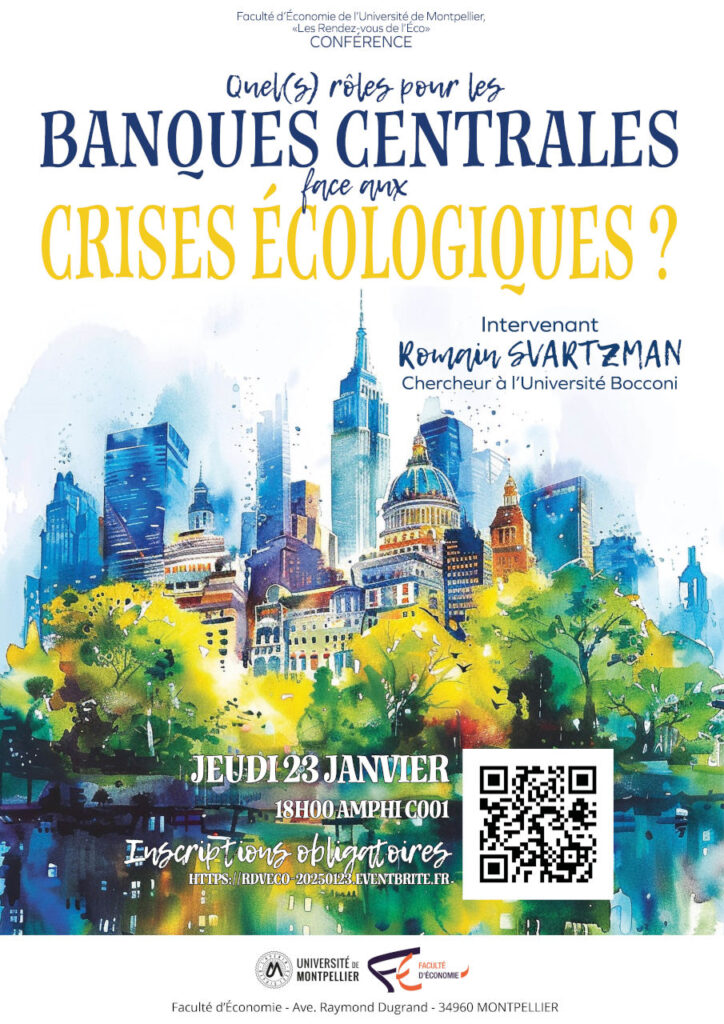
A conference on the topic “What role(s) should central banks play in addressing environmental crises?” as part of the “Rendez-vous de l’éco” series at the University of Montpellier
As part of the “Rendez-vous de l’Eco” series, the Faculty of Economics at the University of Montpellier is organizing a conference on the theme: “What Role(s) Should Central Banks Play in Addressing Ecological Crises?” on Thursday, January 23, 2025, starting at 6:00 p.m., at the Richter Campus of the Faculty of Economics.
Why this conference?
What roles can and should central banks and financial supervisory authorities play in the green transition? This question, which was almost entirely absent from academic and political debates until the late 2010s, has gained prominence in recent years. The numerous academic articles and public policy proposals that have emerged on this topic can be classified into two categories: (i) a risk-based approach that aims to integrate climate and nature considerations into the day-to-day operations of central banks, without calling into question their current mandates and practices; (ii) a proactive approach that seeks to harness central banks to support the transition, highlighting their ability to redirect financial flows.
Both of these approaches appear to face significant limitations. In particular, the scenarios (implicit or explicit) underlying existing studies often overlook issues that are crucial for central banks, such as: the ability of different transition scenarios to generate GDP growth and opportunities for capital accumulation; the fact that the transition will likely take place in a world where physical shocks are becoming more frequent, which could exacerbate phenomena such as profit-price spirals; the new geoeconomic reality in which high-income countries may not be the leaders in “green” technologies, leading to a major reconfiguration of trade and capital flows, which could in turn have a significant impact on the role of central banks (for example, what will be the new global reserve currency?).
Assessing the role of central banks and financial regulators in the ecological transition therefore requires an interdisciplinary approach, combining a political economy perspective on money and finance with socio-technical perspectives on what the transition might actually look like. This presentation will aim to propose various (non-exhaustive) approaches for developing this agenda.
Speakers
Romain Svartzman is a researcher at Bocconi University (at the Institute for European Policymaking) and a research associate at the Institute for Innovation and Public Purpose (IIPP, University College London). His research focuses on developing scenarios for ecological transition and assessing their macrofinancial implications, as well as on potential reforms to the international monetary and financial architecture. Romain previously worked as a senior economist at the Banque de France. He earned his Ph.D. in ecological macroeconomics from McGill University (Canada). He has conducted research across all continents. He was recently appointed (July 2024) Chair of the French National Committee for UNESCO’s Intergovernmental Hydrological Program.
Practical Information
- Date: Thursday, January 23, 6:00 p.m.
- Location: School of Economics, Richter Campus, Lecture Hall C001
- Registration is required
- Learn more