A Partnership Agreement on Environmental Health
On Wednesday, October 25, the City of Montpellier, Montpellier Méditerranée Métropole, and the major national organizations based in the region1, the University of Montpellier, the University of Montpellier Paul-Valéry, the EPHE, the Institut Agro, EID Méditerranée, and the Montpellier University Hospital signed a groundbreaking partnership agreement titled “Health Ecology 2023–2030” to incorporate integrated approaches to health—such as the OneHealth approach—into public policy. This agreement establishes a consortium for reflection, action, and research on shared themes to guide and enrich local governments’ “environmental health” policies.
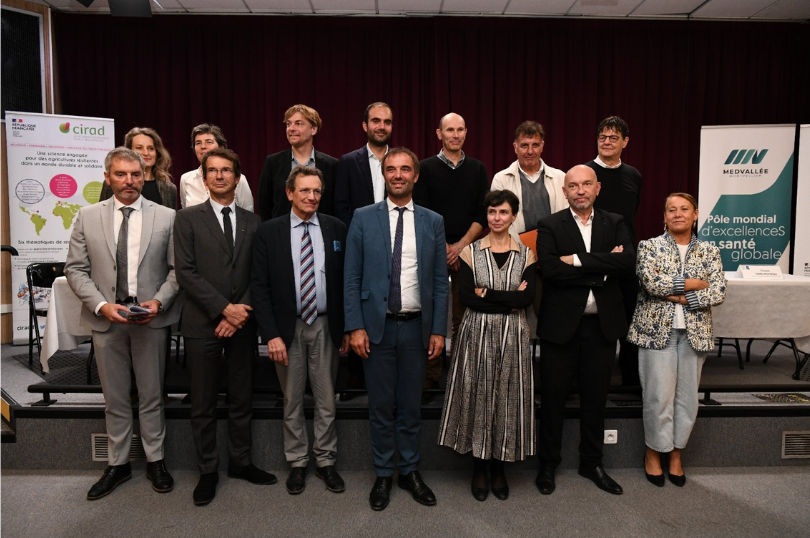
This partnership agreement, which will run for 7 years (2023–2030), is organized around nine key areas:
1. Accelerate the transfer of exposome research to better understand—and thus better prevent—diseases linked to environmental damage,
2. Study the ecological resilience of ecosystems to better understand and prevent environmental degradation and the factors contributing to the emergence of infectious diseases and zoonoses,
3. Monitor the ecology and evolution of hosts, reservoirs, vectors, and pathogens to assess risks and develop strategies for prevention, surveillance, and control,
4. Assess the links between management, design, and planning practices related to urban (re)vegetation or the evolution of peri-urban agroecological practices and vector-borne risks,
5. Experiment with new tools and strategies to adopt a sustainable and integrated approach to vector and vector-borne disease risk management at the regional level,
6. Assess, monitor, and prevent the health impacts of species that may cause damage, non-native species, invasive alien species, and plant pathogens using methods consistent with environmental conservation,
7. Identify, promote, and share awareness-raising tools with all stakeholders and audiences to improve public understanding of environmental health and the prevention of risks related to the environment and biodiversity loss,
8. Accelerate the contribution of the social sciences to environmental health within open science and participatory science research projects, in conjunction with “living labs” initiatives that invite citizens, residents, and users to play an active role in research, innovation, and changes in practices,
9. Propose concrete measures to the City of Montpellier and the Montpellier Metropolitan Area to evolve the legal frameworks governing urban planning, citizenship, and urban environmental management.
- Signatories: Montpellier Méditerranée Métropole, City of Montpellier, CNRS, CIRAD, IRD, INRAE, University of Montpellier, Paul-Valéry University – Montpellier 3, EPHE, Institut Agro, EID Méditerranée, Inserm, EFS, Montpellier University Hospital ↩︎