A membrane made of nanoporous hybrid materials for natural gas upgrading
A Franco-Saudi consortium comprising researchers from the Charles Gerhardt Institute in Montpellier (University of Montpellier/CNRS/ENSCM) and the Centerfor Research , Advanced Membranes and Porous Materials (KAUST) has developed a new crystalline porous hybrid material that, when formed into a membrane, purifies natural gas by selectively capturing not only nitrogen but also carbon dioxide relative to methane with exceptional selectivity and permeability. Published in the journal *Nature* on June 23, 2022, this research paves the way for more efficient industrial processes for purifying natural gas and biogas.
In the current energy landscape, the processing of natural gas—which accounts for more than 25% of the world’s energy sources—is of major importance for its use in residential and industrial applications. Natural gas sources, which are primarily contaminated with nitrogen and carbon dioxide, are currently purified on an industrial scale using energy-intensive cryogenic distillation processes that represent a significant economic cost in the exploitation of this energy source. It is therefore becoming urgent to explore alternative purification technologies that are more efficient and less costly.
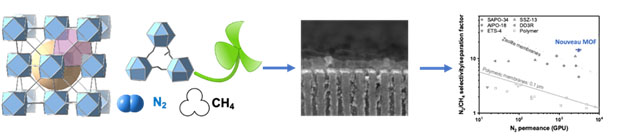
A French-Saudi consortium has developed a crystalline porous hybrid material, commonly known as a Metal-Organic Framework (MOF), formed by combining a metal oxide linked by an organic ligand, capable of selectively binding nitrogen over methane. This solid features nanoscale cages accessible through triangular windows, the size and shape of which have been engineered to allow the passage of nitrogen—a linear molecule—while preventing access by methane, a spherical molecule.
This new material was processed into a membrane that achieved exceptional separation efficiency and permeability for nitrogen relative to methane compared to other polymeric and zeolite membranes tested to date under actual operating conditions. This process results in reductions in methane purification costs of more than 70% compared to the cryogenic processes commonly used in the industry.
Suitable for the selective capture of other contaminants such as carbon dioxide, the design of this new membrane—the result of synergy among complementary disciplines (molecular modeling, materials development, membrane fabrication, and performance testing)—opens up new prospects on an industrial scale for the utilization of natural gas and biogas. And beyond that, it could well revolutionize the field of gas purification, which poses major challenges in the energy and environmental sectors (improving air quality, producing pure hydrogen, etc.).