Universities and the Pandemic: What Impact on Higher Education?
Reflecting on the impact of the pandemic on higher education to better support the university’s transformation process. That was the focus of the online symposium organized by theUM on September 22, which brought together more than 40 experts virtually.
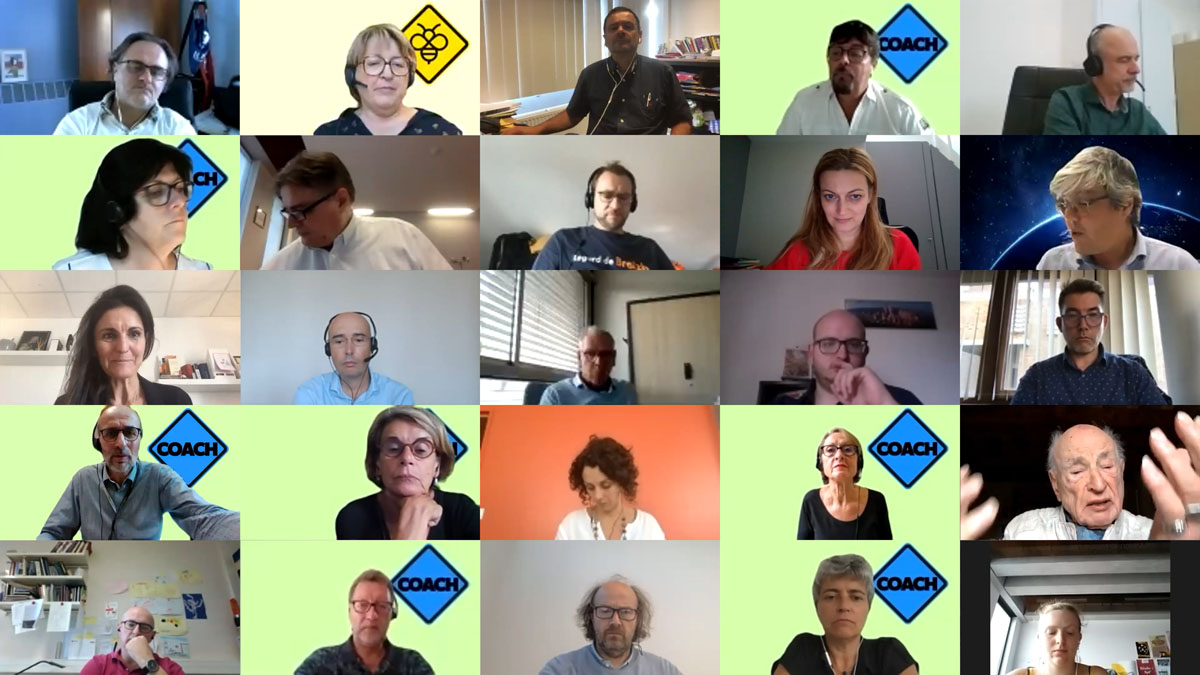
While the pandemic and lockdown have brought their share of complications to our daily lives, they have also provided an opportunity for constructive reflection, as Brigitte Lundin so aptly illustrates. The director of the Center for Educational Innovation—i-Site MUSE—has indeed been able to channel this unprecedented experience into a broad reflection on the transformation of universities. This initiative was undertaken in collaboration with Sophie Guichard, director of the Fabrique numérique at the Conservatoire national des arts et métiers (CNAM), and Thierry Sobanski, director of the digital campus at the Catholic University of Lille.
Squaring the Circle
Deeply committed to educational innovation, these three colleagues conceived a symposium last spring to better examine the consequences and implications of the pandemic for higher education.“Higher education is often seen as built around the triangle of pedagogy, technology, and learning spaces, with students at the center. Our idea is to move students out of that center—to no longer work solely for them, but with them,”explains Brigitte Lundin.
The symposium, which brought together forty participants in a virtual space, was centered on this concept known as “squaring the circle.” Experts, higher education professionals, and students were thus able to exchange ideas during the various workshops offered.“To ensure open dialogue and sincere exchanges, it was essential for us that the discussions take place in a non-hierarchical setting,” emphasizes Brigitte Lundin.
From Consequences to Questions
A series of discussions opened by sociologist and leading thinker on complexity Edgar Morin, who, in his opening address, offered food for thought on how to better understand the university’s role. He called for a fight against unilateralism, oversimplification, and dogmatism, while also advocating for a fundamentally multidisciplinary university:“We have before us an excellent opportunity to confront a complex reality. This word does not mean ‘complicated’; it means a reality that contains connections and interactions between factors that may be biological, social, ecological, psychological, religious, and so on.”
The workshop discussions thus highlighted some of the pandemic’s impacts on higher education: the importance of universities’ role in society, the need to rethink time, pace, and spaces as well as forms and models of assessment…“Viewing uncertainty and the unknown as opportunities for learning, fostering interdisciplinary communities, and making pedagogical transformation a shared resource—all of these aspects are now essential to shaping the future of education,” explains Brigitte Lundin.
“It is the synergy of all our experiences that will enable us to learn and continue moving forward.” This is, therefore, an ongoing process that deeply challenges our institution by placing long-term co-creation at the heart of our reflection, along with the financial, cultural, and regulatory obstacles we must overcome so that the university can fully occupy its rightful place and play a role throughout our lives. These are all avenues for future discussion.
A top-notch cast
Among the forty or so experts who made up the impressive lineup for this symposium were, among others: Anne Sophie Barthez, Director General of Higher Education and Professional Integration at the Ministry of Higher Education, Research, and Innovation (ESRI); François Taddei, Director of the Paris Center for Interdisciplinary Research; Jean-Charles Cailliez, Vice President for Innovation and Development atthe Catholic University of Lille; and Benoît Raucent, President of the Louvain Learning Lab.
Many representatives from theUM , of course, took part in this event, including: David Cassagne, Vice President for Digital Technology in Education; Jean Patrick Respaut, Vice President for Education and Student Life; Alexis Vandeventer, Student Vice President; and Michel Mondain, Dean of the Faculty of Medicine. The Faculty of Education, SupAgro,ENSCM, and the directors of the IUTs were also involved in this major discussion, alongside students from Caen, Montpellier, and Paris.