Would you like a sixth finger?
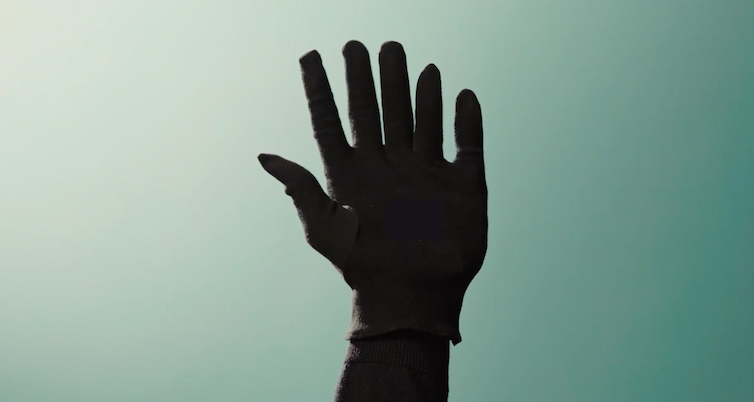
Have you noticed what sets this hand apart from the ones you usually see? Go ahead and count the number of fingers…
Ganesh Gowrishankar, University of Montpellier
The hand is equipped with a robotic “artificial sixth finger” that we developed in collaboration with Professor Yoichi Miyawaki of the Tokyo University of Electro-Communications in Japan.
Users can control this sixth finger independently of their other fingers. In fact, using an algorithm, we can isolate the portion of forearm muscle activity that does not contribute to our normal finger movements and use that signal to control the robotic finger.
It is also equipped with a “haptic” sensor (referring to the sense of touch): this sensor detects what a finger would feel and calculates “haptic feedback”—that is, slight deformations applied to the palm of the hand that generate tactile sensations.
Users can operate this extra limb with minimal training—for many people, after less than an hour of use. Great for playing the piano!
We are thus studying how our bodies react to new limbs—this is also necessary when the body has to adapt to a prosthesis, for example.
When the Representation of the Body Changes
Through behavioral and brain imaging experiments, our research focuses on how the user’s brain “adopts” the sixth finger. Changes in users’ body perception occur very quickly.
More specifically, we asked users to touch a target line with their own little finger (without seeing their fingers), and this experiment showed that users actually become uncertain about the location of their own little finger in space.
We are currently continuing these studies to directly observe potential changes in brain activity in users, usingfunctional magnetic resonance imaging, related to the representation of their robotic sixth finger. For example, we may seek to determine which areas of the brain “activate” when the user moves the finger.
In neuroscience, the “embodiment” of a limb refers to the human brain’s ability to “accept” that foreign limb and believe that it is part of its body—in French, this is referred to as “incarnation.”
Another striking example is the“rubber hand illusion,” in which a participant fears that someone will tap their hand even though their “real” arm is elsewhere.
The human brain can adapt to foreign limbs
This example and other scientific studies conducted over the past few decades—including our own—have shown that it is actually quite easy to trick our brains into believing that artificial limbs are part of our bodies: the brain is highly adaptable and flexible in terms of what it defines and accepts as our body.
This flexibility is very useful, because the human body changes as we grow and age. Physical changes can also result from accidents or paralysis, to which we are potentially able to adapt.
This concept of “embodiment” is also what allows us to accept prosthetics to replace or supplement lost functions.
Are there limits to accepting a new member?
Through our research on supernumerary limbs, such as the sixth finger, we are exploring the limits of this acceptance. Is it possible to add new limbs to our natural body? And can we still perceive the added limbs as part of our body?
Several previous studies have attempted to answer this question by attaching additional artificial limbs—such as robotic fingers, arms, and a virtual tail —to humans.
However, all of these attempts have relied on “limb replacement,” in which the added limb is driven by the movements of an existing limb, and all haptic feedback on the added limb is fed back to the existing limb—effectively replacing that existing limb with a new artificial limb.
In our study, we are investigating whether our brain can accept an additional, truly independent limb—one that can be moved independently of any other limb and from which we can receive haptic feedback independent of any other limb. It would appear that it can.
Thus, from an applied perspective, our findings—namely, that our brains can accept additional limbs—are encouraging for the future development of wearable prosthetic limbs.
Ganesh Gowrishankar, Researcher at the Montpellier Laboratory of Computer Science, Robotics, and Microelectronics, University of Montpellier
This article is republished from The Conversation under a Creative Commons license. Readthe original article.