Water4Future Hackathon: Solutions That Flow Naturally
One hundred forty high school students from three continents participated in the Water4Future Hackathon on March 18, 19, and 21. Organized by the UNESCO Icireward International Center and the University of Montpellier, this fifth edition focused on the theme “Water, Crises, and Resilience.” The Samuel Beckett International French High School in Ireland took first place, while the Madelaine Daniélou School Group in Côte d’Ivoire and the Jules Guesde High School in Montpellier were the standout favorites of the 2024 edition.
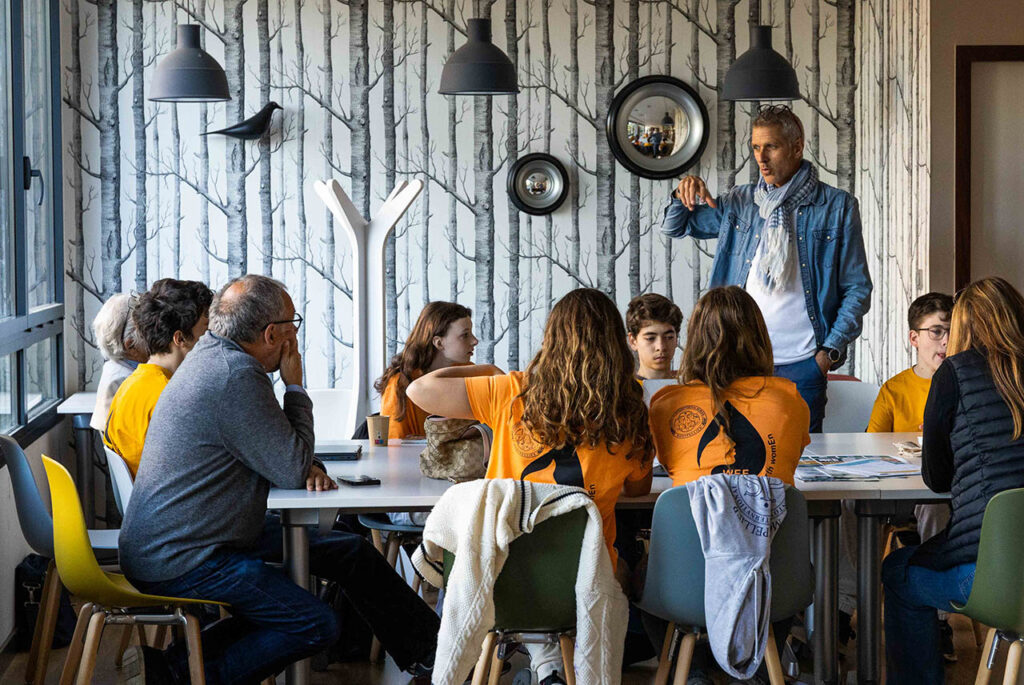
What if it were possible to take inspiration from a beetle living in the desert to capture fog and turn it into drinking water; to sell or buy treated wastewater at competitive prices on a new secondhand water market platform; or even to directly treat river water in a village in Côte d’Ivoire so its residents wouldn’t have to boil it every time? These three ideas didn’t come from a science-fiction movie but from the brilliant minds of the high school students who won this fifth edition of the Water4Future High School Hackathon.
Exactly 48 hours
There were 140 participants at the starting line, ready to take on the challenge from their locations in Europe (Montpellier, Castelnau-le-Lez, Perpignan, Marseille, Réunion Island, Germany, Ireland), Africa (Morocco, Senegal, Ivory Coast), North America (United States), and South America (Bolivia). Their mission? To devise, in exactly 48 hours, sustainable technical, regulatory, and/or social solutions to water-related issues at the local and international levels. Difficulties in accessing drinking water, early-onset droughts, water restrictions, extreme high water, and flooding… The issue of water is now critical on every continent and represents a major challenge today and for future generations.
To tackle this challenge, high school students worked simultaneously—either in person or via video conference—to develop innovative projects. The various teams were guided throughout the process by professionals and experts in the field. At the end of the 48 hours, the students presented their solutions to a panel of judges who selected the best projects for awards.
Six awards
First prize was awarded to the Samuel Beckett International French High School in Ireland for its project inspired by the beetle. Second prize went to the Französisches Gymnasium, the French high school in Berlin, which developed a community-focused app to request or offer help in the event of a flood. The Françoise Combes School Complex in France also devised a solution to flooding: small polymer beads capable of absorbing water and releasing it over the following two weeks. They won third prize. Finally, the two “Coup de cœur” awards went to the Lycée Jules Guesde in Montpellier for its secondhand water marketplace platform and to the Madelaine Daniélou School Complex in Côte d’Ivoire for its water treatment system directly connected to the river in a village located in northern Côte d’Ivoire. See you next year—here’s hoping the water keeps flowing.
The UNESCO Icireward Center
The UNESCO ICIREWARD International Center (International Center for Interdisciplinary Research on Water Systems Dynamics), located in Montpellier, brings together and strengthens collaboration among nearly 480 scientists and 180 doctoral students across 17 research laboratories. The center’s scientific community thus forms a rich, multidisciplinary, and international network dedicated to improving our understanding of water-related issues. Its research areas combine hydrological, chemical, and biological sciences with the social sciences to provide comprehensive expertise in addressing water resource challenges, including water availability, quality, equitable distribution, and extreme events (floods, droughts). ICIREWARD works year-round with elementary and middle school students, high school students, college students, and the general public (through the Water4Future program, PLOUF, and on Friday, March 29—awareness-raising workshops for schoolchildren as part of World Water Day 2024).