Georges Frêche, one Monday in Lecture Hall A
On October 22 of this year, the University of Montpellier—and the School of Law and Political Science in particular—paid tribute to Professor Georges Frêche, who passed away ten years ago. Here’s a look back at the career of an extraordinary academic and political figure who didn’t wait for posterity to build his own legend.
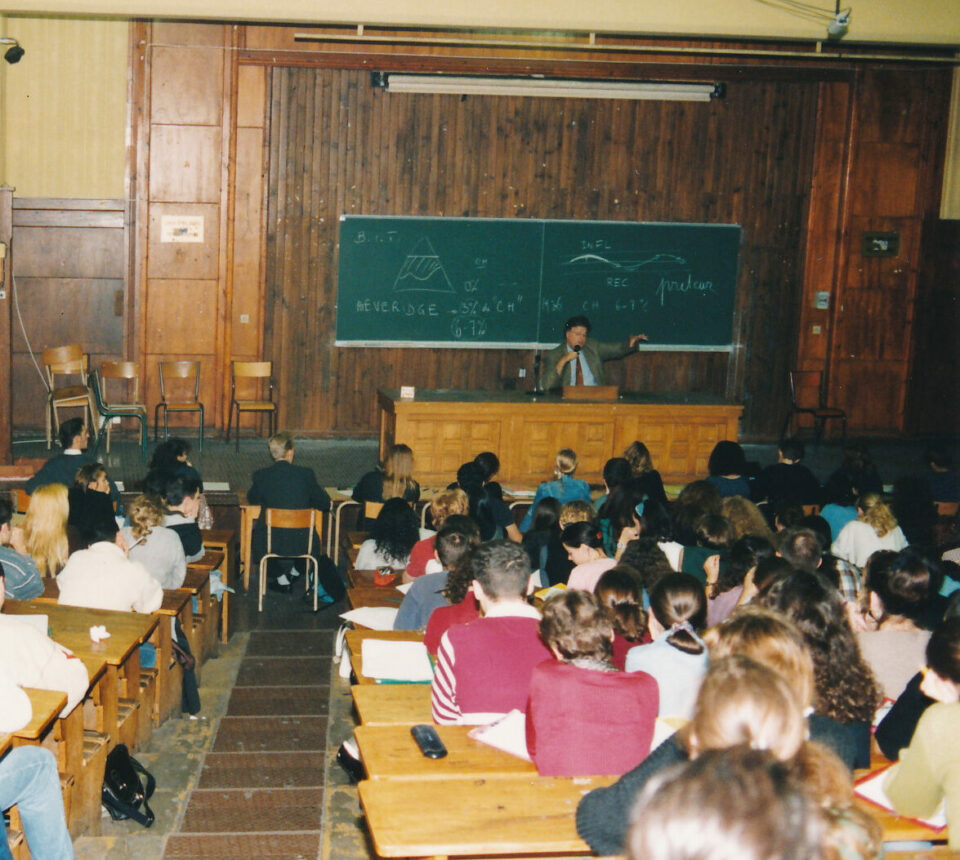
“I was his student; it was the late 1970s, and it was a golden age,” recalls Claude Cougnenc, president ofthe Association of Friends of Georges Frêche. “Our relationship with him was very direct. In the lecture hall, we would challenge him directly; there was some friction because he had a hard time accepting dissent.” That friction did not prevent the professor from drawing his student into a political adventure that would last more than thirty years, making him his friend and most loyal collaborator.
Students, academic colleagues, political allies—and often all three at once—many of them gathered in the Salle des Actes on Thursday, October 22, to nostalgically recall Monday classes in Lecture Hall A. They were there less for their passion for the history of law than for the memory of a professor who was “out of the ordinary,” in the words of Michel Miaille, who taught alongside him in the 1980s and 1990s. “We’d write our questions on little notes that we’d pass from hand to hand, and Georges Frêche would answer, ” recalls Hussein Bourgi, now a senator from Hérault. “He tackled every social issue without taboos—condoms, abortion, secularism, the wearing of the veil…”
"There's nothing dumber than an expert."
Ten years later, Carine Jallamion—his former assistant and now associate dean of the School of Law—still speaks of those moments with emotion. “He would constantly tell us that a good student must know a little about everything. ‘There’s nothing dumber than a specialist,’ he used to say with a smile, in his colorful way of speaking. He didn’t like pure scholars who, in his eyes, had no practical experience.” He never missed an opportunity to demonstrate this during impromptu lectures on topics chosen by his students. “He loved to share his knowledge—he couldn’t help himself. He shared his worldview as both a mayor and a professor. He blended these two experiences without any political doublespeak.”
Without mincing words, but with a ferocity that none of his former students would dare to deny, “he liked to scare people a little and could tear you apart with a single sentence while still accepting a retort. He could even laugh it off,” the associate dean continued. Georges Frêche also embodied the art of never letting anyone else write his legend, “even if it meant telling us stories that were completely unbelievable but so funny. He told us he’d been a dancer at the Moulin Rouge with Line Renaud to pay for his studies! ” A bit of fantasy that in no way detracted from the talent of the man whom Professor Michel Miaille compares to a “modern Socrates who knew how to involve students in the construction of knowledge.”
“This university meant a great deal to him, and of all the ceremonies organized in his honor this year, this is the one Georges Frêche would have preferred,” adds Hussein Bourgi. “It was thanks to this university that he formed this loving bond with Montpellier. It was through this faculty that he met Claudine, his wife, and many of his political allies—Claude Cougnenc, Christine Lazerges, Paul Alliès—as well as his opponents, with Olivier Dugrip foremost among them.” The dean of the law school, Guylain Clamour—who at the time was an assistant to Dean Dugrip—has not forgotten the verbal sparring between the two rivals: “He was passionate and combative, and there were certainly battles […] but while these two men were largely at odds within this university and in politics, they both had the breadth of vision to treat one another with respect and consideration.”
“The Journey of an Unconventional Small-Town Guy”
A native of Puylaurens in the Tarn region, Georges Frêche had initially planned to make his mark in the city of Toulouse. He attended high school there and took preparatory classes at the Lycée Joffre in Montpellier before moving to Paris, where—in addition to an impeccable academic career—he would follow, in the words of Michel Miaille, “the path of an atypical provincial.” After being accepted into the prestigious École Pratique des Hautes Études, he went on to attend the renowned HEC in 1961, from which he retained “a taste for practical matters, business, and development.”
Turning his back on a promising career as a business executive, he began a dual degree program in law and history at the Sorbonne and the Paris Law School, from which he graduated with two doctorates in 1969. His time in Paris did nothing to diminish his regional roots, as his history dissertation focused on Puylaurens in Languedoc—a Huguenot town from the Edict of Nantes to the Hundred Days—and his law dissertation on Toulouse and the Midi-Pyrénées region during the Enlightenment. “Thus, the Parisian by adoption never ceased to be a Languedoc native in heart and spirit,” continues his former colleague.
A paradox that would define him throughout his life. A provincial figure of international renown who became a Knight of the Order of Academic Palms, a Commander of the German and Spanish Orders of Merit, and a recipient of the Hellenic National Order—not to mention his honorary doctorate from Kingston University. “Feet in the clay and head in the stars, as he liked to say. A professor of legal history who quoted Lao Tzu, a man of the Enlightenment who admired Machiavelli,” the professor concluded.
"Law and medicine: the two pillars of Montpellier"
Back in 1969. After adding a teaching certification in public law and political science to his impressive list of achievements, Georges Frêche accepted a position at the University of Toulouse. Politics had already entered the life of this young Maoist, and he would admit a few years later that he “chose that university because, even then, I wanted to run for mayor there.” However, he was ultimately denied the position in Toulouse, and in 1970 he secured the creation of a position in Montpellier—a city he would never leave.
Elected mayor only seven years later, he worked tirelessly to elevate Montpellier to the ranks of major cities. “For him, Montpellier had two pillars: law and medicine. That’s where the city’s international development had to begin,” explains Hussein Bourgi.
According to Philippe Augé, president of the University of Montpellier, “It was around knowledge that the visionary Georges Frêche built Montpellier’s development, and today we can only marvel at the balance and harmony with which he accomplished this. He promoted the development of medicine in the north—already planning the relocation of the medical school—the economy in the south with Richter, and the sciences in the west with the prospect of the Balard chemistry hub, which we inaugurated two years ago.”
After becoming regional president in 2004, Georges Frêche made the reunification of the universities one of his major projects, “at the cost of numerous clashes with university presidents,” recalls Philippe Augé. He was also the one who secured funding for “Operation Campus, ” “not because his project was better than the others, but because he didn’t hesitate to commit, promising 50 centimes for every euro the government would contribute. He was a great builder. ” Projects on a scale befitting him that never prevented him from returning to his Lecture Hall A every Monday. It was in the spring of 2007 that he gave his last lecture there. That day, Guylain Clamour, sitting at the back of a packed room, heard his words spoken in a voice trembling with emotion: “For years, because I was surrounded by young people, I thought I was young.”
News
Teacher Training: Emmanuel Macron Chooses Mende to Roll Out His Reform
Published on: September 11 , 2026
To mark the start of the school year, French President Emmanuel Macron,…