Guillaume Cassabois: Matter in Light
Thanks to his groundbreaking research on semiconductor nanostructures—and in particular on the physical properties of boron nitride—physicist Guillaume Cassabois of the Charles Coulomb Laboratory atUM just been awarded the 2025 Jean Ricard Grand Prize by the French Physical Society. While the award recognizes an individual achievement, the researcher emphasizes the importance of teamwork throughout his research.
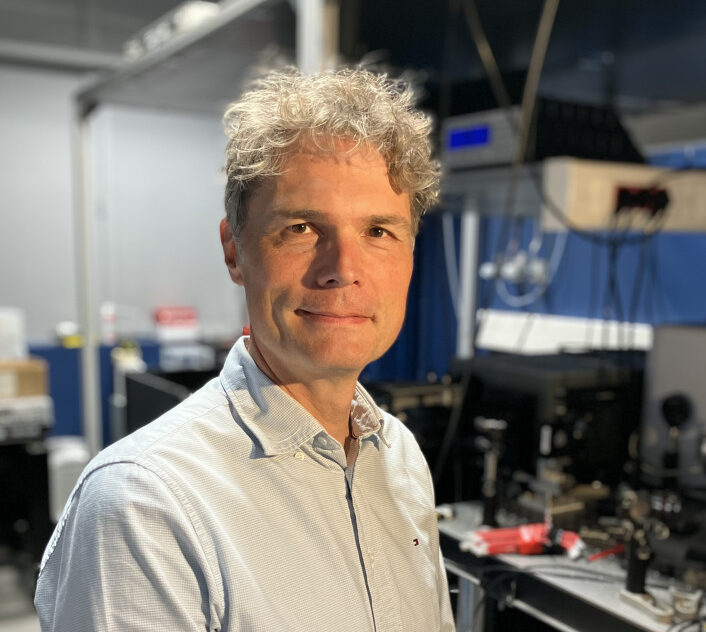
Guillaume Cassabois works on the scale of the infinitely small, where quantum laws reign. For those who might worry that they won’t understand his research, the physicist at the Charles Coulomb Laboratory and professor at the University of Montpellier offers reassurance:“We all live in a quantum world. ” Lasers, MRI imaging, and the transistors that make up computers are technologies that have emerged from a century of research in quantum mechanics.
From Arsenide to Graphene
He studies semiconductor nanostructures using optical spectroscopy. In doing so, he is contributing to the second quantum revolution—the one that began in the 2010s and seeks to apply quantum properties at the atomic scale to new technologies. Among these technologies, the best-known—and perhaps the least advanced—project is the quantum computer, which would use matter’s ability to exist in two states at once to perform calculations much faster.
After defending his dissertation in 1999 at the École normale supérieure, Guillaume Cassabois devoted the early part of his career to the qubit—the quantum bit that, unlike our current computers, where transistors manipulate 0s or 1s, can be both 0 and 1 at the same time. While serving as an assistant professor at Jussieu, he attempted to create this qubit by fabricating a quantum dot—an object measuring just a few nanometers made of indium arsenide. Ultimately, superconductors prevailed over quantum dots in the race to develop the qubit. The researcher then shifted his focus to nanotubes, a nanostructure made from graphene—a material consisting of a single layer of carbon atoms arranged in a honeycomb pattern—which can emit single photons. Among quantum applications, single photons are highly sought after. This is the case in quantum cryptography, where the impossibility of creating a perfect copy of a photon makes it possible to encode messages in an unbreakable way.
Defects in Silicon
When he joined the University of Montpellier in 2010, Guillaume Cassabois set out to explore yet another new avenue: optical defects in silicon.“Such a defect exists in diamond and allows for the emission of single photons on demand at visible wavelengths. My intuition was to find the equivalent in silicon, a material widely used in microelectronics that could emit in the infrared, at the wavelengths used in telecommunications optical fibers.”
Bingo. His team was the first in 2019 to observe the defects they were looking for. Guillaume Cassabois emphasizes the role of the team in this achievement:“Anaïs Dréau [a researcher at L2C and the 2025 recipient of the Gustave Ribaud Prize fromthe French Academy of Sciences] was setting up a highly effective experimental setup to study silicon carbide, a project that Vincent Jacques (L2C) was able to support financially using leftover funds from his ERC grant. ” He went on to argue that collaboration andthe “small savings”in laboratories are crucial for staying competitive against the U.S. and Chinese heavyweights. Today, the Montpellier team is contributing to pioneering international advances in the technological application of this discovery, which makes it possible to integrate quantum emitters into silicon chips.
Boron nitride on board
Taking advantage of another strength of his laboratory—optical spectroscopy in the ultraviolet range, a field in which Bernard Gil is an expert—Guillaume Cassabois is investigating the properties of another semiconductor material: boron nitride (BN). “At first, working with bulk crystals a few millimeters in size, I felt as though I were doing physics from the 1960s. I had no idea of the incredible physical properties of this material, which has a structure similar to graphene.” Together with his colleague Pierre Valvin, they achieved an experimental breakthrough“using two-photon spectroscopy in the deep ultraviolet” and revealed the exceptional optical properties of this material, which could enable the production of deep-ultraviolet LEDs for water sterilization and surface disinfection.
“This groundbreaking work marked the birth of a new field that is now booming: boron nitride-based photonics,” noted an article by the French Physical Society on the occasion ofthe 2025 Jean Ricard Grand Prize—an award that recognizes a physicist for outstanding and original work. As just one example of the international impact of his work, Guillaume Cassabois launched the first international workshop on boron nitride in Montpellier in 2023—a conference that has since been held in Australia, the United States, and will soon take place in South Korea…
News

[LUM#23] Floods: Insurers Overwhelmed
Published on: July 15 , 2026
As episodes of heavy rain become more frequent, flooding will become increasingly…