Jan E. Leach, a researcher who “feeds” on bacteria
An internationally renowned American plant pathologist, Jan E. Leach has dedicated her career to rice diseases, sustainable plant resistance, and the effects of climate change on plant health. A distinguished university professor and emeritus researcher at Colorado State University, and a member of the U.S. National Academy of Sciences, she was awarded an honorary doctorate by the University of Montpellier on April 3, 2026.
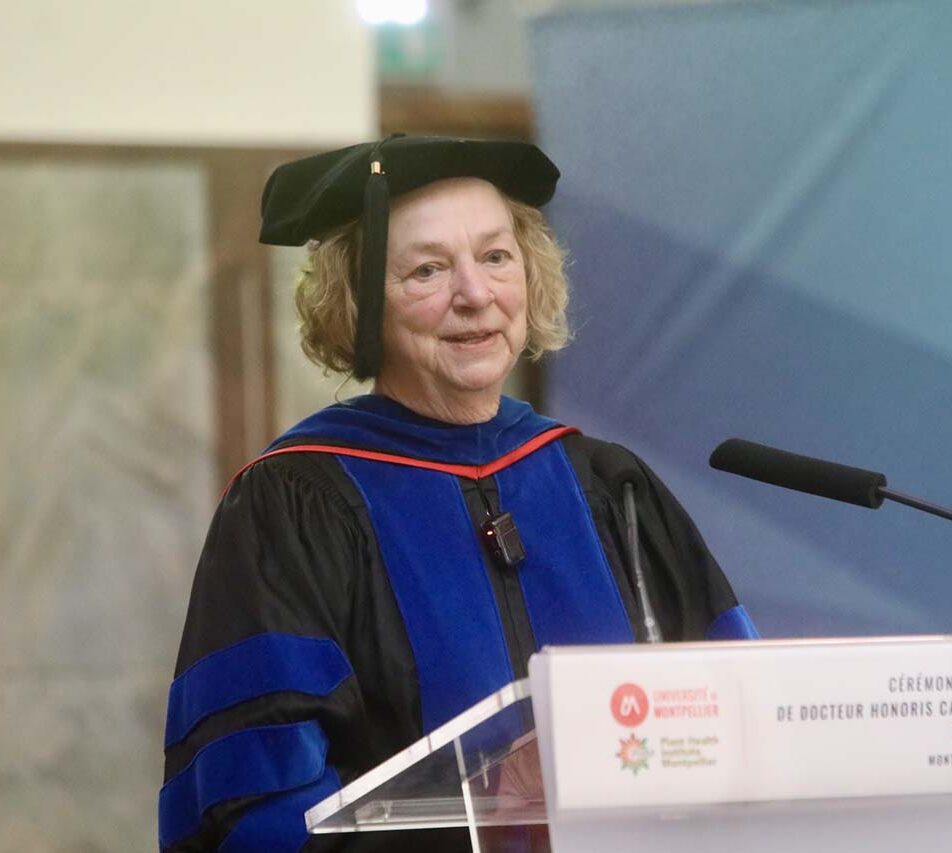
“I’m going to take you to some rather muddy rice paddies,” warns Jan E. Leach. With this invitation to an unusual journey, one of the leading international figures in plant pathology—a professor emerita and associate dean for research at the College of Agricultural Sciences at Colorado State University—takes us on a scientific adventure that brings us up close to the earth, plants, and microbes… And she leads us in the footsteps of those she has worked alongside throughout her career: “I am here not because of what I have accomplished on my own, but because of what my research community, my team, my friends, and my family have achieved together.”
All microbes lead to science
With a smile on her face, Jan E. Leach naturally describes herself as“a girl from the Midwest” who grew up in Lincoln, Nebraska—the true agricultural heartland of the United States. In the 1970s, she studied microbiology there before discovering plant pathology. The American researcher says with a laugh: “I realized I could do something useful, interesting, and important, all while working with plants and having fun with microbes.” After earning her master’s degree, she went on to pursue a Ph.D. in plant pathology at the University of Wisconsin –Madison—one of the historic hubs of plant pathology—under the guidance of Professor Luis Sequeira. He played a decisive role in introducing her to“big science”and to a certain philosophy of mentorship that would stay with her forever: the need to train students who will surpass their mentors. Jan Leach then turned her attention to a bacterial disease of the potato and became passionate about applying molecular techniques to solve scientific problems. Recognizing the need to engage with the international research community, she went to England for her postdoctoral fellowship, where she spent three years conducting research on a hop disease for Guinness.
Resilience to Climate Change
In 1984, Jan E. Leach returned to the United States, where she joined Kansas State University as an assistant professor. Her mission: to advance our understanding of how pathogens cause disease in plants. She thus focused her research on rice bacterial blight and its pathogen, Xanthomonas oryzae. This bacterium, which causes significant crop losses in many rice-growing regions around the world, quickly became the central focus of her scientific career. The researcher analyzed how the bacterium attacks, how the plant resists, and how to translate this knowledge into sustainable resistance. It was a pioneering vision.
After spending twenty years in Kansas, Jan Leach moved to Colorado State University, where she was given free rein. She chose to approach plant pathology from a more holistic perspective, taking into account numerous aggravating external factors.“That’s where my heart lies: in agriculture and in the question of how we’re going to feed humanity,” she acknowledges. Her research shows how, under the impact of climate change, plant pathogens are multiplying and spreading into areas that had long been spared, while new ones are emerging, directly threatening global rice production. Faced with this urgent situation, Jan Leach takes a systems-based approach to the problem and formalizes the concept of the phytobiome: no longer looking solely at the plant and the bacterium, but also at temperature, soil, the microbiome, insects, and the environment.
It takes a whole village
This way of thinking about interactions applies not only to plants; it also shapes her approach to research. “It takes a village to raise a child ” is one of Jan Leach’s favorite sayings. It is also the phrase that best sums up her greatest strength: her ability to bring people together. A network of researchers from around the world has formed around the American researcher. The University of Montpellier holds a unique, almost familial place within this network. Herhonorary doctorate sponsor, Valérie Verdier, President and CEO of the IRD, recounts the decisive role Jan Leach played in her career—both as an advisor and as a mentor—when she needed to reorient her research.
“This is a team that is currently recognized worldwide and that Jan continues to follow and host; she continues to facilitate contacts and networking for the team—with scientists, American universities, donors, and international research centers specializing in rice. ” The team in question is the one Valérie Verdier established more than 20 years ago, which specializes in rice bacterial diseases in Africa. Currently based at the Plant Health Institute (PHIM) in Montpellier, its members include Lionel Gagnevin, anhonorary doctorate recipientand former student of Jan E. Leach. Impressed by her“ability to get things done,” the CIRAD researcher fondly recalls the years he spent working alongside her at Kansas State University in the 1990s: “That’s where I learned everything. And not just the technical aspects. I also learned that when you work on rice, you’re not working for yourself but for others.”
A commitment rooted in laughter
Her extraordinary scientific career has earned her the highest honors: winner of the Agropolis Foundation’s Louis Malassis Prize, member of the U.S. National Academy of Sciences, fellow of leading learned societies… Jan E. Leach is a true “scientific diplomat” who channels her knack for building consensus, her compassionate leadership, and her ability to take action into fostering sustainable scientific networks. Yet she has never stopped teaching or supporting her colleagues with unwavering generosity, and she is deeply committed to advancing women in science. “As a mentor, you’ve shaped the careers of so many researchers, including my own, ” emphasizes Valérie Verdier. She can’t help but add with a knowing smile: “Jan is also an expert at making us laugh! We laugh and have a blast with Jan.”
News
Nemesis: An Exceptional ERC Synergy Project That Is Starting to Prove Its Worth
Published on: September 3 , 2026
Two years after its official launch, the first scientific report from the Nemesis project…