Kōichi Tanaka: The Mistake That Changed Chemistry
Kōichi Tanaka, winner of the 2002 Nobel Prize in Chemistry, was awarded an honorary doctorate from the University of Montpellier on July 9, 2026. The University is thus recognizing the career of this Shimadzu engineer, a pioneer in mass spectrometry, and the scientific ties forged with the Montpellier university-hospital clinical proteomics platform in the field of neurodegenerative diseases.
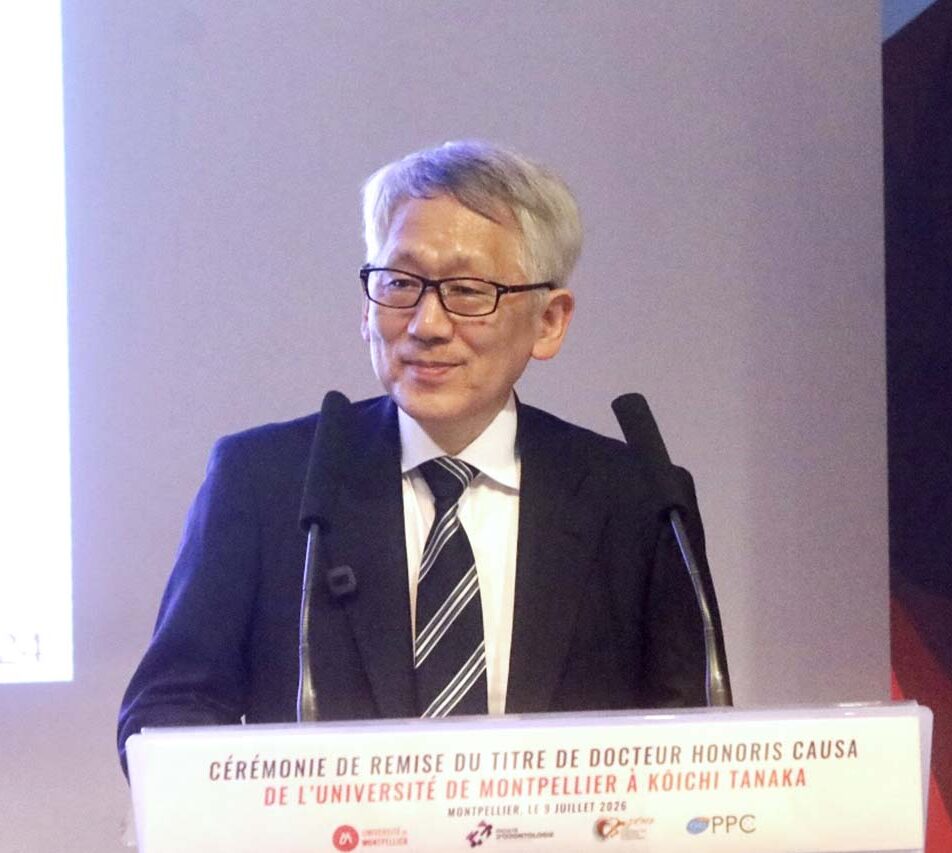
It’s not every day that the University of Montpellier awards an honorary doctorate to a Nobel laureate. This is only the second time, following the Congolese doctor Denis Mukwege in 2021. And Kōichi Tanaka is not just any Nobel laureate.
His career path defies academic norms. “ At age 43, you became one of the youngest recipients of this award while making history as the first Nobel Prize in Chemistry laureate not to hold a master’s or doctoral degree, ” notes Philippe Augé, president of the University of Montpellier. Yet Kōichi Tanaka has changed the face of science. And this uniqueness has undoubtedly contributed to that.
A journey fraught with challenges
Born in 1959 into a modest family in Toyama Prefecture, Japan, Kōichi Tanaka dreamed of becoming a doctor. Convinced he wasn’t up to the task, he turned to another field that was then booming: electrical engineering. It was a path that suited this train “otaku”—a Japanese term for enthusiasts with particularly in-depth knowledge in their field—perfectly. A tireless worker, he enrolled at Tohoku University, where he studied engineering as well as psychology, literature, and foreign languages. However, burnout forced him to repeat his sophomore year.
“That’s when my life truly began: a life marked by repeated failures, over and over again,” he says. He then failed to get into the semiconductor lab he had his sights set on and turned to antenna engineering. With a bachelor’s degree in electrical engineering, he applied to“a world-renowned manufacturer of electrical equipment.” Another failure. On the advice of a professor, he eventually joined Shimadzu, a Kyoto-based manufacturer of scientific and medical instruments.
The Mistake of a Lifetime
Tanaka hoped to put his electrical engineering skills to use in medical equipment and thus reconnect with the field of medicine. Another disappointment: at the research lab, the roles had already been assigned, and he was put in charge of chemical experiments. There he was, thrust into a field about which he knew almost nothing. “They convinced me by saying, ‘In chemistry, all you have to do is run experiments; even a beginner can handle it, ’” he recalls.
As with every new direction he took, Tanaka threw himself into it with total dedication and joined Shimadzu’s research on mass spectrometry. This technology makes it possible to “weigh” a molecule after charging it electrically, but the methods of the time caused large biological molecules to fragment. Tanaka kept one piece of valuable advice in mind: “Chemistry experiments aren’t just a series of failures; it’s okay to fail.”
In February 1985, a handling error changed the course of his research. Rather than discarding his sample, Tanaka decided to test it. This error led to the development of soft laser desorption (SLD), which enables the analysis of intact proteins by mass spectrometry.
The discovery is gaining traction
A patent was filed that same year. Tanaka presented his findings at international conferences and then published them with his colleagues in 1988. The product’s commercial launch was less successful: too far ahead of its time, the LAMS-50K—the first commercial soft-laser ionization mass spectrometer—struggled to find a market. In 2024, however, it would be honored with an IEEE Milestone, an international recognition awarded to technological innovations that have left a mark on the history of science and engineering.
Tanaka continued his research at Shimadzu, notably at its British subsidiary from 1997 to 2002. When he was told he was a candidate for the Nobel Prize, he thought it was a joke. In 2002, he became a co-recipient of the Nobel Prize in Chemistry along with John B. Fenn and Kurt Wüthrich. He was honored for his work on mild desorption-ionization applied to biological macromolecules. In Japan, his success did nothing to diminish his humility. In 2003, Tanaka took over as director of a mass spectrometry research laboratory established in his name by Shimadzu. His work would eventually lead him to Montpellier.
Innovation in the Service of Medicine
Even when he was dreaming of a career in medicine, Tanaka already wanted to change patients’ lives. Christophe Hirtz shares this ambition. As the sponsor of Tanaka’s honorary doctorate and a professor of biochemistry and clinical proteomics at the Montpellier School of Dentistry, he co-founded the university-hospital clinical proteomics platform with Sylvain Lehmann in 2010. Based at the Institute for Research in Regenerative Medicine and Biotherapy (IRMB) in Montpellier, the platform uses mass spectrometry, among other techniques, to identify biomarkers for neurodegenerative diseases.
In 2015, Shimadzu and the Montpellier platform formed a scientific partnership that combined the company’s instrumental expertise with the team’s clinical skills. Several mass spectrometers were made available to the platform. Four years later, the initial results led to a cooperation agreement and several joint projects. Christophe Hirtz then began working with Kōichi Tanaka, whose expertise he admired.
They first met in Japan in 2019 at a scientific event. Christophe Hirtz recalls: “I went over to greet him: ‘It’s an honor to meet you, Professor Tanaka.’ And he interrupted me, saying earnestly, ‘I’m not a professor; you’re a professor—I’m just Mr. Tanaka.’ That day, he taught me a lesson in humility.”
Sharing Humility
Though a private person, Kōichi Tanaka never misses an opportunity to point out that his Nobel Prize and his innovations are the result of a collective effort. In his speech, he also spoke about his failures and the influence of traditional culture and manga. For him, there is no set path: creativity is fueled by every experience and by “the ability to communicate across disciplines.”
In his view, his success stems from courage, perseverance, the ability to change one’s perspective, and, above all, the willingness to try—even if it means making mistakes. “All of you here naturally possess creative potential, ” he insists. Perhaps we are all just one failure away from winning the Nobel Prize one day.
News
Nemesis: An Exceptional ERC Synergy Project That Is Starting to Prove Its Worth
Published on: September 3 , 2026
Two years after its official launch, the first scientific report from the Nemesis project…