Philippe Jarne: An Ecologist by Nature
The French Society for Ecology and Evolution has awarded its 2020 Grand Prize to Philippe Jarne, a CNRS researcher at the Center for Functional and Evolutionary Ecology. The prize recognizes his research in evolutionary and population biology, invasion biology, and ecology. A profile of a gastropod specialist.
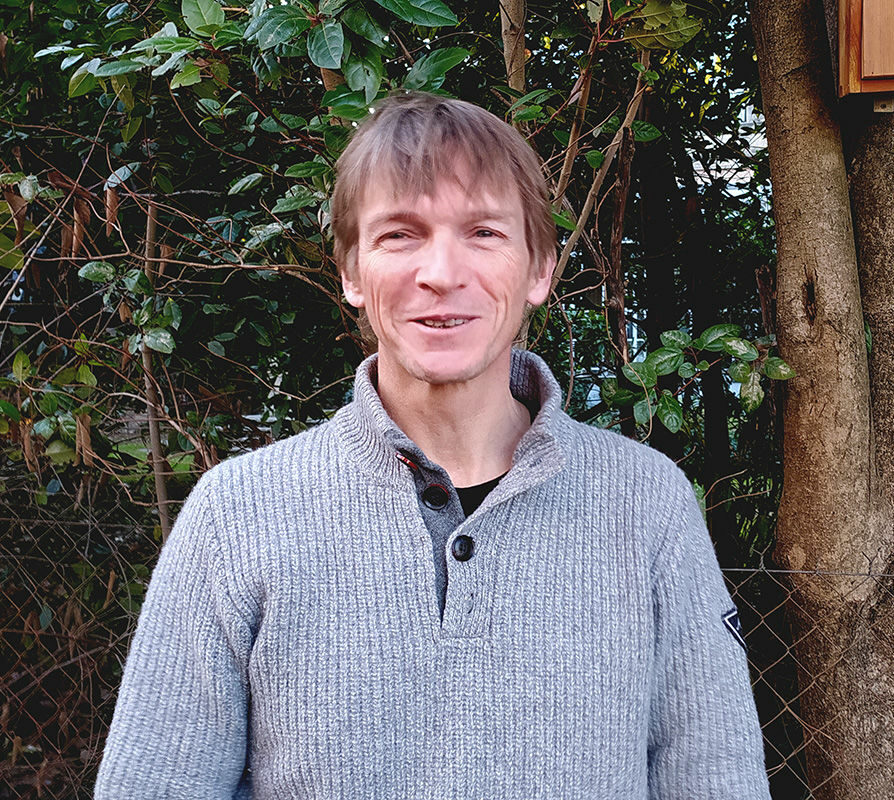
Philippe Jarne and snails go way back. It’s a special relationship that began in 1971, in his third- and fourth-grade classrooms in Chalon-sur-Saône, thanks to two intermediaries: his elementary school teachers.“Two eco-conscious teachers who took us every week to observe a pond a few kilometers from the school. We’d find big freshwater snails there—that’s probably where I first came into contact with snails,” recalls the researcher.“Not only did we observe nature, but we were lucky enough to be able to bring it back to school: minnows, ground beetles, newts, frogs, turtledoves, and even a grass snake! Our classroom was like a zoo.” Those two extraordinary years helped shape a very personal relationship between nature and the child I was back then—“always out and about, fishing for pike, carp, and catfish.”
Common Thread
A connection to nature that would serve as a true common thread throughout the life of a man who describes himself as“an incorrigible rural provincial.” While attending high school, Philippe Jarne was interested in biology. And among those memories is a teacher—his biology teacher.“She introduced me to evolutionary biology, and I was immediately fascinated by its historical dimension.”So after graduating from high school, he enrolled in a biology prep program in Toulouse, followed bythe Montpellier School of Agronomy, where he made friends who introduced him to political ecology and immersed him in the world of naturalism. With them, the student spent a lot of time birdwatching in the Camargue, studying the plants of the garrigue, and reflecting on politics. By the time his studies at SupAgro came to an end, Philippe Jarne had also reached a firm conclusion: the agronomy of the “Thirty Glorious Years” wasn’t for him.
He discovered his true calling later when he enrolled in the Master’s program in Biodiversity, Ecology, and Evolution at the University of Science and Technology of Languedoc, in Professor Louis Thaler’s laboratory, where his instructors included Pierre-Henri Gouyon and Jacques Blondel.“I realized I could make evolution my career—it was a revelation! I immediately thought to myself: ‘This is what I want to do.’”At first, Philippe Jarne planned to work on birds. But snails caught his attention again.“Louis Thaler suggested I work on tropical mollusks instead; that’s when I set foot in the tropics for the first time—in Côte d’Ivoire and Niger, in particular.” Gastropods would also be the focus of his civil service.“I didn’t want to do military service, so instead I spent two years at anINRA station on the shores of Lake Geneva studying freshwater snails.” Just like back by the pond in third grade…
Unusual Sexuality
In 1990, Philippe Jarne defended his biology dissertation under the supervision of Bernard Delay. His topic?“Reproductive Systems and Genetic Structures of Populations in Hermaphroditic Freshwater Gastropods.” He has since become a specialist in the unique sexuality of gastropods.“They are hermaphrodites, meaning they possess both sexes within a single individual. My goal was to understand the evolution of their reproduction and to determine how much of their biological capacity they allocate to male and female functions.”
After completing his dissertation, Philippe Jarne went to the United States for a postdoc position in Chicago, working alongside Brian and Deborah Charlesworth.“The Mecca of evolutionary biology! ”“I learned a tremendous amount from the people I worked with; it was an opportunity for incredible intellectual growth, but also for building an equally incredible network—that experience was a real career booster,” recalls the researcher, who considers himself“extraordinarily lucky.” His good fortune continued upon his return to France.“In 1992, I took the CNRS competitive exam and was fortunate enough to be hired directly as a CR1 at the Institute of Evolutionary Sciences in Montpellier, at just 29 years old.” Two years later, thanks to Bernard Delay, the young researcher found himself“already with a team on his hands—four excellent Ph.D. students!”
Among them was Patrice David, a colleague with whom he has worked closely ever since. “An exceptional researcher, and 28 years of working together without a single argument.” The duo is joined by a third member, researcher Jean-Pierre Pointier. This triumvirate of evolutionary biologists has based its work in Martinique and Guadeloupe to study biological invasions and the dynamics of species communities in the Caribbean. In particular, they focused on Physa acuta, a freshwater gastropod of the Physidae family.“It’s a highly invasive species native to North America but now found everywhere.”
From High Standards to Excellence
Philippe Jarne conducts this research at CEFE, which he joined in 1999 as part of the Genetics and Evolutionary Ecology team,“a group of like-minded people who study evolutionary ecology and are working on the same question: how species arise and evolve. I’m lucky to work with brilliant and friendly people,” says Philippe Jarne, who played a key role in shaping ecological research by serving successively as team director, then department director, and finally deputy director of CEFE before leading the laboratory from 2011 to 2014 and, ultimately, the Cemeb Labex from 2013 to 2019.“Helping people in their careers has been and remains an immense pleasure,” emphasizes the ecologist, who prefers high standards to mere excellence. “Everyone contributes to a project to the best of their ability; the idea is to work with kindness while bringing out the best in everyone. It is from these high standards that excellence is born.”
This excellence is now recognized worldwide, as evidenced by Montpellier’s second-place ranking in ecology in the 2017 Shanghai Ranking. “I truly appreciate how fortunate I am to be a researcher in evolutionary biology and ecology in Montpellier—a wonderful hub for these fields, with a highly collaborative approach to research that I value greatly.”
A Flurry of Awards
Each year, the French Society for Ecology and Evolution awards a grand prize, a research prize, and two young researcher prizes. In 2020, three of these prizes were awarded to CEFE staff members:
- The 2020 SFE² Grand Prize was awarded to Philippe Jarne for his research in evolutionary and population biology, invasion biology, and ecology.
- The 2020 SFE² Young Researcher Awards were presented to two former doctoral students from the laboratory, Julie Louvrier, who wrote her dissertation on “Statistical Modeling of the Distribution of Large Carnivores in Europe” under the supervision of O. Gimenez, and Maxime Dubart, who wrote his dissertation on “Shellfish and Crustaceans: Spatio-Temporal Dynamics of Metacommunities in Freshwater” under the supervision of P. David and P. Jarne.
The award winners will present their work at the SFE2 Annual General Meeting in January 2021.
News

The AAP TALENTS – PTL CARLA and CHIMENE from the Chemistry Division
Published on: October 6 , 2026
As part of the I-SITE Program of Excellence (PEI) at the University of Montpellier (UM) and the…