Véronique Lecointe: Kindness as a guiding principle
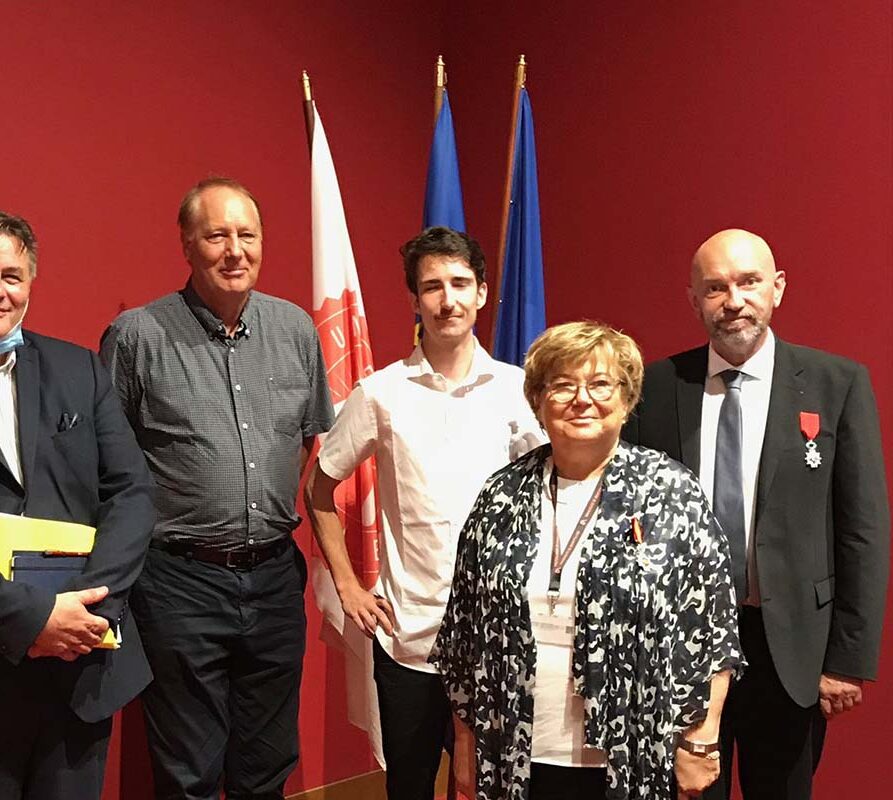
Véronique Lecointe, director of the Department of Midwifery at the University of Montpellier, was honored for her career with the title of Knight of the Legion of Honor. This distinction caps off a rich career and shines a spotlight on an essential profession: midwifery. A profile.
Is being a midwife a calling? “It wasmore of a default choice at first,” admits Véronique Lecointe, who had originally planned to become a general practitioner. After “failing” the medical school entrance exam following her high school graduation, the young woman turned to the entrance exams for physical therapy, nursing, and midwifery—all three of which she passed. Faced with this second-choice scenario, Véronique Lecointe chose midwifery. It was a revelation.“It certainly wasn’t the career I had intended to pursue, but I immediately felt right at home in it.” Her place was then, for three years, at the midwifery school in Reims, where she earned her state certification.“Three wonderful years”during which she discovered everything that defines the essence of this profession, which she found joy in practicing from the very start.“Interacting with the ‘moms’ and their newborns is incredibly emotional. I realized just how much we could mean to them during those very special moments when emotions run high and feelings are raw.” This revelation propelled her to the top of her class at the graduation ceremony in 1980.
Kindness
Véronique Lecointe then embarked on a rich and varied career path that took her from Reims to Montpellier, via Tours and Paris, alternating between working as a midwife in a hospital and practicing privately. It is a profession that, even today, is sometimes not given the recognition it deserves.“Midwives practice a medical profession listed under Title V of Book I of the Public Health Code, and are the primary care providers for physiological births. This includes registration and medical monitoring of pregnancy, preparation for childbirth, ultrasounds, delivery, postpartum care, as well as preventive gynecological care, contraception, and medical termination of pregnancy… A midwife is fully capable of supporting a woman throughout her entire reproductive health journey.” Always with the same core principle in mind:“compassion. The idea of a birth free from violence is deeply rooted in midwifery training and practice—it is central.” Encouraging the expectant mother, respecting her, reassuring her, congratulating her throughout labor, and supporting her.“Every moment of the birthing process should be nothing but joy,” states the midwife, who describes a profession that requires“putting oneself aside and not taking center stage.” Working behind the scenes, with compassion.
A caring nature that requires many different qualities.“You have to know how to earn patients’ trust, which requires excellent listening skills,” explains the midwife, who emphasizes that her profession demands not only very dexterous hands but also“big ears to hear clearly.” And then there’s the ability to find the right words when speaking to mothers and expectant parents. It’s a multifaceted profession that requires initial training in which the humanities, psychology, and ethics play a major role in the curriculum, thereby enabling a better approach to complex situations. “For example, providing interdisciplinary care for very young pregnant girls without their parents’ knowledge. It’s a situation every midwife has encountered at least once in her career, ” says Véronique Lecointe.
Confidence in their abilities
To pass on this knowledge and expertise, and to ensure the continuity of this professional ethos, she decided in 2006 to pursue a career in teaching.“I enjoy mentoring students throughout their academic journey, from the bachelor’s to the master’s degree,” explains the assistant director of the Montpellier teaching site of the Department of Midwifery at theUM, who is also president of the National Conference of Midwifery Educators. “I teach students that a midwife must never compromise her professional independence in any way and is bound by confidentiality regarding everything that comes to her knowledge in the practice of her profession—that is, not only what is entrusted to her, but also what she has seen, heard, or understood. Not to mention personally providing, with conscientiousness and dedication, care in accordance with current scientific evidence as required by the patient and the newborn. For this, they must have complete confidence in their skills.” A trust that is also earned over time and through experience.“A midwife is like ‘a fine wine’—she gets better with age,” jokes the native of Champagne. Until she becomes a grand cru, honored this year with the rank of Knight of the Legion of Honor for her 39 years of service as a midwife. A prize-winning vintage.
News

Rouages: “In terms of training and dialogue, Mobilab is a wonderful tool”
Published on: September 21 , 2026
Basile Ploteau is a research engineer at the Itap Joint Research Unit (UMR), Technologies and Methods for…