A Journey Through Public Law with Pascale Idoux
Pascale Idoux is a professor and researcher in public law, and she talks about her field the way others talk about birds: by taking you on a journey. Over the course of an hour spent within the walls of an office at the School of Law and Political Science, she takes us on a journey from the European Organization for Public Law to the training program at the Institut de l’entreprise, touching on nuclear law, the Institut universitaire de France, and, of course, the University of Montpellier.
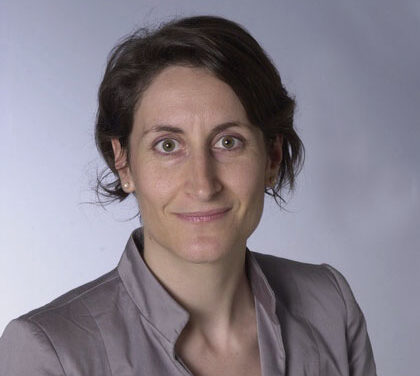
“One day, a colleague from another field jokingly asked me, ‘But what does a legal researcher actually look for? Articles in the code? ’ He made me laugh! I know it’s not always easy to understand what we do here.” ”With a smile so graceful it shines through even behind a mask, Pascale Idoux has the look and the down-to-earthness of those who are truly passionate about their work. And a résumé as thick as a Dalloz.”
Are legal references lost on you? Pascale Idoux starts from the beginning, beginning by setting the stage. The law? “A toolbox,” replies the researcher.“The law is effective or successful when social, economic, and political relationships function smoothly. There’s always some friction, but the law is a tool for regulating, pacifying, giving concrete expression to values, and strengthening the collective.” ” Public law? “It’s the law that applies to public institutions—that is, the state, local governments, universities… It also governs the relationships between public institutions and private individuals. It’s a timely issue given the public health measures that are severely restricting individual freedoms.”
Skillful Guidance
As with any good portrait, we set out to find that initial spark—what ignited her passion for public law. The answer comes with a laugh: “You’re going to find this funny.” She then goes back to her first year of law school at the University of Montpellier. A very young high school graduate who was more interested in philosophy and history. Knowing nothing about law school, she chose constitutional law and the history of law as electives, thereby ruling out the civil law track. “It was when I got to know the others that I realized civil law is the very foundation of it all. In a lecture hall of six hundred students, there were probably only two or three of us who hadn’t taken civil law. It was too late to change my mind, but luckily, I ended up liking it.” The path she took from there is enough to restore confidence in any student who might be doubting their choices.
The student, who was ill-guided (and yet, fortunately), eventually earned her doctorate and became a professor and researcher. This dual role soon led her toward new challenges and new areas of study. She thus took up the mantle of the International School of Nuclear Law following the retirement of its founder. “It was a very original initiative in Montpellier—a sort of summer school that awarded a university diploma. We had 60 different nationalities, people asking tough legal questions—like those insurers exploring how to insure against nuclear risk! It was quite a mind-blowing experience. ” Having become a professor of administrative law—a branch of public law—at the University of Montpellier, she took on the role of co-director of the master’s program in applied public law in 2009, and subsequently became co-director of the master’s program, now renamed “Public Law and Litigation.” She continues to hold this position while also heading the Law and Political Science Department.
Europe: A Copernican Revolution
On the research front, she joined CREAM, the Center for Research and Administrative Studies in Montpellier. Public law does indeed offer many avenues for research, and some of them naturally bring you closer to the legislative chambers. “A public law researcher must engage in forward-thinking, projecting themselves into the future to try to anticipate legal issues and help shape the discourse. It’s not when an amendment is introduced in the middle of the night in the National Assembly that you have time to launch a broad discussion.”
In 2012, it expanded beyond the scope of French law and became a member of the European Public Law Organization (EPLO). Based in Greece, the organization holds an annual academic conference bringing together scholars from across Europe. “It’s a place where we discuss major issues in public law with legal experts from various countries—whether they’re academics, members of the Council of State, or their equivalents in other countries. And there, too, when it comes to cultural clashes, it can sometimes be quite eye-opening! ”
For the researcher, the shift to the European framework represents THE Copernican revolution in her discipline, public economic law. It is a subject to which she devotes herself wholeheartedly, noting that, in order to build Europe, states had to dismantle entire sections of their legal systems, without, however, systematically establishing a genuine common project. This issue lies at the heart of a collective work (1) that she co-edited with Jean-Bernard Auby. “The difficulties in securing face masks, followed by vaccination challenges, are now making Europe aware of its shortcomings. After having removed every obstacle to the free flow of activities and goods from one country to another, how can we now use public law to help build a proactive common economic and industrial policy? ”
At the Intersection of Disciplines
In 2013, Pascale Idoux joined the Institut universitaire de France for a five-year term as a junior member. This status opened the doors to the Institut des hautes études de l’entreprise (IHEE), which took her—along with about forty others—on a unique year-long adventure. “We were a fairly diverse group—journalists, union activists, rising stars from CAC 40 companies, politicians, judges… This little group would periodically hop on a bus, train, or plane to visit companies, attend conferences, and debrief together.” From this experience, the researcher developed a passion for networking and interdisciplinary work. “We generally came from the same socio-professional backgrounds and shared common interests and reading materials, yet we didn’t approach things in the same way, and that taught us to be self-critical.”
It was ultimately this intersection of disciplines—her specialization in public economic law—that won her over for good. As she began working with regulatory authorities such as the Conseil supérieur de l’audiovisuel (CSA) on ways to adapt to the emergence of digital platforms like Netflix, she realized that to take her legal expertise further, she also needed to understand economics. “At that time, itwas invaluable to me to have economist colleagues—who were at the very top of their field but able to explain to me in simple terms the background of the economic debates I was discovering as a lawyer. I then understood the value and the pleasure that can be derived from these cross-pollinations of perspectives.” She maintains a constant connection to economics by updating every two years the handbook on public economic law founded in the 1990s by Montpellier professor Jean-Philippe Colson.
From Digital Technology to Communications Law
It was during this assignment for the CSA that she returned to the field of electronic and digital communications law (2). “I’m very interested in this because it completely redefines the scope of regulations and regulatory authorities. It’s stimulating to try to understand the phenomena that are revolutionizing or reshaping the landscape in our areas of expertise.” Pascale Idoux focuses on the challenges and decision-making practices of regulatory authorities, as well as communications law, and regularly publishes columns on this highly topical subject. “Can Twitter suspend the account of a sitting president? How should we balance the accountability of platforms in the fight against illegal content? These are examples of questions we might ask ourselves, ” she explains.
Another example is the sanction imposed by the CSA on the Cnews network following discriminatory remarks made on air by one of its commentators. This is a highly sensitive public law issue that raises questions about the delicate balance between freedom of expression and regulatory oversight of what may or may not be broadcast via audiovisual media. “This is an area that really stirs up legal professionals. Our field is constantly changing and interacting with society, which allows me to take an interest in many things, without ever losing sight of the central question: How do all these major issues impact my niche area of expertise?”
(1) European Economic Governance, 2017, edited by Jean-Bernard Auby and Pascale Idoux, Administrative Law Series, Bruylant
(2) This month, she is also publishing a book titled *Digital Technology, Law, and Justice* with Christophe Albiges and Laura Milano, two colleagues from the University of Montpellier, published by CREAM.
News

Rouages: “In terms of training and dialogue, Mobilab is a wonderful tool”
Published on: September 21 , 2026
Basile Ploteau is a research engineer at the Itap Joint Research Unit (UMR), Technologies and Methods for…