“Accelerating the transition to sustainable development”
Launched in March 2019 as part of the I-SITE Program of Excellence “Montpellier University of Excellence” (MUSE), the Montpellier Advanced Knowledge Institute on Transitions (MAK’IT) is a newcomer among the Institutes of Advanced Studies (IEA).
As a hub for knowledge development, collaboration, and interaction between the local ecosystem and the international scientific community, MAK’IT aims to encourage scientific communities to contribute to the analysis, support, and acceleration of the transitions necessary to achieve the Sustainable Development Goals (SDGs) in the fields of agriculture and food, the environment, and health.
As a tool for collective intelligence, the Institute promotes interdisciplinary exchange and the development of new approaches and innovative research methodologies, in close collaboration with policymakers and citizens.
Vision
The Sustainable Development Goals (SDGs), as adopted under the auspices of the United Nations, call for a profound transformation of our societies toward more innovative, inclusive, and adaptive models. This transformation relies on a series of major transitions that must be orchestrated at the intersection of health, the environment and climate, agriculture, and food. From the local to the global level, these transitions represent challenges that research must help address. MAK’IT has set itself the goal of revitalizing the venues and methods for mobilizing scientific knowledge and creating new forums for addressing the many controversies sparked by these changes.
Functions
Programming: Contribute to the planning of research on transitions and strengthen the development of a school of thought at the local, national, and international levels.
Looking Ahead: Identify and promote relevant foresight exercises, and strengthen the scientific expertise and capabilities needed to implement these transitions.
Influence: Fostering debate within national and international bodies where transitions are conceived and implemented, by serving as an interface between science and society and between science and politics.
Activities
Hosting International Researchers
MAK’IT offers international researchers from all geographic regions and academic disciplines the opportunity to spend several months conducting research in Montpellier. The Institute facilitates their exchanges and supports their interactions with Montpellier’s scientific community and the non-academic world.
Freed from their day-to-day responsibilities, these researchers—working individually or in groups—pursue scientific projects of their choice in collaboration with research institutions in Montpellier. These projects are characterized by a strong interdisciplinary approach focused on the analysis of controversies, innovative methodologies and research areas, real-world science-society interactions, and an impact on the transition toward sustainable development.
Applications for a fellowship at the Institute undergo a selective evaluation process by the MAK’IT Scientific Council, composed of independent international experts. The Council meets twice a year to evaluate applications submitted in response to the Institute’s main calls for applications: “GUEST SCIENTISTS,” “COHORT,” “French Institutes for Advanced Study” (FIAS), and “Constructive Advanced Thinking” (CAT).
Organizing International Events in Montpellier
To strengthen the scientific communities’ involvement in public discourse, MAK’IT organizes a full program of events centered on hosting international researchers. Weekly meetings among resident researchers allow them to discuss the impact of their work across disciplinary and sectoral boundaries. Monthly discussion sessions, the “MAK’IT Talks,” which bring together academics and researchers, policymakers, and representatives from civil society and the private sector, foster reflection on issues related to current and future societal challenges.
Partnerships and the development of European and international initiatives related to the SDGs
MAK’IT collaborates with other organizations, institutions, and think tanks of a similar nature or with an interest in similar topics, with a particular focus on accelerating the transition toward sustainable development and strengthening scientific capacity in countries of the “Global South.” In particular, the Institute has forged close partnerships with French (RFIEA), European (NetIAS), and international (UBIAS) networks of Institutes of Advanced Studies.
A true laboratory for change, MAK’IT is committed to ensuring that the findings of its work benefit future generations and inspire their commitment to sustainable development. In addition to widely disseminating its publications, the institute actively promotes the implementation of educational content and innovative curricula.
Specific Features
- Alignment with the broader framework of the 2030 Agenda for Sustainable Development and the Sustainable Development Goals (SDGs)
- 3 priority areas of action: agriculture and food, the environment, and health
- Strengthened Dialogue Between the Life Sciences and the Social Sciences
- The Science-Politics-Society Interface and an Original Approach Through the Analysis of Societal Controversies
- Geographic Focus on the “South” (“Leaving No Scientific Community Behind”)
- Roots in a local scientific community and within a close-knit network of international academic and institutional partners
News
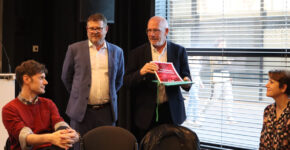
MAK’IT Celebrates Five Years in Business
Published on: April 5 , 2024
To mark its fifth anniversary, the Montpellier Advanced Knowledge Institute…