Science Bar: “Can Biological Control Save the World?”
This event has already taken place!
Thursday, February 8, 2018, from 8:30 p.m. to 10:00 p.m.
Brasserie le Dôme – Montpellier
Free admission (subject to availability)
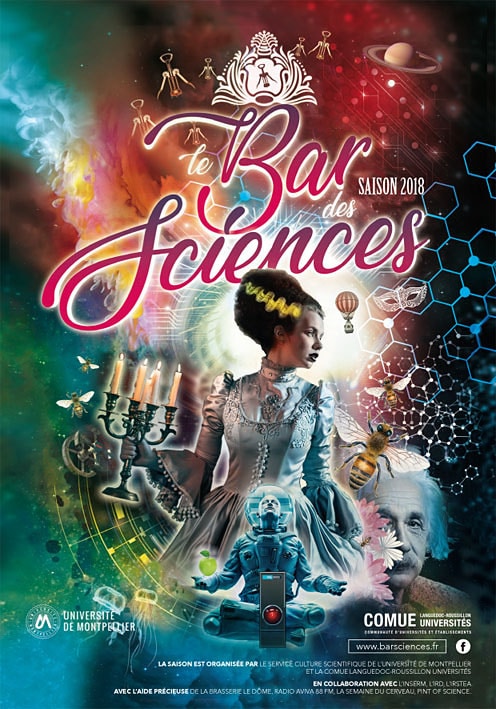 Biological control is a method of controlling pests—whether animal or plant—using living organisms that are natural enemies of the pests, known as biological control agents.
It is based on humans exploiting, for their own benefit, a natural relationship between two living beings, according to this principle:
- The target of the control effort is an undesirable organism—such as a pest of a crop, a weed, or a livestock parasite… ;
- A control agent is a different organism—most often a predator or a pathogen of the target organism—that kills it or limits its development, sooner or later.
Naturally present in most ecosystems, biological control can be intentionally used—in agriculture, among other fields—as an alternative to conventional pesticides.
As environmental protection is increasingly recognized as a major global concern, biological control could represent a viable alternative to chemical control.
This science-society debate will be moderated by:
- Fabrice Chandre, a researcher atthe IRD ( Research al Research Institute for Development), specifically inthe joint research unit on Infectious Diseases and Vectors: Ecology, Genetics, Evolution, and Control (MIVEGEC Laboratory). He is also Director of the CNEV (National Center of Expertise on Vectors);
- Mylène Ogliastro, a virology researcher atINRA (National Institute for Agronomic Research ), specifically at the Diversity, Genomes, and Microorganism-Insect Interactions (DGIMI) laboratory.
Facebook page of the Bar des sciences in Montpellier
Website of the Scientific Culture Department at the University of Montpellier
COMUE website
News
“Medical Students in the Interwar Period”: A Unique Immersion into the History of the Montpellier-Nîmes School of Medicine
Published on: September 21 , 2026
The University of Montpellier is presenting an exhibition dedicated to the lives of female students and…