International Symposium “Theories and Practices of Care”
This event has already taken place!
Saint Charles Campus – Conference Room 1, Paul Valéry Montpellier 3 University – 3400 Rue du Professeur Henri Serre, 34090 Montpellier.
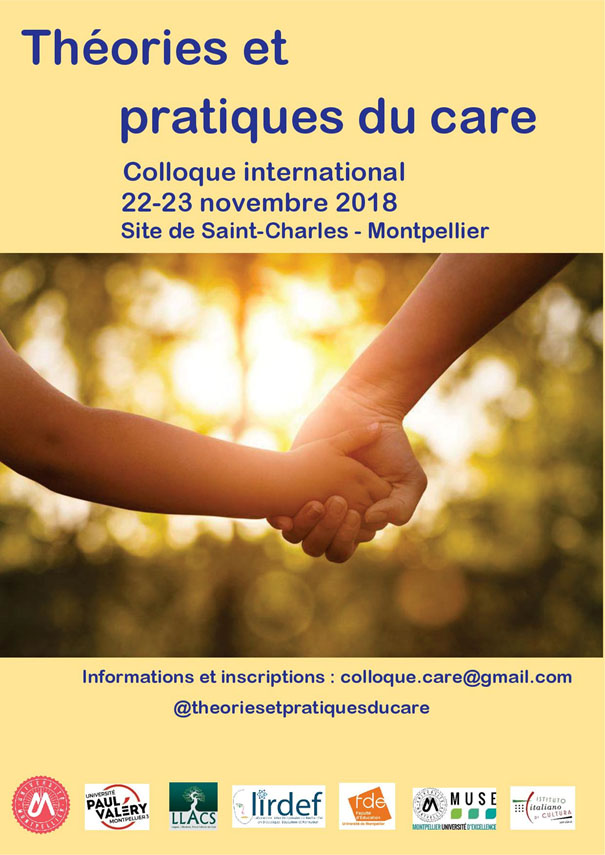 The goal of the conference is to create a space for discussion centered on the concept of care. The ethics and philosophies of care that have developed over the past three decades appear, in fact, to be relevant to many professional fields (including education, social work, and urban planning, among others).
The contributions of the discussions on care are based on several key concepts, which also serve as the main themes of the conference:
- Recognition of the interdependent relationships that connect human beings to one another, as well as to other species and the environment. This interdependence stands in contrast to the widespread notion in our society of a fixed and separate identity. Understanding the interdependent relationships in which each of us is involved is fundamental to fostering cooperation among different sentient beings.
- The inherent vulnerability of life manifests itself in various forms and at different stages of existence (childhood, old age, illness, crises, etc.). Recognizing this vulnerability is the very foundation of a care-oriented approach, both as a practice and as an ethic.
- The importance of a sensitive, non-utilitarian relational sphere made up of acts and knowledge of care—often subtle and spontaneous. A sphere in which everyone becomes aware that they need care and must provide care in order to live. These acts and this knowledge are intrinsically linked to a political dimension—to the creation of the conditions for “living together.”
This conference thus aims to further explore the avenues opened up by the multidisciplinary studies that have highlighted these principles. The goal is to help shed light on the value—and indeed the necessity—of care in the ways we inhabit the world (our relationships with ourselves, with others, with the environment, and so on).
Four fields of study are being considered:
- Ecology of the Mind: What role can care play in an ecology of the mind grounded in an understanding of how consciousness works? How can care help cultivate what is valuable in life and thereby strengthen the meaning that people ascribe to their experience of the world?
- Education: How might an education in care lead students to take care of themselves and others? How does the concept of care challenge teaching practices and individual and collective learning processes?
- The Environment: How can the core concepts of care (interdependence, vulnerability) transform the way we perceive natural environments and interact with them? What benefits might arise from integrating care theories into land-use planning practices?
- Artistic practices (literature, art, film): How does artistic creation contribute to the emergence of an ethic of care?
More info:
- Download the program as a PDF
- Website
- Register by email
Contacts:
News

When Generative AI Can Predict Fish Communities
Published on: October 23 , 2026
A new study published on October 22 in *Current Biology* and led by Noémie Coulon,…