Invasive Species: Aiming for Zero Damage in the Mediterranean
This event has already taken place!
Florida turtles, nutria, ring-necked parakeets, Louisiana crayfish, tilapia in Morocco… Whether terrestrial, aquatic, or flying, some of these non-native species were intentionally introduced for food, ornamental purposes, recreation, or biological control. Others have traveled against their will, carried along by globalized trade as “hitchhikers.” Long considered useful or harmless, some have since multiplied uncontrollably.
In the Mediterranean basin, invasive species are currently disrupting natural balances, competing with local species, and contributing to the decline in biodiversity. Their impacts extend beyond the environmental sphere: agriculture, fisheries, water management, and infrastructure are also affected, with economic consequences that can sometimes be significant.
Against a backdrop of globalized trade, climate change, and the increasing vulnerability of ecosystems, the issue of invasive species has become a major concern. To better understand this phenomenon and explore possible solutions, the Bar des Sciences is hosting an event titled “Invasive Species: Aiming for Zero Damage in the Mediterranean.”
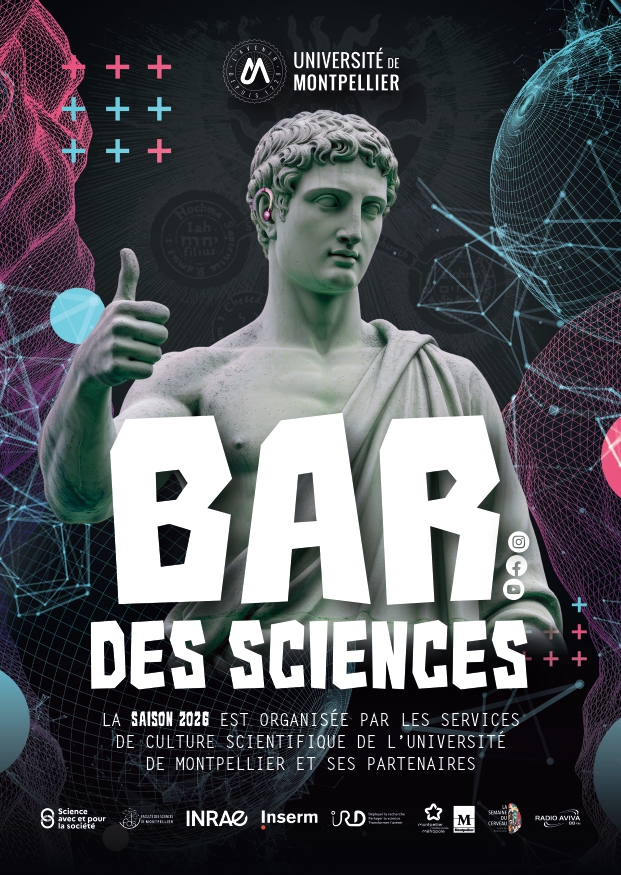
During this fun evening, the public is invited to chat over a drink with experts on the topic at this second event of the Bar des Sciences—2026 edition.
To discuss this topic, five experts from various disciplines will answer questions from the audience live:
- Jean-François Agnèse is a research director at the IRD specializing in fish population genetics. He studies the various factors influencing the evolution of these populations in their natural habitats at the Institute of Evolutionary Sciences in Montpellier (ISEM – IRD, CNRS, University of Montpellier).
- Olivier Gimenez is a CNRS research director in the Human-Animal Interactions team at the Center for Functional and Evolutionary Ecology (CEFE – CNRS, University of Montpellier, EPHE, IRD, INRAE, Institut Agro Montpellier, Paul Valéry University of Montpellier). His research combines the fields of animal ecology, statistical modeling, and the social sciences, and focuses on the conservation biology of mammals in the face of the impacts of human activities and climate change.
- Carole Kerdelhué is a research director at INRAE and deputy director of the Center for Biology and Population Management (CBGP—INRAE, CIRAD, Institut Agro, IRD, and the University of Montpellier). Her research focuses on population ecology and evolutionary genetics; she specializes in forest insects and studies cases of biological invasions.
- Jean-Pierre Rossi is a research director at INRAE within the Center for Biology and Population Management (CBGP – INRAE, CIRAD, Institut Agro, IRD, and the University of Montpellier). His research focuses on the ecology of forest insects and the impact of climate change on phytosanitary risks associated with biological invasions.
- Jean-Michel Salles is a CNRS research director at the Montpellier Center for Environmental Economics (CEE.M – CNRS, INRAE, Institut Agro, University of Montpellier). His research focuses on the economics of ecosystems and biodiversity, particularly the economic impact of biological invasions.
Free admission, subject to availability
The Bar des sciences has become one of Montpellier’s flagship events for scientific culture, offering a participatory, community-driven discussion on all aspects of science once a month from January through June. Throughout the season, scientists are invited to engage in a dialogue where their knowledge and practices are shared and discussed.
Once again this year, the Bar des Sciences is receiving support from the University of Montpellier’s “Science with and for Society” (SAPS) ministerial certification program. As part of this certification, we remain committed to making scientific culture increasingly accessible. Special attention will be given to the inclusion of deaf and hard-of-hearing individuals at every Bar des Sciences event. As such, this event will feature sign language interpretation provided by Des’L Interprétation and a collaboration with students from Lycée Joffre who are taking the French Sign Language (LSF) elective; they will open the event in LSF.
The season is co-produced by theUM scientific outreach departmentsUM its partners: INRAE, INSERM, IRD, the Montpellier Faculty of Sciences, and Aviva Radio.
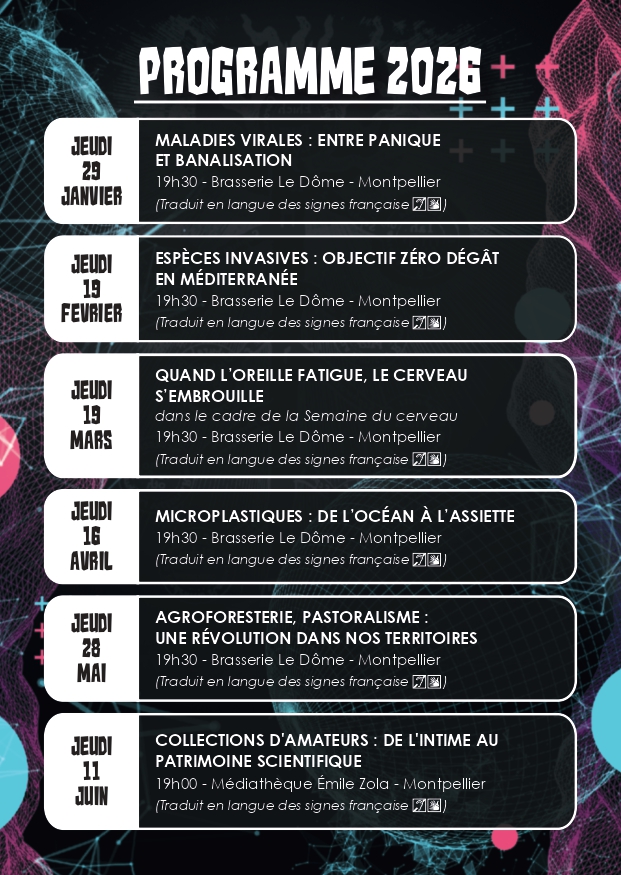
Upcoming Schedule:
- March 19: When Your Ears Get Tired, Your Brain Gets Confused. As part of Brain Awareness Week. 7:30 p.m., Brasserie Le Dôme, Montpellier. Translated into French Sign Language.
- April 16, Microplastics: From the Ocean to the Plate. 7:30 p.m., Brasserie Le Dôme, Montpellier. Translated into French Sign Language.
- May 28, Agroforestry, Pastoralism: A Revolution in Our Regions. 7:30 p.m.,
Brasserie Le Dôme, Montpellier. Translated into French Sign Language. - June 11, Amateur Collections: From the Personal to Scientific Heritage. 7:00 p.m.,
Émile Zola Media Library, Montpellier. Translated into French Sign Language.
Receive aUM summary of theUM calendar
* By entering your email address, you agree to receive a weekly summary of theUM calendarUM email and acknowledge that you have read ourprivacy policy. You can unsubscribe at any time by using the unsubscribe linkor by contacting us via email.
News

35th Science Festival: “Saveurs savantes” Comes to the University of Montpellier
Published on: July 22 , 2026
From October 2 to 12, the Hérault will come alive with the Science Festival, an event…