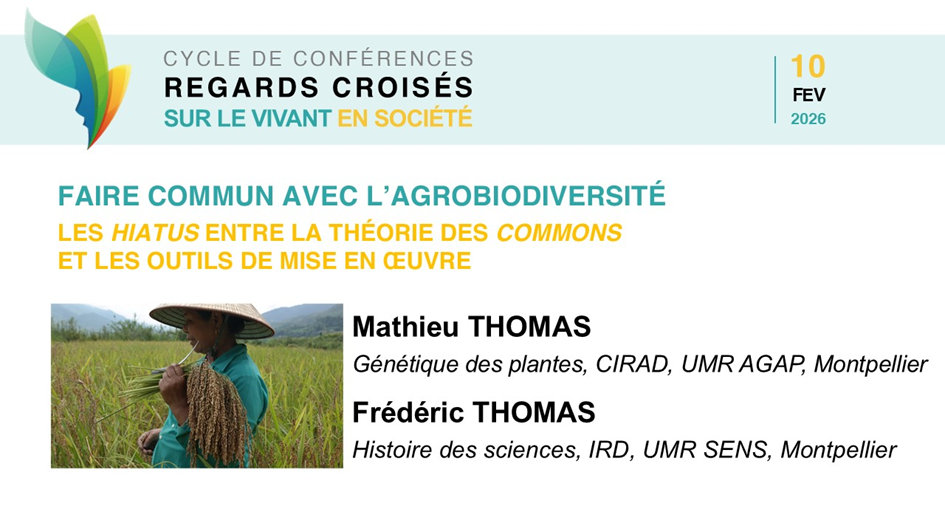
Building a Commons Around Agrobiodiversity – The Gaps Between Commons Theory and Implementation Tools
This event has already taken place!
The Humanities Research Centers in Montpellier (MSH SUD) and Toulouse (MSHS-T), the key challenges BiodivOc, RIVOC, and Octaave, the University of Montpellier (AEB Cluster), Paul Valéry University (UPVM), and the doctoral school “Territories, Time, Society, and Development ” (ED 60) are pleased to invite you to the next conference in the series “Perspectives on Life in Society.”
Everysecond Tuesday of the month between October 2025 and May 2026.
Challenges! It’s time to face the challenges. Poverty, health, food security, water, climate, biodiversity… All the indicators are flashing red; environmentalists have even succeeded in putting the concept of “planetary boundaries” on the international agenda; and scientists (some scientists, at least) are wondering how to put their expertise to work in support of “transitions.”
In light of the challenge posed by this transition, Mathieu Thomas and Frédéric Thomas —a population geneticist and a historian of genetics, respectively—will compare their perspectives on the relevance (or lack thereof) of applying Commons theory to research on “cultivated diversity,” with the aim of moving beyond the dichotomy between formal and informal seed systems.
This lecture series brings together perspectives from specialists in the humanities and social sciences on one hand, and in ecology (in the broad sense) and the environment on the other, to explore major environmental issues and broaden our understanding through an interdisciplinary approach.
Eight doctoral schools in Occitanie (ED58, ED60, and Gaïa in Montpellier; SEVAB and SDU2E in Toulouse; ED305 and ED544 in Perpignan; and ED Risques et société in Nîmes) offer this program to their doctoral students as part of their training (registration required via ADUM).
The primary goal is therefore “acculturation,” particularly for young researchers (although the seminars will be open to the entire scientific community), and to demonstrate how the same subject can be studied in very different ways by different scientific disciplines. In the longer term, the goal is to encourage emerging researchers to integrate interdisciplinary approaches into their day-to-day work.
The series, offered in a hybrid format, is broadcast live from the Maison des sciences de l’Homme.
Receive a weekly summary of theUM 's schedule
* By entering your email address, you agree to receive a weekly summary of the “UM ” calendar via email and acknowledge that you have read ourprivacy policy. You can unsubscribe at any time by using the unsubscribe linkor by contacting us via email.
News
Call for Proposals: ExposUM Master's Internship Support
Published on: August 28 , 2026
ExposUM is an initiative of the University of Montpellier and its partners[1] aimed at…