Artificial Intelligence in Healthcare. The Future of Our Brains: Are We Losing Our Minds?
This event has already taken place!
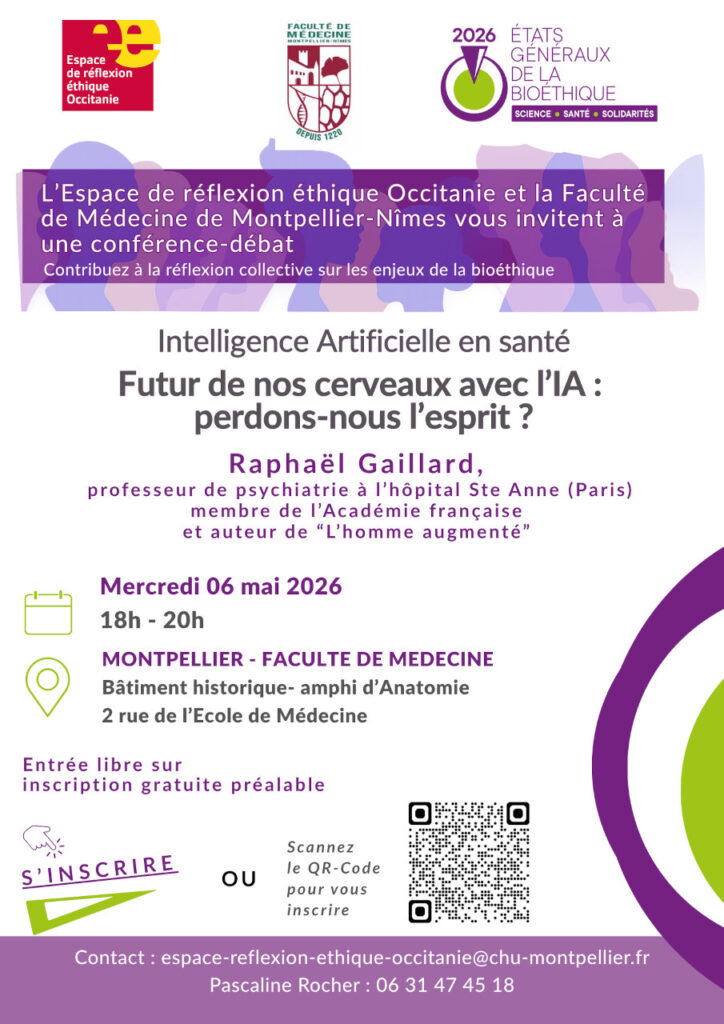
A public forum held as part of the National Bioethics Conference, in partnership with the Montpellier-Nîmes School of Medicine.
Artificial Intelligence in Healthcare.
The Future of Our Brains: Are We Losing Our Minds?
Truly “augmented” medicine will be shaped as much by a return to the humanities as by new technologies.
Raphaël Gaillard, professor of psychiatry at Ste Anne Hospital (Paris), member of the Académie française, and author of *L’homme augmenté*.
Beyond the Divide
For more than twenty years, a neurotechnological shift linked to digital and algorithmic environments has been shaping our behavior. A profound transformation of our society is underway.
Should we be afraid of an inevitable brain-machine hybrid?
Doctors on the front lines
AI has established itself as a valuable tool for identification, guidance, and follow-up, as well as an aid for synthesizing information and making diagnoses in complex cases. It also saves doctors time, but how can we mitigate the risk of dehumanization in patient care?
Is AI, which started out as a support tool, on its way to becoming the dominant force? Is there an alternative vision in which virtual agents and therapists work in tandem?
To train practitioners to use these powerful systems without becoming dependent on them
Assessing the biological and cognitive impact of AI will provide a better understanding of the public health and educational challenges it poses.
The use of AI, which has become second nature to most students, presents both benefits and real dangers (erosion of reasoning skills, lack of personal engagement in learning, and fragmented attention).
There is a high risk of confusing formal consistency with an understanding of the complexity of reality. To be able to make informed decisions, it is essential to learn to cultivate a reflective and critical approach. This requires removing cultural and organizational barriers in medical education.
Receive a weekly summary of theUM 's schedule
* By entering your email address, you agree to receive a weekly summary of the “UM ” calendar via email and acknowledge that you have read ourprivacy policy. You can unsubscribe at any time by using the unsubscribe linkor by contacting us via email.
News

Mapping the Distribution of Migratory Seabirds to Better Protect Them
Published on: September 17 , 2026
Migratory seabirds, which are particularly vulnerable, are important indicators of…