Jacques Curie's Mineralogy Between Paris and Montpellier; The Experimental Sciences Under the Third Republic
This event has already taken place!
Jacques Curie was a forgotten physicist and mineralogist who, along with his younger brother Pierre, was responsible for the discovery and first description of the piezoelectric effect—the phenomenon that allows certain types of crystals to convert mechanical stress, such as compression, into an electric current. The piezoelectric effect is used in many areas of everyday life: gas lighters, sensors, microphones, quartz watches… Most cell phones contain piezoelectric components.
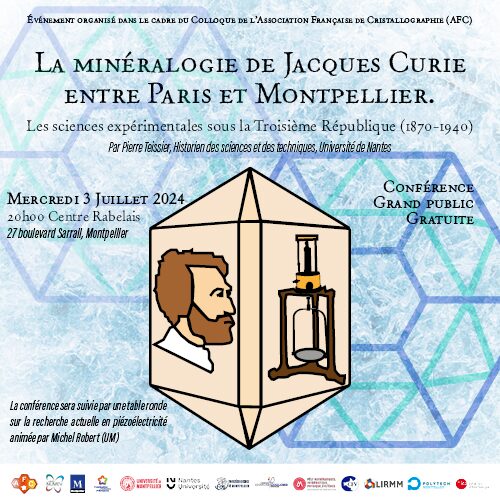
Jacques Curie (1855, Paris – 1941, Montpellier) was a professor of mineralogy at the University of Montpellier from 1883 to 1925, with the exception of the years 1887–1889, during which he taught at the School of Sciences in Algiers. He discovered the piezoelectric effect in 1880 at the age of 25 while working as a laboratory assistant at the Faculty of Sciences in Paris with his brother Pierre, who was 21 at the time. Jacques continued to refine the determination of the piezoelectric constant until 1910 using a device initially designed by the two brothers in Paris. This instrument, the piezoelectric quartz, was also used by Pierre and Marie Curie to measure the natural radioactivity of a substance placed in an ionization chamber. In particular, it made it possible to measure extremely weak electric currents.
Jacques Curie will be the focus of the public lecture at the French Crystallographic Association’s conference in Montpellier on Wednesday, July 3, 2024, at 8:00 p.m. at the Centre Rabelais (27 Boulevard Sarrail, Montpellier). The lecture will be given by Pierre Teissier, Associate Professor of the History of Science and Technology at the University of Nantes:“Jacques Curie’s Mineralogy Between Paris and Montpellier: Experimental Sciences under the Third Republic (1870–1940).” Thelecture will be followed by a panel discussion on current research in the field of piezoelectricity. The roundtable discussion will be moderated by Michel Robert, former president of the University of Montpellier 2, with the participation of Emmanuel le Clézio (Institut Électronique du Sud, Montpellier), Lionel Torres (Montpellier Laboratory of Computer Science, Robotics, and Microelectronics, Polytech Montpellier), and Jean-Michel Marin (Dean of the Faculty of Sciences at Montpellier, Alexander Grothendieck Institute).
The event is sponsored byNUMEV, the University of Montpellier’s Laboratory of Excellence (LabEx) focused on the interaction between computer science and engineering, and the life and environmental sciences.
Receive a weekly summary of theUM 's schedule
* By entering your email address, you agree to receive a weekly summary of the “UM ” calendar via email and acknowledge that you have read ourprivacy policy. You can unsubscribe at any time by using the unsubscribe linkor by contacting us via email.
News

Mapping the Distribution of Migratory Seabirds to Better Protect Them
Published on: September 17 , 2026
Migratory seabirds, which are particularly vulnerable, are important indicators of…