Microplastics: From the Ocean to Our Plates
This event has already taken place!
Microplastics—plastic particles smaller than 5 mm made of chemical polymers—are now found everywhere: in the oceans, the air, the soil, our food, and even in human blood. Their ubiquity makes them one of the major environmental challenges of the 21st century.
Where do these particles come from? What effects might they have on wildlife, plants, and human health? How do researchers detect and study them? And most importantly, what scientific solutions are emerging to reduce or eliminate these persistent pollutants?
To better understand this phenomenon and its implications, we invite you to a unique event: “Microplastics: From the Ocean to the Plate.”
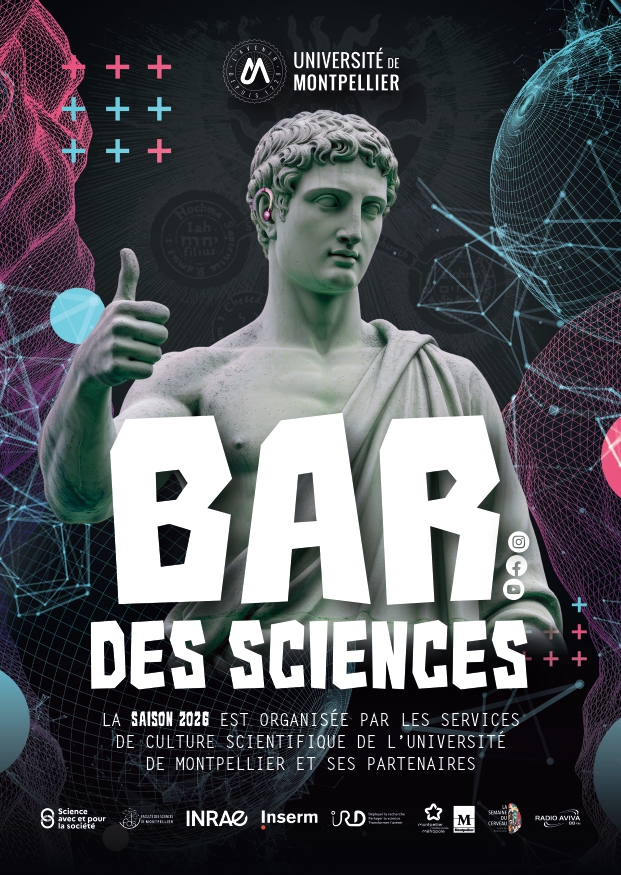
During this fourth evening of the Bar des Sciences—2026 edition—participants will have the opportunity to chat freely with scientists over a drink and ask any questions they may have.
To discuss this topic, three experts from various disciplines will answer questions from the audience live:
- Sylvain Catrouillet is an associate professor in the Faculty of Sciences at the University of Montpellier and a researcher in polymer chemistry and physical chemistry at the Charles Gerhardt Institute (ICGM—University of Montpellier, CNRS, ENSCM). His research focuses on the relationship between the chemical structure of polymers and the architectures they form when they self-assemble in solution.
- Xavier Cousin is a research scientist at INRAE in the MARine Biodiversity, Exploitation and Conservation (MARBEC – INRAE, CNRS, IRD, Ifremer, University of Montpellier) laboratory. He studies the effects of micro- and nanoplastics and associated chemicals on fish physiology.
- Laura Arsenie is an associate professor of polymer chemistry at Polytech Montpellier and a researcher at the Charles Gerhardt Institute (ICGM and Polytech Montpellier – University of Montpellier, CNRS, ENSCM). She is developing new approaches involving polymers for environmental and health applications, particularly materials for pollutant capture and antifouling (anti-adhesive) coatings.
The Bar des sciences has become one of Montpellier’s flagship events for scientific culture, offering a participatory, community-driven discussion on all aspects of science once a month from January through June. Throughout the season, scientists are invited to engage in a dialogue where their knowledge and practices are shared and discussed.
Once again this year, the Bar des Sciences is supported by the University of Montpellier’s ministerial “Science With and For Society” (SAPS) designation. As part of this designation, we remain committed to making scientific culture increasingly accessible. Special attention will be given to the inclusion of deaf and hard-of-hearing individuals at every Bar des Sciences event. As such, this event will feature sign language interpretation provided by Des’L Interprétation.
The season is co-produced by the scientific outreach departments of theUM and its partners: INRAE, INSERM, IRD, the Montpellier Faculty of Sciences, Radio Aviva, and Radio Divergence.
Upcoming Schedule:
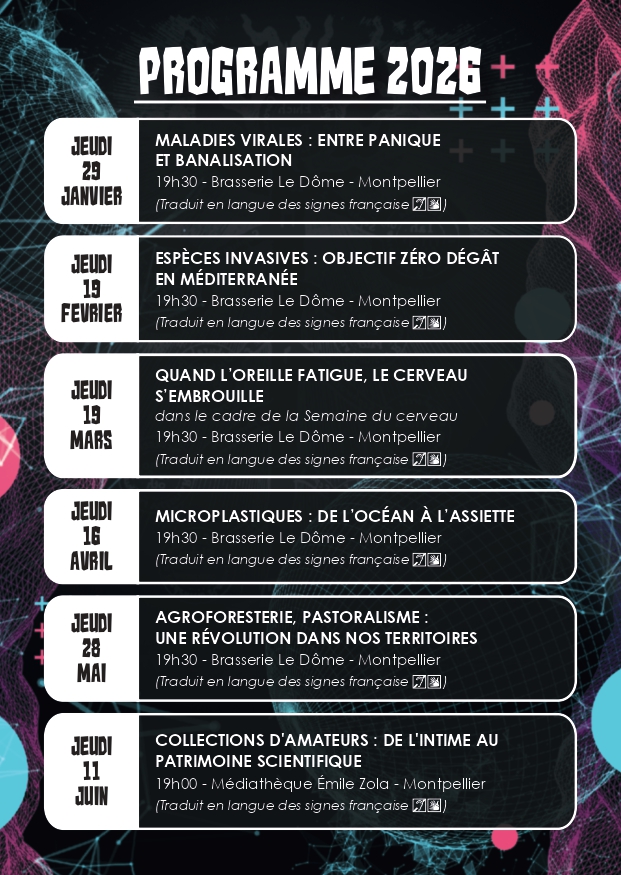
- May 28, Agroforestry, Pastoralism: A Revolution in Our Regions. 7:30 p.m.,
Brasserie Le Dôme, Montpellier. Translated into French Sign Language. - June 11, Amateur Collections: From the Personal to Scientific Heritage. 7:00 p.m.,
Émile Zola Media Library, Montpellier. Translated into French Sign Language.
Receive a weekly summary of theUM 's schedule
* By entering your email address, you agree to receive a weekly summary of the “UM ” calendar via email and acknowledge that you have read ourprivacy policy. You can unsubscribe at any time by using the unsubscribe linkor by contacting us via email.
News
The Cost of Nuclear Electricity: The Details of the Mechanism Proposed by the Government for the New EPR2 Reactors
Published on: October 21 , 2026
A cornerstone of France's energy strategy to gradually replace its existing fleet…