The Role of Protected Areas in Biodiversity Conservation – An Interdisciplinary Analysis of the Effectiveness of Their Management
This event has already taken place!
The Montpellier School of Humanities (MSH SUD) and the Toulouse School of Humanities (MSHS-T), the BiodivOc, RIVOC, and Octaave research initiatives, the University of Montpellier (AEB Cluster), Paul Valéry University (UPVM), and the doctoral school “Territories, Time, Society, and Development ” (ED 60) are pleased to invite you to the next conference in the series “Perspectives on Life in Society.”
Everysecond Tuesday of the month between October 2025 and May 2026.
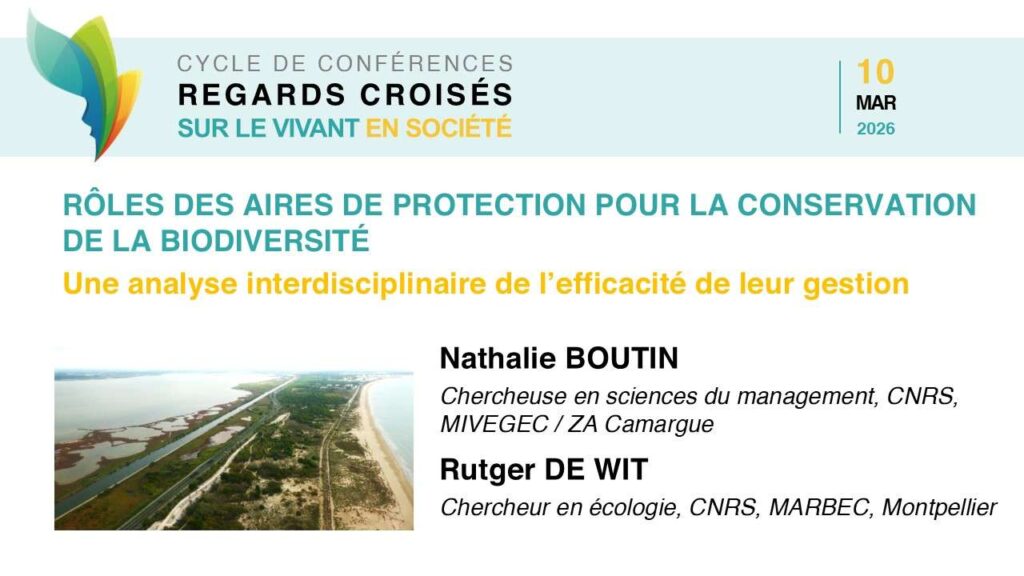
Why would an ecologist want to collaborate with a colleague in the field of management science? Why is management science interested in protected areas (PAs)?
Since 2006, the IUCN has provided a framework for assessing the effectiveness of protected area (PA) management, given that these areas play a vital role in biodiversity conservation. Consequently, the term“paper park”has emerged to describe PAs where management is deficient or highly ineffective. In France, PAs are at the heart of biodiversity conservation policies. Their contribution to conservation depends not only on the richness of these natural environments or their legal status, but above all on how they are managed.
Nathalie BOUTIN and Rutger DE WIT offer a cross-disciplinary perspective combining ecology and management science to understand why some protected areas struggle to achieve their objectives. Drawing on research conducted in the lagoons of southern France, we analyze the constraints faced by managers, who are often caught between administrative requirements, quantitative or profitability targets, and the complexity of living ecosystems.
This lecture series brings together experts from the humanities and social sciences on the one hand, and ecology (in the broad sense) and environmental studies on the other, to explore major environmental issues and broaden perspectives toward an interdisciplinary approach.
Eight doctoral schools in Occitanie (ED58, ED60, and Gaïa in Montpellier; SEVAB and SDU2E in Toulouse; ED305 and ED544 in Perpignan; and ED Risques et société in Nîmes) offer this program to their doctoral students as part of their training (registration required via ADUM).
The primary goal is therefore to foster “interdisciplinary understanding,” particularly among early-career researchers (although the seminars will be open to the entire scientific community), and to demonstrate how the same subject can be studied in very different ways by different disciplines. In the longer term, the goal is to encourage aspiring researchers to incorporate interdisciplinary approaches into their day-to-day work.
The series, offered in a hybrid format, is broadcast live from the Maison des sciences de l’Homme.
Receive a weekly summary of the UM calendar
* By entering your email address, you agree to receive a weekly summary of the UM calendar via email and acknowledge that you have read ourprivacy policy. You can unsubscribe at any time by clicking the unsubscribe linkor by contacting us via email.
News
Science at UM [S05-ep18]: Three Years of Thesis Research Summarized in Three Minutes
Published on: May 22 , 2026
This week on "Science at UM," PhD students Jacintha Naby from the LMGC and Charles Sanctorum from…