In Cazilhac, a "planetary trail" for walking through the solar system
What if we could explore the solar system on foot, along a stream, with our family or our class? This is now possible in Cazilhac, on the Fesquet departmental estate, thanks to the creation of a planetary trail designed by Ana Palacios, an astronomer at the University of Montpellier, in collaboration with the elementary school students at the Montessori Sud Cévennes Je d’Enfants school.
Located in the Hérault Gorges, about 40 kilometers north of Montpellier and at the gateway to the Cévennes National Park, this unique trail offers a fun, scientific, and poetic exploration of the solar system. Accessible to everyone, it transforms a simple walk into a journey through space.
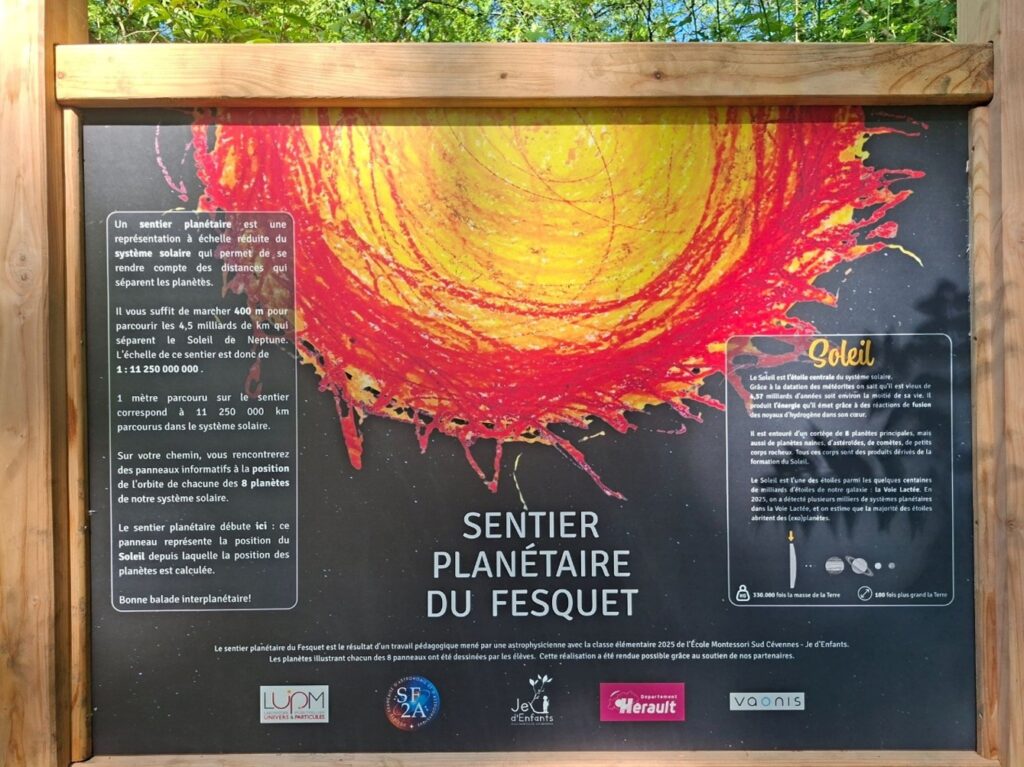
A Path to Understanding the Immensity of the Universe
The concept is simple: to depict the solar system on a reduced scale along a path. As you walk along, you discover the positions of the planets, their characteristics, and above all, the staggering distances between them. That is the whole point of the exhibit: to let you physically experience what numbers alone cannot convey. Walking a few meters, then much farther before reaching the next planet, helps you better grasp the immensity of the solar system—and also realize just how tiny a place our planet occupies within it.
A project that began in a classroom
Behind this installation, which is open to the public, lies first and foremost an educational adventure that spanned an entire school year. With Ana Palacios, the children explored the solar system through science, of course, but also through mathematics, language, art, and even mythology. The students helped design the project—from research and illustrations to building a scale model. The Fesquet Planetary Trail is thus also the result of their work. It’s a concrete way to demonstrate how science can be taught differently, by drawing on curiosity, imagination, and hands-on experience.
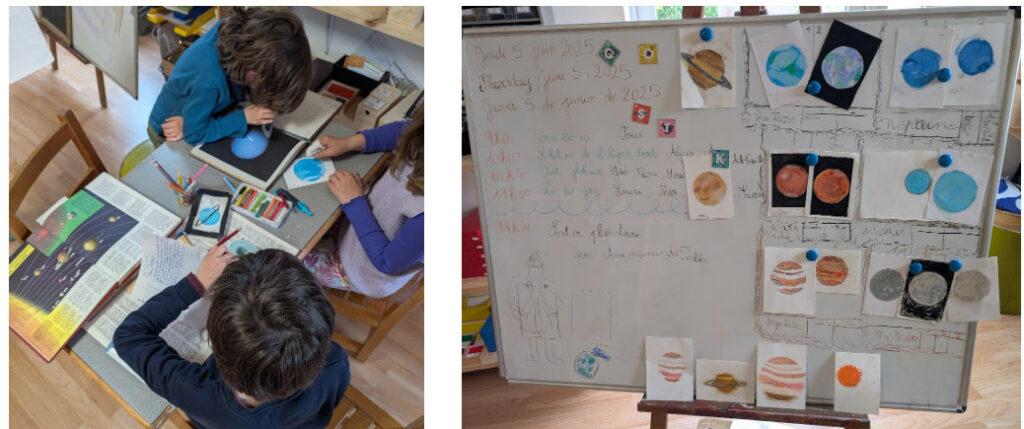
A new place for residents and visitors to explore
Thanks to the support of the Univers et Particules Laboratory in Montpellier, the French Society of Astronomy and Astrophysics, Vaonis, and the Hérault Department, the project was able to take on a sustainable form, with panels installed on the Fesquet departmental estate. The site, which is already very popular, is particularly well-suited for this purpose: a 400-meter tree-lined path in a natural setting enjoyed by families, school groups, local residents, and passing visitors.
The trail thus enriches the area’s range of walking options with an unexpected dimension: a journey that blends nature and astronomy. Located in the immediate vicinity of the Cévennes National Park—one of Europe’s largest reserves of starry skies—the installation also takes on special significance.
An experience that continues on your smartphone
The trail signs feature QR codes that provide access to additional content about each planet, hosted by the University of Montpellier. This allows visitors to continue exploring, either on-site or after their walk. This new trail also echoes the one installed on the University of Montpellier’s Triolet campus in 2008, to mark the International Year of Astronomy, which will be renovated in 2026.