Science at UM [S05-ep02]: Toward Cognitive Virology?
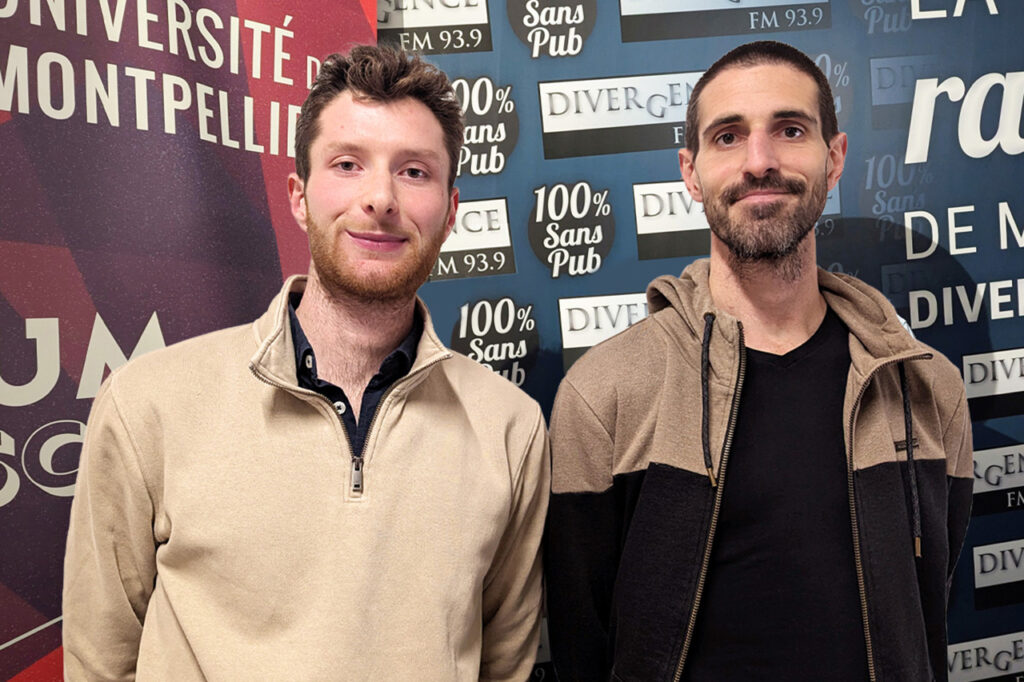
This week on "Science at UM": Raphaël Gaudin and Jules Bouget from the Montpellier Institute for Infectious Disease Research talk to us about cognitive virology. Our report takes us to the dendrochronology lab at the Montpellier Institute of Evolutionary Sciences with Benoit Brossier, and finally, last-minute guest Nathan Roure will introduce us to the Sud de Sciences. A program broadcast every Wednesday on Divergence.
On November 28, the newspaper Le Monde published an op-ed written by a group led by Solenn Tanguy, president of Winslow Public Health, titled“The symptoms of long COVID only make sense when linked to their cause.” This op-ed followed another one also published in Le Monde on November 4 under the title“Alongside the science of diseases, we advocate for the science of symptoms.” A text drafted by researchers and clinicians advocating for a psychosomatic perspective on this same Long Covid.
Proof that six years after its emergence, Long Covid remains a disputed condition in France.
Yet numerous studies document and confirm the persistence of long-term cognitive impairments following COVID-19. One such study, published last September in *Nature Medicine*, compared 351 people hospitalized for COVID-19—with an average age of 54—to 2,927 people who were similar in terms of age, gender, and education level. The result is chilling:“It’s as if these patients’ brains had undergone a 20-year acceleration of the aging process,” says one of the authors.
And COVID isn’t the only virus that causes cognitive impairment: West Nile virus, chikungunya, rabies… All these agents have become experts in the art of infiltrating our brains, and they don’t always do so without leaving traces, as explained by Raphaël Gaudin and Jules Bouget, researchers at the Montpellier Institute for Infectious Disease Research (IRIM) and authors of an article titled “When Viral Infections Alter Neural Circuits: Toward Cognitive Virology, published in the journal Sciences Direct on November 7, 2025.
See also:
- A Strategist Named Zika, Lum Magazine
In the second half of the program, we begin a series of reports from the Institute of Evolutionary Sciences in Montpellier. For the first report, Benoit Brossier takes us on a tour of the dendrochronology lab, where he studies tree growth rings.
Finally, Nathan Roure, the press relations officer at the University of Montpellier, introduces us to the Sud de Sciences festival, which began on December 2 and will run through the 7th for its8th edition.
At UM Science, you’ve got the program—let’s get started!
Co-production: Divergence FM / University of Montpellier
Host: Lucie Lecherbonnier
Interview: Lucie Lecherbonnier / Aline Périault
Reporting: Aline Périault
Production: Alice Rollet
Tune in to the show “A l’UM la science” on Divergence FM 93.9

UM podcasts are now available on your favorite platform (Spotify, Deezer, Apple Podcasts, Amazon Music, etc.).