Science at theUM [S05-ep14]: When the Tardigrade Shares Its Superpowers
This week on *A l’UM : Science*, Simon Galas and Myriam Richaud from theIBMM , as well as Aymeric Bailly from the CRBM , join us to discuss the gene that gives tardigrades their superpowers. In the second half of the show, we’ll visit the food technology platform at the Qualisud laboratory with Caroline Oda. Finally, Marianne Dupré Gabirot introduces us to the Science Bar on April 16. A program broadcast every Wednesday on Divergence.
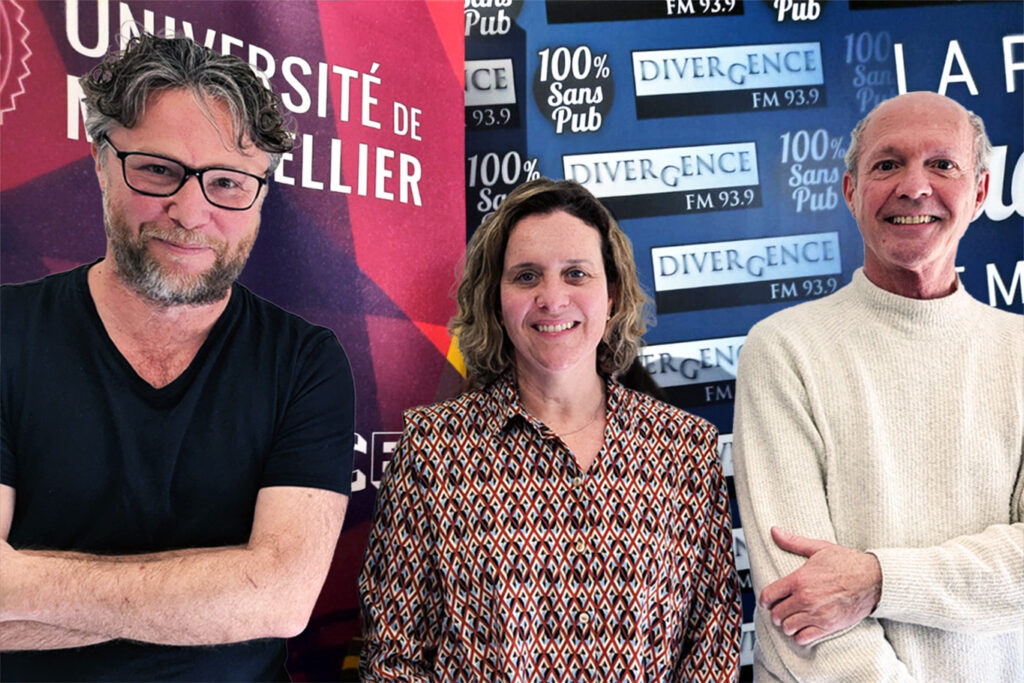
In the Marvel Universe, we all know Spider-Man, the Hulk, and Wolverine; at DC Comics, there are the classics like Superman, Batman, and Catwoman. But have you heard of Tardiman—or maybe Tardiwoman—the blockbuster creation of the Max Mousseron Institute of Biomolecules?
X-rays and gamma rays roll right off him; the temperature of liquid helium leaves him completely unfazed, as do extreme heat or drought, which will send him into a state of cryptobiosis. Just like Graeme Allwright’s cat, you can send him to the moon or to the butcher—his superpowers will keep him unscathed. But where does the strength of this creature—also known as the little water bear—come from?
DNA sequencing of our tiny superhero had already revealed the role of a specific gene called Dsup. And it was this gene that our guests transferred to a nematode. Simon Galas and Myriam Richaud, researchers at the Max Mousseron Institute of Biomolecules, where they run one of only two tardigrade breeding facilities in France, along with Aymeric Bailly, a researcher at the Montpellier Center for Cellular Biology Research, are the authors of this experiment. They published an article in *Science Advances* titled “The tardigrade Dsup protein extends the lifespan of *C. elegans* by inhibiting mitochondrial respiration and promoting resistance to oxidative stress.”
Check out:
- The in-depth feature “Indestructible Tardigrades” in *A l’UM * *La Science*
In the second part of the program, we’ll visit the food technology platform at the Qualisud laboratory at CIRAD, which specializes in food process engineering for tropical and Mediterranean regions. A 1,200-square-meter facility where we’ll tour the various technical labs used for research—and which students can also access—all with a common goal: to optimize the sensory, nutritional, and health qualities of processed foods of plant or animal origin. And to kick off this series, Caroline Oda tells us how she uses filtration to recover valuable molecules from mango or grapefruit waste.
Finally, Marianne Dupré Gabirot, head of the science outreach department at theUM , will present the upcoming Bar des sciences, which will take place on Thursday, April 16, at 7:30 p.m. at the Brasserie le Dôme, focusing on the topic of microplastics.
At "UM : Science," here's the lineup—let's get started!
Co-production: Divergence FM / University of Montpellier
Host: Lucie Lecherbonnier
Interview: Lucie Lecherbonnier / Aline Périault
Reporting: Aline Périault
Director: Alice Rollet
Listen to the show “A l’UM la science” on Divergence FM 93.9
Check out theUM podcasts, now available on your favorite platform (Spotify, Deezer, Apple Podcasts, Amazon Music, etc.).