With droughts, will we still be able to generate electricity using dams?
Not all dams are built to generateelectricity; some are used to support agriculture or regulate river flow. In France, hydroelectric dams account for between 11 and 12 percent of the country’s electricity generation, far behind nuclear power but ahead of wind and solar power.
Jacques Percebois, University of Montpellier
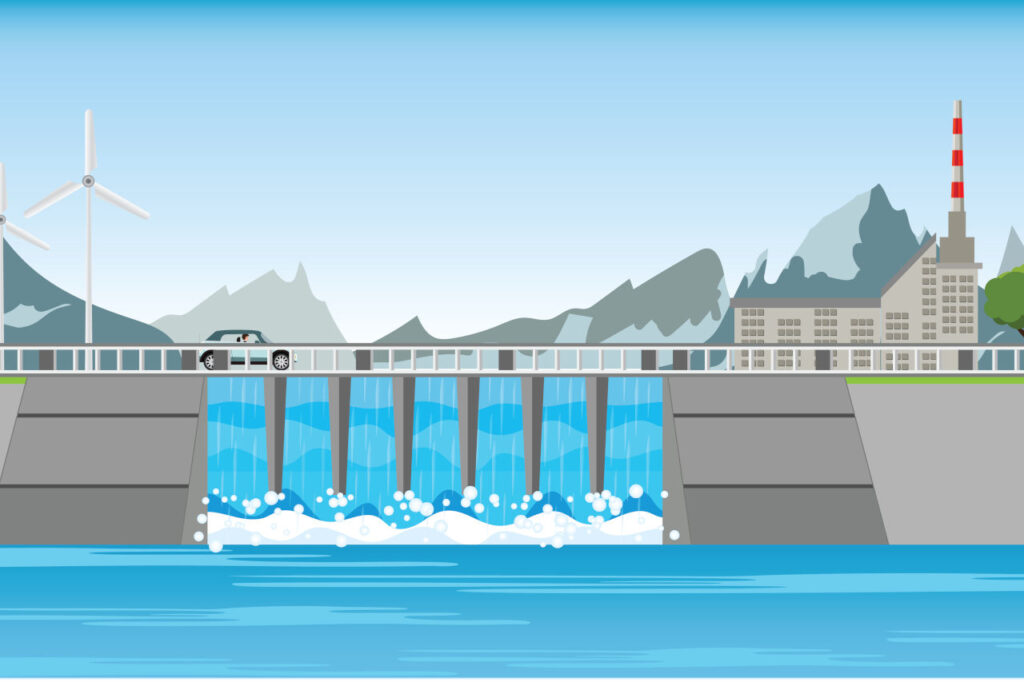
Hydropower also provides one-sixth of the world’s electricity, making it the world’s leading carbon-free energy source. It is a form of energy that, in fact, emits noCO2 (even though carbon is produced during the construction of the facility) and, above all, it is a way to store electricity (water is stored because there is no economically viable way to store electricity on a large scale). In this case, we refer to it as a dispatchable power plant because we can choose when to generate electricity.
There are three main types of dams: run-of-river dams, which continuously generate power from a river; reservoir dams, which have a large water storage capacity and thus allow for inter-seasonal storage; and pumped-storage plants, which consist of two dams—one upstream and the other downstream of a penstock. Water is pumped from downstream to upstream during off-peak hours, and electricity is generated during peak hours by turbining the water from the upstream dam. This allows for optimization of when electricity is generated. It is important to note that a dam’s electrical output is proportional to the head and the flow rate through the turbine.
There is still significant potential for hydroelectric power generation worldwide, but this potential remains limited in France. It is difficult to build new dams for environmental reasons (preservation of biodiversity), but we can hope to increase the potential of existing dams through new investments.
In any case, global warming is likely to jeopardize the use of hydroelectric power due to a lack of water in rivers, but also because of reduced snowfall in the mountains, since snowmelt is a major source of river flow.
It is estimated that this warming could reduce the flow of major rivers by about 20% in the coming decades; however, the impacts will vary from region to region. Taking the Rhône as an example, its flow rate (and likely that of other rivers as well) is estimated to have decreased by 6% to 7% over the past 50 years, and the closer the river gets to its mouth, the more its flow rate decreases.
According to the French Electricity Transmission Network (RTE), hydroelectric generation was down 35% in July 2022 compared with July 2021.
Furthermore, competition between energy and agricultural uses is likely to intensify if water becomes scarcer. River water is also used to cool nuclear power plants, which is why new plants are more likely to be built on the coast. Dams sometimes have to release water to allow for irrigation, especially in the summer. But the water that is released is then no longer available in the winter, which reduces electricity production.

If you have a question too, ask your parents to send an email to: . We'll find a scientist to answer your question. In the meantime, you can read all the articles "The Conversation Junior".
Jacques Percebois, Professor Emeritus at the University of Montpellier, researcher at the CNRS Art-Dev Joint Research Unit, University of Montpellier
This article is republished from The Conversation under a Creative Commons license. Readthe original article.