Engineering Schools Facing the Challenge of the Digital Transition: The Case of Polytech
On the eve of the Polytech Network conference in Lyon on October 3 and 4, 2017, let’s take a look at the unique characteristics, strengths, and challenges of this young network of 14 university engineering schools.
Marc Bidan, University of Nantes; Alexandre Cabagnols, Clermont Auvergne University and Roxana Ologeanu-Taddei, University of Montpellier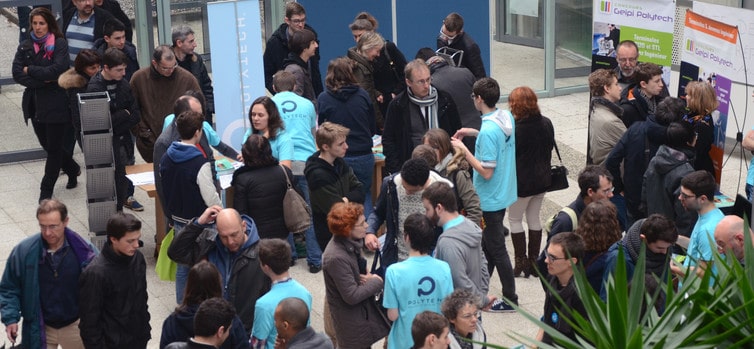
Of course, these 14 institutions remain marginal compared to the 205 schools identified in France. However, their 3,000 annual graduates out of a total of some 35,000 (of whom 30% women but also too few !) now make it the leading program leading to an engineering degree.

Polytech
The recent integration of Polytech Nancy into the network, the adoption of the status of “associated schools,” the creation of the “Polytech Partnership Foundation,” and the arrival of Millennials are, in fact, symbolic events that must be analyzed and considered in light of the digital transition.
It should be noted that all three of us— Professors —are faculty members in the Humanities and Social Sciences departments at the schools in Clermont-Ferrand, Montpellier, and Nantes.
The Origins of the Polytech Network
This network was established in the early 2000s with the emergence of various university engineering schools resulting from local mergers of engineering schools (Nantes (= Ireste + Isitem + Esa Igelec) in 2000, Marseille in 2001, Orléans (= Esem + Espeo) and Tours in 2002, Grenoble in 2003, Clermont (=CUST) in 2006, etc.).
These pioneering schools aimed, on the one hand, to align themselves with the French public university system and, on the other hand—which is closely related—to enhance their national and international visibility.
To date, the results speak for themselves. They make this network—along with the IAE network, created in 1955 for university-affiliated management schools—a resounding success. This success story is based on a unique partnership involving universities, the Ministry of Higher Education, Research, and Innovation (MESRI), the Conference of Directors of French Engineering Schools (CDEFI), and the Commission for Engineering Degrees (CTI).
Already 70,000 engineering graduates
Thus, as of February1, 2017, the Polytech network comprises 14 public schools under the jurisdiction of the MESRI that award engineering degrees recognized by the CTI. It also includes two affiliated schools (ISTIA Angers and ENSIM Le Mans), which are “intended to use the same admission process as the member schools of the Polytech network for high school graduates (the Geipi Polytech entrance exam) and for students in preparatory classes for the grandes écoles (the Polytech entrance exam).” It offers a dozen fields of study (computer science, civil engineering, thermal and energy engineering, mechanical engineering, biomedical engineering, mathematical engineering and modeling, materials science, etc.).
The network has already graduated more than 70,000 engineers currently working in the field and awards degrees to approximately 3,000 students each year, making it the largest in France in terms of the number of degrees awarded. It draws on the expertise of some 1,300 full-time Professors , dozens of research laboratories, hundreds of visiting professors, and thousands of practicing specialists from all professional sectors who contribute on an ad hoc basis (lectures, tutorials, lab sessions, projects, seminars, workshops, serious games, etc.).
The Strength of Joint Competitive Exams and Non-Traditional Hiring Practices
The 14 member schools of the network—as well as about 15 other non-member engineering schools—recruit their engineering students at the high school diploma level through a joint entrance exam called Geipi Polytech, which attracts approximately 16,000 applicants each May for about 3,000 spots offered at the roughly 30 schools participating in this major post-high-school entrance exam.
Similarly, the schools in the network recruit students at the bac +2 level through the entrance exam known as e3a. This exam is common to many engineering schools and is open to students in science-focused preparatory classes.
Ultimately, engineering graduates from the Polytech network generally come from three main groups, and interaction and exchange among them should be encouraged: 1/3 PEIP, 1/3 CPGE, and 1/3 DUT
Finally, it should be noted that the schools in the network also recruit their engineering students through numerous other admission pathways based on academic credentials, application reviews, or prior academic experience. A first example: the innovative program designed for students who passed their first-year medical school exams (PACES) but were not admitted to medical school, as part of the AVOSSTI project, which was selected by the jury for the IDEFI call for proposals in 2012. Eligible students who voluntarily choose this path then enter directly into the second year of the integrated PeiP program (preparation for Polytech engineering schools) at one of the network’s schools. A second example: the opportunity offered to certain STI2D high school graduates after completing a preparatory program at an IUT. A third and final example: the 3+1+2 track designed for students from Shanghai Maritime University.
The Polytech Ecosystem
In addition to the network’s 14 member schools, this ecosystem includes the two affiliated schools, the CTI—which awards the engineering degree and oversees the accreditation required to grant that degree—; the CDEFI (Conference of Directors of French Engineering Schools); the MESRI, which oversees the recruitment and careers of university faculty members ( Professors )—primarily temporary teaching and research associates (doctoral students), associate professors, and full professors; the universities (and the CPU), which serve as the institutional “parent organizations” of which the Polytech schools are components; research laboratories, which may of course include members from universities, scientific research centers (CNRS, Inserm, INRIA, IRD, INED, IFSTTAR, etc.), and other grandes écoles (École Centrale, École Polytechnique, INSA, Institut Mines-Telecom, etc.); the alumni association (Polytech Alumni) and the student association; the international experiences of network members (Polytech Abroad); and finally, the recently established “Polytech Partnership Foundation.”
The uniqueness of this young ecosystem—which is currently limited to metropolitan France—lies in the interoperability and coherence of the network’s 14 members. It also rests on joint leadership provided by the network coordinator and his team and—in our view—on a triad of shared values centered on the concepts of ambition, community roots, and kindness.
The Three Challenges of Massive, High-Quality Degree Conferral
The network faces three complex and intertwined challenges, consistent with what the network has now become after 17 years of existence.
1. Balance mass participation and quality
The first is that of a degree program that must continue to be both large in scale (enrollment) and high in quality (teaching and research). This network has become, de facto, the leading provider of engineering education in France, “producing” approximately one out of every ten engineers annually. Even though the number of engineers trained in France remains far too low to meet the strong demand and the 10,000 annual retirements (the Conference of Directors of French Engineering Schools aims to graduate 50,000 students in five years, thereby significantly exceeding today’s figure of 35,000 graduates), the strength of this network—with its twelve specializations and 70,000 active engineers—clearly makes it one of the most significant direct contributors to national competitiveness. The effort to reindustrialize France —and Europe—needs engineers!
Thus, the Polytech network must retain control over the selection process and recruitment procedures. However, throughout this educational process—including, and perhaps especially, during the two years of integrated preparatory classes—the network must (1) encourage rather than penalize, (2) guide and support, and (3) be open to non-traditional profiles and talents. In this respect, it differs from the IAE network, which faces the complexity of an unmanaged selection process and the strong appeal of business studies!
2. Govern globally and act locally
The second challenge is that of its governance. It must continue to be both global and local. It will need to remain global through active and visible coordination of the network, a one-stop shop for partners—whether public or private, national or international—powerful shared tools such as the e-planet educational platform or the admissions exam, jointly implemented educational and research projects, and shared communication and visibility, support for the growth of our key arm, Polytech Alumni, and our “calling cards” —the BDE and BDS student unions—and so on.
It will also need to think locally, with recruitment for the “ Professors ” aligned with major local priorities, research efforts consistent with competitiveness clusters, private partners, and other regional business and innovation ecosystems, and the creativity and originality of locally driven educational innovations, and the long-term sustainability of specializations deeply rooted in specific regions, such as the marine algae program in the GPB program in Nantes-St. Nazaire or the “from scanner to scalpel” track in the GM program in Marseille. The challenge of governance must be conceived at the network level and implemented at the local level—that is, at the level of the 14 schools and, in some cases, the specializations themselves.
3. Embrace Millennials and adapt to an inevitable digital transition
The third challenge is that of digital transition and transformation. It has surpassed the challenge of the early 2010s regarding globalization, even though it builds on some of the same approaches (interdisciplinarity, research, networking, openness). However, it also requires trainers to have a solid understanding of the complexity and irreversibility of this phenomenon, which is driven by the rapid platformization of economic activities (big data, algorithms, pricing, monitoring, outsourcing, disintermediation, etc.) and by the functional/fictional interplay of the technologies that underpin it—a reality that, in part, necessitates a rethinking of the role of the “Professor.”
Rethinking How We Welcome Hyper-Connected Engineering Students
This challenge also requires us to rethink how we welcome generations of engineering students who are very different from their predecessors—and, therefore, from their teachers and instructors. These generations, with their exotic and controversial labels (Generation Y, Millennials, digital natives, YOLO, Generation Peter Pan, etc.), are characterized by numerous paradoxes. It is essential to adapt to them by prioritizing active listening and empathy in our teaching, as well as the acquisition of skills—including (1) the ability to integrate into an organization and (2) the ability to take into account the industrial, economic, and professional challenges discussed on page 7 of this CTI document—rather than, strictly speaking, knowledge (which quickly becomes obsolete)—and by reinventing our assessment tools, which are still too exclusively based on grading from 0 to 20 and ranking relative to the arithmetic mean. For example, we should value their cognitive agility, their curiosity, their appetite for coworking and third places, and finally their hyper-connectivity —which is not merely an “inability to concentrate for long periods”—as well as their pursuit of “beauty,” “ethics,” and “pleasure.”
This hyper-connectivity is, moreover, directly linked to the emergence of a “hyper-industrial society,” which is itself undergoing profound transformations due to the penetration of ICT into the very heart of productive activity (Pierre Veltz, *La société hyper-industrielle*, 2017: value chains, the internal organization of companies, strategies, and the role of the workforce are thus being reimagined.
This digital transition is not merely technological but also “societal.” Its rollout is underway, and its ultimate outcome remains uncertain. This poses a challenge for educational support, which must incorporate into training the non-scientific and non-technical dimensions—namely the organizational, economic, legal, societal, environmental, and managerial aspects—specific to the emerging digital ecosystems in which our future engineers will operate and—hopefully—thrive.
Rethinking the Modular Approach to Engineering Education
The idea is to offer bridges and other pathways to other types of skills. For example, the recent partnership signed with the IAE network is a promising avenue to explore and build upon to give our students some additional tools. The goal is to help them acquire managerial and entrepreneurial skills so they can better open certain doors that will present themselves throughout their future careers, which will inevitably be “dual-skill” careers.
This agreement is consistent with the numerous local agreements that have existed since the 2010s between the IAE and Polytech divisions of certain universities, aimed at developing new professional profiles. This challenge of dual expertise with dual entry paths (engineer-manager/manager-engineer) is also linked to the challenge of lifelong learning and the future, massive challenges of accommodating students in a vocational training system that has finally been revamped.
Two Approaches to Addressing These Challenges
We propose to strengthen what is currently one of the network’s key strengths—namely, collaboration among its 14 schools—and to prioritize the pursuit of relevance.
1. Strengthen exchanges, mobility, and interdisciplinary collaboration
Paradoxically, the network’s youth is also an asset in terms of operational flexibility and the ability to adapt both to the digital transition and to the arrival of new generations of engineering students who differ significantly—in both substance and form—from those who came before them.
With regard to students, the schools must be able to increase short- and medium-term mobility within the network as a whole, even though it is already relatively significant following the two years of preparatory studies and during the fifth year. With regard to faculty and staff, the network must also be able to improve their mobility. It must also continue to establish cross-disciplinary services, centers, or departments—in addition to language programs designed to help students achieve a TOEIC score of 785 —focused on the “humanities” (economics, management, law, sociology, etc.), which are well-structured and offer a significant volume of coursework (amounting to 20% of the total curriculum).
These cross-disciplinary units have proven to be useful, flexible, unifying, and well-received— particularly by employers—according tofeedback from post-graduation surveys. They can also serve as an valuable 3E (school/student/company) meeting point for the essential support ofapprenticeships and work-study programs.
2. In the balance between rigor and relevance, focus on relevance
Let’s address one of the main—and likely controversial—challenges. Indeed, it is customary to base the excellence of research and scientific training on the combination a high level of rigor and a high degree of relevance.
In this regard, from the perspective of our respective “humanities” departments, it seems to us that rigor (for example, aimed at a precise and reliable result?) has been prioritized for too long at the expense of relevance (i.e., aimed at a useful and appropriate result (… for the question at hand)?). Consequently—in a world rich in questions, disruptions, interdisciplinarity, and algorithmic – We believe it is important to shift the focus back toward the pursuit of relevance.
The idea is to prioritize the acquisition of skills that are relevant. Skills that will preserve (at least a little!) the White-Collar Workers and Big Data. First and foremost, engineering students must learn to thoroughly understand and define the problem at hand, to consider its impacts (even the most unlikely and counterintuitive ones) and its implications. The next step is to propose a reasonable and effective methodological approach (prioritizing efficiency over effectiveness) in order to help provide a scientific and technical solution that is acceptable, cost-effective, and useful.
 Engineers, faced with a digital world that is disrupting the hierarchical structure of knowledge, must accept that they are no longer the ones “who know and can do everything” and instead become experts who know how to communicate shamelessly when he no longer knows !
Marc Bidan, Professor of Information Systems Management at Polytech Nantes, University of Nantes; Alexandre Cabagnols, Associate Professor of Economics and Management at Polytech Clermont-Ferrand, Clermont Auvergne University and Roxana Ologeanu-Taddei, Associate Professor with the authority to supervise research in Management Sciences at Polytech Montpellier, University of Montpellier
The original version This article was published on The Conversation.