INEAR3D: 3D Printing for Hearing Health
Led by the Charles Gerhardt Institute in Montpellier (CNRS, UM, ENSCM), conducted in partnership with the Montpellier-based company Cilcare, and supported by the University Innovation Cluster (PUI), the Inear3D project is on track to recreate the architecture of the round window of the ear in 3D. This organoid-in-the-making could greatly facilitate the study of treatments for hearing health.
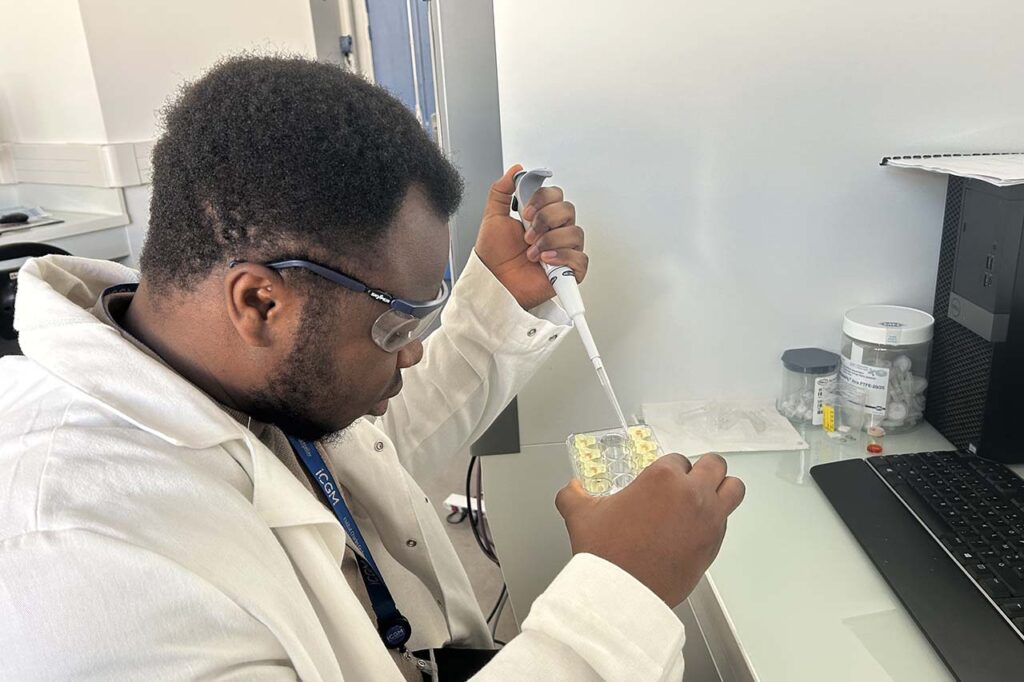
In Montpellier, theICGM ’s macromolecular materials team is on the verge of overcoming a major hurdle in the field of hearing health. Commissioned by Cilcare, a company that develops and tests otological treatments, these researchers are working on the biomimetic printing of a complex organ: the round window of the ear, a biological barrier that ensures the diffusion of most active ingredients involved in hearing. “The inaccessibility of the cochlea and the lack of human cellular models are two major obstacles,” says Sylvie Pucheu, director of preclinical innovation at Cilcare.
Moving Beyond the Animal Model
Until now, it has been impossible to test treatments currently in development without using animal models. But Inear3D could soon offer biotechnology companies a unique and highly innovative alternative through 3D printing, thanks to both its high resolution and its reproducibility. For Sébastien Blanquer, a researcher at ICGM and the project’s principal investigator, this approach addresses both a practical and an ethical need. “Working with animal models is very costly, and there are obvious ethical limitations, which is why we need to develop biotechnologies,” he explains.
Since 2024, the scientist has been working closely with Cilcare, alongside two colleagues from the lab: Emmanuel Belamie, a specialist in materials science and bioengineering, and Marie-Noëlle Labour, an expert in cell biology. “Our department’s approach is to work as a team and draw on everyone’s expertise to carry out our research projects as effectively as possible, ” he explains. Together, they are studying this thin biological barrier that separates the middle ear from the inner ear. The team was further strengthened in April with the arrival of Gabin-Junior Endjeu Tchouassi, who began a doctoral project focused on this topic.
Bioprinted device
From a practical standpoint, the scientists opted for stereolithography, a well-established technique in the field of 3D printing, an area in which the expertise of ICGM researchers is already well recognized. The principle involves building the membrane layer by layer, with each layer being “photo-crosslinked”—that is, solidified through exposure to light. “But with this process, it’s important to study various types of polymer materials and investigate how they interact with cells to create a bioprinted device,” explains Sébastien Blanquer.
“Ultimately, this system will enable the rapid fabrication of these membranes, with thicknesses ranging from 100 to 200 micrometers. Our goal is, of course, to replicate properties as close as possible to those of the round window, but also to be able to test the various active ingredients using a simpler protocol.” At the same time, the team also reached out to Yvan Duhamel, an engineer at the Pro3D platform of the Laboratory of Mechanics and Civil Engineering (LGMC) at the University of Montpellier, to develop devices that would facilitate the study of the diffusion of these substances.
Prototype in 2028
Developed as part of a Cifre thesis, Inear3D was selected as a winner of the “Companies and Campus” call for projects in October 2024. Thanks to this initiative, launched as part of the Montpellier University Innovation Cluster, the team received a grant of 50,000 euros to help cover the various research costs associated with this project: “We have a collaboration agreement with Cilcare, but any additional support is welcome, ” the researcher admits. “Research comes at a cost, and especially in cell culture, with biological consumables, the bill can be steep.”
This fine example of a partnership between the research community and the private sector is expected to result in a prototype by 2028, after which the scientists will hand over the results of their research to Cilcare, with the goal of advancing the field of hearing therapy. According tothe Pasteur Institute, hearing loss is the most common sensory disorder in humans. Given what’s at stake, this should make quite a splash…