From Research to Startup: Theralan's Success Story
When an innovator meets a university incubator, the result is an budding entrepreneur who thrives in an ecosystem supportive enough to help them flourish. This is the case for Romain Lanotte, a PhD alumnus of the University of Montpellier whose deep-tech startup, Theralan, is supported by the academic incubator Initium. Meet a passionate young researcher who aims to revolutionize cancer treatment in the coming years.
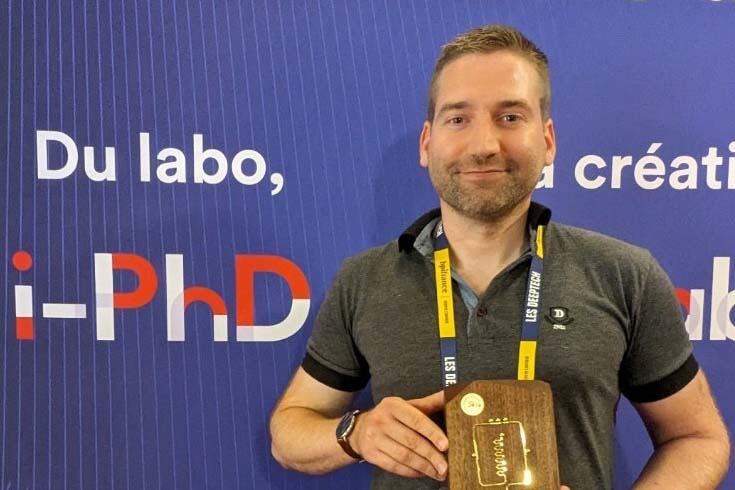
The meeting is taking place at the Initium coworking space, located in the Port-Marianne neighborhood. In late September, with the weather feeling like an Indian summer, a back-to-school breakfast is being held there, bringing together a few of the project leaders supported by the incubator. Among them is Romain Lanotte, 34. Last June, his project, Theralan, was officially approved to move into the incubation phase. This marks a major milestone in a journey that began a few years earlier, while he was still a student.
From 2014 to 2018, Romain Lanotte worked on his Ph.D. in health biology at the IRCM (Montpellier Cancer Research Institute). He “doesn’t count the hours” he spent working on a complex topic:“My thesis focused on studying a molecule found on the surface of cancer cells and how to target it with therapeutic antibodies and potentially develop them into cancer drugs.”Antibodies are large molecules that can target and destroy tumors—a process known as immunotherapy. Despite the pressure—his final year of doctoral research was funded by the Ligue contre le cancer—he achieved significant results, leading to a scientific publication and a patent application for the new molecules he developed. And he alreadyhas plenty of ideas in mind:“During my thesis, I thought to myself that I could replicate the process with other molecules.” The young researcher isn’t the type to jump into things on a whim. Preferring to broaden his professional and scientific experience, he’s aiming for a postdoc abroad—preferably across the Atlantic. But things don’t always go as planned.
Lockdown and Business Plan
Instead of heading to Toronto, Romain Lanotte is confined to his home due to the global health crisis caused by COVID-19. It’s spring 2020, and everything has come to a standstill. Instead of sitting around twiddling his thumbs, the newly minted doctor dove back into his research:“I put my ideas down on paper, worked out the budgets, and taught myself about business plans and entrepreneurship online…” His financial situation remains precarious during these times of crisis. “As a young, unemployed doctor, I had a hard time convincing certain players in the ecosystem to support me on this entrepreneurial path ,” he admits. That’s why he accepted a position as director of studies at Eurofins, near his home, where he manages“more than 80 studies for pharmaceutical companies and a portfolio worth several million euros,” which reassures him of his ability to manage an entrepreneurial project. He stayed there for a year and a half before resigning in January 2023, turning down a permanent contract in the process. His mind was made up: he was going to throw himself 300% into his business venture, to which he was already devoting a good portion of his free time.
i-PhD Award Winner with Pepite Deep Tech
“I saw the call for applications to join the Initium incubator; since I was an alumnus, it was a perfect fit,” says Romain Lanotte. “I was accepted into the Pépite Deeptech program, launched as part of the University Innovation Cluster (PUI). Why deep tech? Because it’s disruptive innovation—something that aims to transform society—and that’s exactly what I want to do with the molecules I’m developing.” For six months, his startup project, named Theralan, took shape, and things finally started moving forward:“The incubator gave me the credibility I needed. Thanks to its support, I was able to convince several key players in the ecosystem—such as Inserm, the CNRS, and SATT AxLR—to help me access competitions and entrepreneurship training programs… ” The hard work paid off. In 2023, Romain Lanotte was one of only two winners in Eastern Occitanie of the i-PhD national innovation competition—both of whom, incidentally, were alumni of the Pepite DeepTech program—and he also secured funding from the Montpellier Innovation Booster (BIM), which enabled him to launch the initial stages of research and development.
Making Things Possible
What about tomorrow? As part of Initium’s incubation phase, the future entrepreneur continues to receive support as he tackles his challenges. In this regard, his journey perfectly illustrates the ups and downs of a deep-tech entrepreneur in the healthcare sector. Still registered with Pôle Emploi, Romain Lanotte must quickly join a research institute to benefit from development programs that match Theralan’s scientific and economic ambitions. He already has a pretty good idea about this:“I’d like to work with the Montpellier Institute of Functional Genomics, where I completed my first year of my master’s degree; they’re experts in this field, and the lab strongly supports me in this project. It’s the ideal place to continue this R&D.”
The fact remains that his project is clearly defined:“We’re going to develop a new class of drugs for treating cancers and other diseases—drugs that are more powerful and less toxic than current treatments.” The challenge now is to secure the funding that will make this possible—which is the main focus of this incubation phase:“We’ll need to raise funds to develop our compound through clinical trials; I’ve already estimated the project’s cost at several million. Our goal? To enter Phase 1 clinical trials by 2028 to treat the first patient with a brain tumor and offer a truly effective therapy that extends these patients’ survival.”The young researcher from Montpellier won’t give up:“This is truly my life’s work.”
Excellence in Incubation
Officially launched in September 2022, the Montpellier-based university incubator Initium succeeds theUM ’s I-Lab. The academic incubator aims to strengthen its mission of supporting entrepreneurs within the framework of the I-SITE program of excellence and its three pillars: “nourish, care for, protect .” These project leaders may include students, alumni, doctoral candidates, recent PhD graduates, or research staff associated with the University of Montpellier’s five research clusters. Generally, innovative projects are accepted throughout the year into the pre-incubation phase based on an application review, for a period of 6 to 12 months.
A specialized pre-incubation program, Pépite Deeptech, is designed for students, doctoral candidates, and early-career researchers with disruptive technology projects. It takes place on fixed dates over a five-month period, from February to June. Admission to the incubation phase is based on a jury’s evaluation
and enables participants to begin co-incubation support with a regional organization that is a member of ResO IP+ (a network in the Occitanie Region comprising 50 incubators and business nurseries, of which Initium is a member), which will then take over to ensure ongoing entrepreneurial support. This is a way to benefit from the strength of the ecosystem following the PUI certification (see “Innovation Cannot Exist Without Trust”). Twenty-six projects are currently being supported by Initium in pre-incubation or incubation, and others will be added as applications are received. As for the Pépite Deeptech program, registration begins on November 13; a maximum of ten projects will be selected. Now is the time to embark on an innovative entrepreneurial journey!