Is the entrepreneurial culture really more developed elsewhere than in France?
Entrepreneurship is a key driver of a society’s health and prosperity. It is also a powerful driver of economic growth.
Karim Messeghem, University of Montpellier; Frank Lasch, Montpellier Business School and Justine Valette, University of Montpellier

It fosters the innovation needed not only to capitalize on new opportunities, boost productivity, and create jobs, but also to address some of society’s greatest challenges, such as the United Nations’ Sustainable Development Goals (SDGs).
Promoting entrepreneurship is thus a key priority for many governments around the world. In France, the number of new businesses reached record highs, with nearly one million new companies in 2021, although this figure should be viewed in context given the significant share of micro-entrepreneurship and platform-based entrepreneurship. Does this reflect an entrepreneurial culture that has developed and taken root in recent years? And how does France compare to other countries in terms of its approach to entrepreneurship?
To answer these questions, we conducted two studies in 2021 for the Global Entrepreneurship Monitor (GEM) as part of the LabEx Entreprendre program at the University of Montpellier: the first focuses on entrepreneurial activity and was conducted among the French population aged 18 to 64 (APS Study); the second focuses on the national entrepreneurial ecosystem and was conducted among a panel of experts (NES Study). These two studies are replicated in other countries by national teams affiliated with the GEM, thereby enabling international comparison.
France is about average
The survey of experts shows, in particular, that among the G7 countries, there is a certain degree of consensus regarding the perception of the entrepreneurial ecosystem, which is viewed as generally favorable. Only the United States (5.3/10) stands out slightly. There is a strong similarity among countries such as Germany, Canada, and France (5.1/10), where conditions are generally perceived as fairly favorable. In contrast, these conditions are perceived as less favorable in Italy and Japan (4.7/10).
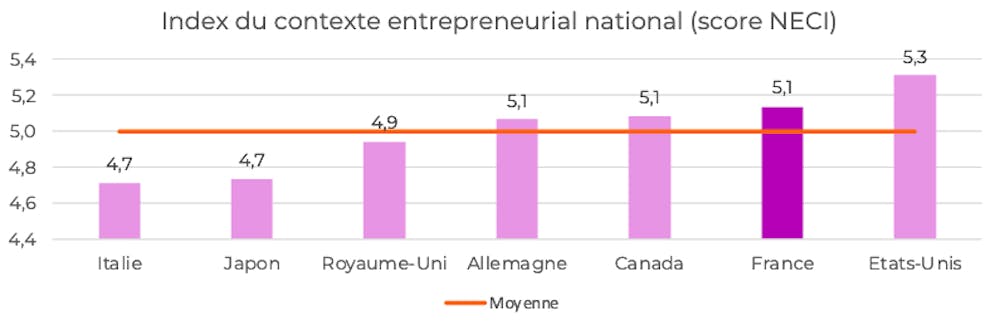
Among the 19 wealthiest countries participating in the GEM, France stands out in terms of government policies (4th out of 19). The efforts made at the national and regional levels over the past two decades to promote entrepreneurship have thus been recognized and have helped foster a particularly dynamic ecosystem of entrepreneurial support.
However, France still lags behind in terms of cultural and social norms (18th out of 19) and entrepreneurial education at the primary and secondary levels (17th out of 19). The entrepreneurial revolution does not yet seem to be having its full impact on society, and further efforts are needed to foster an entrepreneurial culture. Similarly, market access appears to be a weak point (17th out of 19) in the French entrepreneurial ecosystem, which undermines the development of emerging companies.
Positive portrayal
The value placed on entrepreneurial activity in a country—and thus the strength of its entrepreneurial culture—can be assessed using four indicators. These indicators assess whether entrepreneurship is perceived as a desirable career choice, whether it confers high social status, whether it is promoted in the media, and, finally, whether it is easy to start a business in France. This is what we did in our survey of the general population.
When comparing France to other G7 economies, it again falls within the average range. For just over two-thirds of the French people surveyed, entrepreneurship is a desirable career choice. However, only a slim majority (55.4%) considers it to be a high social status today.
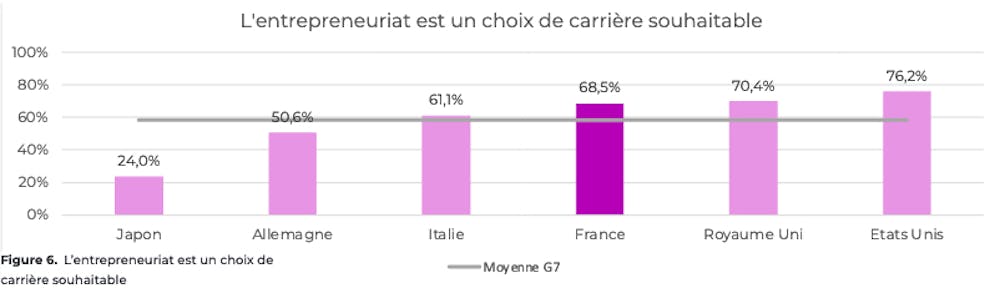
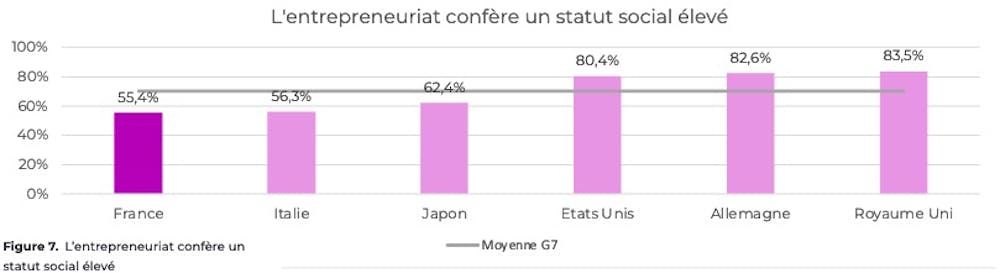
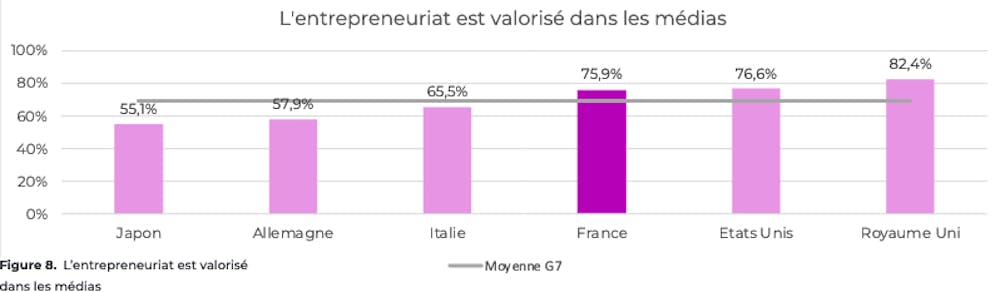
This positive portrayal is an indicator of the evolution of entrepreneurial culture. This culture is influenced by the media, which helps to convey a more or less favorable image of entrepreneurship. A large majority of French people feel that, whether in the media or on the Internet, stories about successful new businesses are highlighted (Figure 8).
One example is the M6 show “Qui veut être mon associé,” which features entrepreneurs seeking funding. This reality TV show, which has been around for about twenty years in other countries, aired in France for the first time in 2021 and is helping to make entrepreneurship and the process of raising funds more accessible to the general public.
Beyond perceived desirability, the issue of perceived feasibility is important. Depending on the country and the time period, perceived barriers related to the ease of registration and the burden of bureaucracy can hinder entrepreneurial intent and behavior. A slim majority believes that it is easy to start a business in France (Figure 9).

For the past twenty years or so, governments have been adopting measures to simplify the process of starting a business. This perception varies greatly from one country to another: the United States, Canada, and the United Kingdom stand out for the perception that it is easy to start a business, in contrast to Japan, Italy, and Germany.
"Making a Living"
However, according to our study, the strongest motivation for entrepreneurs is “to make a living because jobs are scarce” (51.2%). This finding suggests that a majority of them embark on the entrepreneurial journey out of necessity. This figure is higher in Canada (70.7%), Italy (61.3%), and the United Kingdom (63.8%). By contrast, it is lower in the United States (45.8%), Germany (40.9%), and Japan (40.1%).
Entrepreneurs are less likely to pursue an entrepreneurial career to “build great wealth or earn a very high income” (39.4%). The other two motivations apply to only one-quarter to one-fifth of entrepreneurs. Only 25.8% of the entrepreneurs surveyed cited a desire to make a difference in the world as a motivation for starting a business, whereas in the United States (71.2%) and Canada (70.4%), the proportions are much higher. The same is true of the motivation to “carry on a family tradition,” which applies to only 22.9% of entrepreneurs in France, compared to 41.5% in the United States and 50% in Canada.


The study thus confirms the notion that France is becoming an entrepreneurial society. However, entrepreneurial culture does not appear to permeate society as a whole. Action is still needed to remove certain barriers. As the panel experts point out, France lags behind other wealthy countries when it comes to entrepreneurial education at the elementary and secondary school levels.
Conferences on entrepreneurship education at the elementary and secondary school levels could, for example, help participants gain a better understanding of best practices in France and abroad, and develop a strategy tailored to diverse contexts.
Karim Messeghem, University Professor, University of Montpellier; Frank Lasch, Full Professor of Entrepreneurship, Montpellier Business School and Justine Valette, Associate Professor of Management Sciences, University of Montpellier
This article is republished from The Conversation under a Creative Commons license. Readthe original article.