The Russia-Ukraine War: An Analysis of African Countries’ Votes at the UN
In recent weeks, the world has witnessed the most tense situation in international relations since the end of the Cold War, with Russia’s invasion of Ukraine. These tensions were evident during the deliberations and the vote by United Nations members on resolutions calling on Russia to end its invasion and withdraw its forces from Ukraine. These events have also put the resilience of military and political alliances to the test.
Mahama Tawat, University of Montpellier
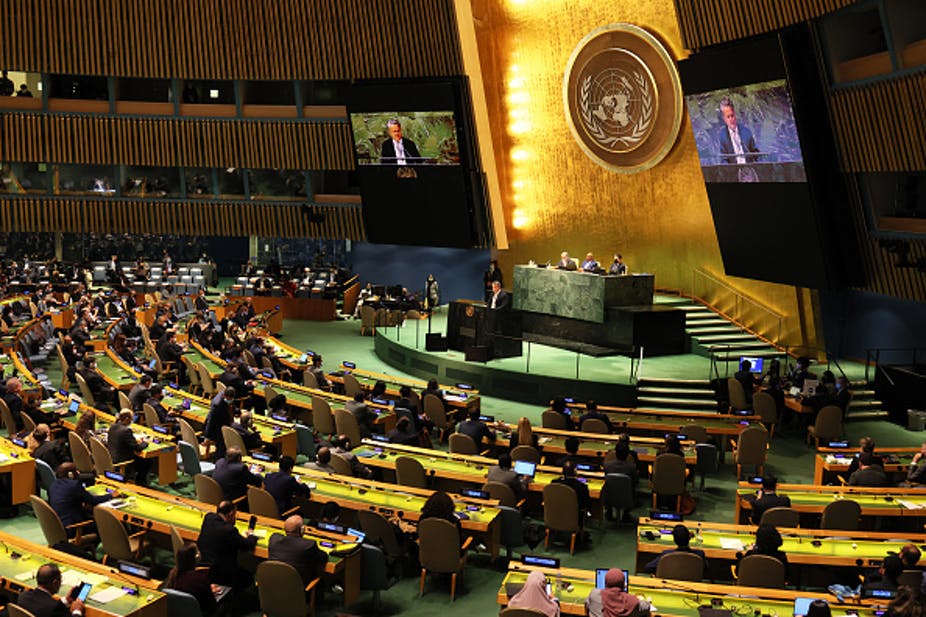
The 54 African countries (representing 27.97% of the total vote) had a significant influence on the outcome of the vote.
First, a meeting of the 12 members of the Security Council was held on February 25, 2021. The three countries representing Africa—Gabon, Ghana, and Kenya—along with eight other countries voted in favor of the resolution. However, Russia used its veto to block it. This veto prompted the United States and 94 countries to convene an emergency session of the United Nations General Assembly on February 27, 2022, during which a similar, but non-binding, motion was presented. This was the first emergency session of the General Assembly in 40 years.
The resolution, which, among other things, condemns Russia’s decision to “raise the alert level of its nuclear forces,” was adopted by the two-thirds majority required by all member states.
African votes were less unanimous in the General Assembly than in the Security Council, where the allocation of non-permanent seats—even though it follows a certain geographic distribution—does not require the countries holding those seats to act as spokespersons for their region.
The majority of African countries clearly sided with Ukraine—28 out of 54 (51.85%). Only Eritrea voted against this resolution. But nearly one-third of them abstained from taking a side (17 out of 54)—assuming that an abstention falls halfway between a “yes” and a “no.” Eight countries were absent.
My research focused on the similarities and differences in how countries respond to crises. For example, I examined the 2015 refugee crisis in Europe and the contrasting responses of Western and Eastern European countries, which I attributed to their different identities—that is, to the question, “Who are we?”
I also examined the Valletta Joint Action Plan, an immigration pact signed by the European Union and the African Union in response to the refugee crisis. I demonstrated that the plan, which helped revitalize relations between the AU and the EU, was based on interdependence that allows the parties to safeguard their interests (territorial integrity for Europeans and economic development for Africans), while acknowledging (especially the more powerful Europeans) that they need one another to advance those interests.
Research conducted by scholars such as the Dutch political scientist Erik Voeten also shows that voting in the General Assembly is—in general—motivated by interests. However, as the American political scientist Alexander Wendt has revealed, what constitutes an interest depends on each government’s perception, to the extent that two rival countries may sometimes vote in favor of the same resolution.
As Voeten pointed out, historically speaking, electoral trends have been influenced by the major issues of the day. In the 1950s, colonialism pitted European countries against Asian and African countries; from the 1960s to the 1980s, it was the Cold War and the division between the Eastern and Western blocs. More recently, these electoral trends have been shaped by developing countries’ desire to secure or maintain aid from developed nations and, increasingly, by the divide between liberal and illiberal democratic and authoritarian regimes.
This divide outweighs other possible explanations for the voting patterns at the General Assembly’s emergency session on the invasion of Ukraine. The degree to which a country aligns with the West or Russia may also serve as an additional explanation.
The Demarcation Line
The group of 28 African countries supporting the resolution consisted mainly of democracies aligned with the West, such as: Benin, Botswana, Cape Verde, the Comoros, the Democratic Republic of the Congo, The Gambia, Ghana, Kenya, Lesotho, Liberia, Malawi, Mauritius, Niger, Nigeria, São Tomé and Príncipe, the Seychelles, Sierra Leone, Tunisia, and Zambia.
But a few undemocratic or hybrid regimes were included on the list, such as Côte d’Ivoire, Gabon, Libya, Chad, Egypt, Mauritania, Rwanda, and Somalia. They did, however, have one thing in common: they were allies of the West, with close military ties (military bases and joint military operations against jihadists).
Conversely, most of the 17 African countries that abstained or, like Eritrea, voted against the resolution, are authoritarian or hybrid regimes; these include, among others, Algeria, Angola, Burundi, the Central African Republic, the Congo, Equatorial Guinea, Madagascar, Mali, Mozambique, South Sudan, Sudan, Tanzania, and Zimbabwe.
Some of these countries have close military and ideological ties with Russia, some of which date back to the Cold War, such as Algeria, Angola, the Congo, Mozambique, Zimbabwe, Mali, and the Central African Republic.
There were, however, a few notable exceptions to the rule.
A number of functioning democracies—Namibia, South Africa, and Senegal—also abstained. All of them have strong ties to the West. However, in the case of Namibia and South Africa, their ruling parties (the South West African People’s Organization and the African National Congress, respectively) received support from the Soviet Union during their struggles for independence.
The case of Senegal is more puzzling, as the country has long been a favorite of the West due to its long democratic tradition. The Senegalese government stated that its abstention was in accordance with the “principles of nonalignment and the peaceful settlement of disputes.” However, the official statement by its president, in his capacity as chairperson of the African Union, as well as that of the chairperson of the AU Commission, could be interpreted as support for Ukraine’s territorial integrity.
This divide between liberal and illiberal perspectives conveys three different kinds of viewpoints.
First, the world is being shaken by this kind of “clash of civilizations” predicted by the American political scientist Samuel P. Huntington, who asserted that cultural identity would be the fault line of global conflicts. This would pave the way for global civilizations: Western, Chinese, Islamic, Latin, Slavic, and perhaps African.
While his vision of a clash—and of identity as its driving force—seems to be coming to fruition, this identity is based on ideology rather than culture, with illiberalism having replaced communism.
Quite simply, we had not yet reached the stage of the triumph of democracy proclaimed by the American political scientist Francis Fukuyama in his book *The End of History*, published in 1992 after the fall of the Berlin Wall.
Second, authoritarian regimes find comfort and support for their survival in their proximity to similar regimes, which serves as a safety net for them. Given that Russia has demonstrated its determination to come to the aid of authoritarian regimes, such as Syria, these countries do not want to rule out the possibility of seeking Russia’s help should their survival be threatened.
Third, if the war in Ukraine escalates on a global scale and a “Cold War 2.0” involving China takes hold, African countries would split into several blocs rather than present a united front.
Viewed in the context of the renewed partnership between the EU and the AU, this rift takes on even greater significance now that, at their summit in Brussels—held one week before the outbreak of the conflict—they had proclaimed a shared vision for 2030 and sought to form a strategic alliance.
When it comes to democracy and alignment, the EU could likely set higher standards and will naturally seek to deepen its relations with like-minded African countries.
Mahama Tawat, Research Fellow, University of Montpellier
This article is republished from The Conversation under a Creative Commons license. Read the original article.