Jealousy Among Siblings in Baboons
A new study conducted by the University of Montpellier and the Montpellier Institute of Evolutionary Sciences (ISEM), in collaboration with the CNRS, sheds new light on the emotional lives of primates. Published in the scientific journal *Proceedings of the Royal Society B*, this research shows that young baboons exhibit behaviors resembling jealousy when they observe their mothers caring for a sibling. Conducted in their natural environment, this research opens up new avenues for understanding the evolution of social emotions in animals.
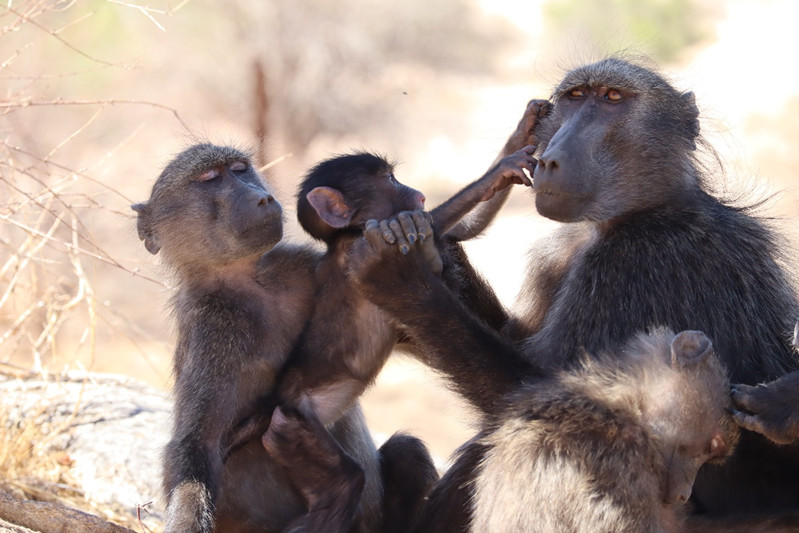
A groundbreaking study on jealousy in the natural world
Jealousy is a complex social emotion that arises when an individual perceives their relationship with a social partner as being threatened by a third party. While its existence in non-human animals remains a subject of debate, it had never before been studied directly in the wild.
To answer this question, an international team led by scientists from the University of Montpellier (ISEM) and the CNRS focused on a well-known situation among humans: sibling rivalry for maternal attention. The researchers observed grooming interactions between baboon mothers and their young, analyzing the reactions of the other siblings.
The results show that young baboons frequently intervene when their mother is grooming a sibling, and they solicit her attention more in this context than when she is simply resting. These interventions generally do not result in the young baboons receiving more grooming, but they sometimes interrupt the ongoing interaction, suggesting an attempt to disrupt the relationship between the mother and the rival.
Behaviors similar to human jealousy
Observations reveal that young baboons tend to target certain members of their litter: younger individuals, those of the same sex, and “favorites”—that is, those who receive maternal care most often. These nonaggressive behaviors closely resemble the expressions of jealousy observed in human children.
These findings support the hypothesis that baboons are capable of experiencing forms of jealousy. They also suggest that these primates are able to assess fairness in the distribution of maternal attention.
Beyond these findings, this study, conducted by the University of Montpellier and the CNRS, demonstrates that it is possible to study animal emotions directly in their natural environment. It thus opens up new avenues for better understanding the ecology, evolution, and complexity of social emotions in nonhuman primates.
A few points:
- Young baboons frequently interfere when their mother is grooming a sibling, and they seek her attention more often in this context than when she is otherwise available;
- They tend to target younger siblings of the same sex, as well as those who receive the most maternal attention;
- These behaviors bear strong similarities to the jealousy observed among human siblings, suggesting comparable emotional mechanisms.
Practical Information:
- The full study: here