The Hubble Tension: Can Magnetic Fields Help Solve One of the Universe’s Greatest Mysteries?
While the expansion of the universe is an established fact, scientists are divided on the rate at which it is occurring.
Levon Pogosian, Simon Fraser University; Karsten Jedamzik, University of Montpellier and Tom Abel, Stanford University
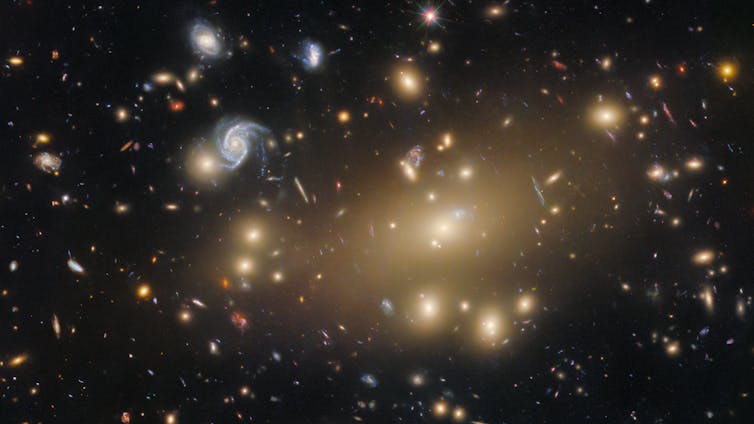
Two of the best methods we have for measuring the rate of expansion of the universe—that is, the Hubble constant—yield results that do not agree. This major problem in modern cosmology is known as the “Hubble tension.”
We wondered whether a theory originally proposed to explain the origin of cosmic magnetic fields might help us solve the mystery of the Hubble tension.
Our recent research explores the possibility that extremely weak magnetic fields—remnants of the first moments following the Big Bang—could help us resolve the Hubble tension, while also offering us insight into physics at energies far higher than those achievable on Earth.
Hubble constant and Hubble tension
Astronomers use the Hubble constant to measure the rate at which the universe is expanding. It is named after the American astronomer Edwin Hubble, who discovered that the universe is expanding.
There are two approaches to calculating the Hubble constant. The first is indirect and relies on the predictions of our cosmological model, which has been adjusted to match the patterns of the cosmic microwave background—the faint residual radiation from the Big Bang.
Instruments such as the Planck space telescope have measured minute fluctuations in this primordial light, yielding a Hubble constant of approximately 67 kilometers per second per megaparsec (km/s/Mpc). A parsec is a unit of distance used in astronomy equivalent to approximately 3.26 light-years, or 30.9 trillion kilometers. A megaparsec is equivalent to one million parsecs.
The second method is more direct and similar to the one Hubble used in the 1920s when he first demonstrated that the universe was expanding. It involves measuring the speed at which distant galaxies are moving away from our own, the Milky Way, by observing the brightness of supernova explosions in those galaxies.
Type Ia supernovae are called “standard candles” because we know that their brightness is the same no matter where they are. We can therefore estimate the distance to them based on their apparent brightness.
To determine their intrinsic luminosity, astronomers use other standard candles, such as Cepheid variables, in neighboring galaxies. These observations, conducted using the Hubble and James Webb space telescopes, yield a higher value of approximately 73 km/s/Mpc.
This difference between the two results is called the “Hubble tension.” The difference between 67 and 73 may seem small, but it is statistically very significant. If both methods are correct, then there must be a flaw in the standard model of cosmology.
Levon Pogosian, Professor of Physics, Simon Fraser University; Karsten Jedamzik, Researcher in Cosmology, University of Montpellier and Tom Abel, Professor of Particle Physics and Astrophysics, Department of Physics, Stanford University
This article is republished from The Conversation under a Creative Commons license. Readthe original article.